

27
terms of pulmonary (related to lungs) effects, central nervous system (CNS) effects,
cardiovascular (connected with heart and blood vessels) effects, gastrointestinal
(related to stomach and intestine) effects, renal (relating to kidney) effects, or dermatologic effects.
Hydrocarbons come in four structural classes.
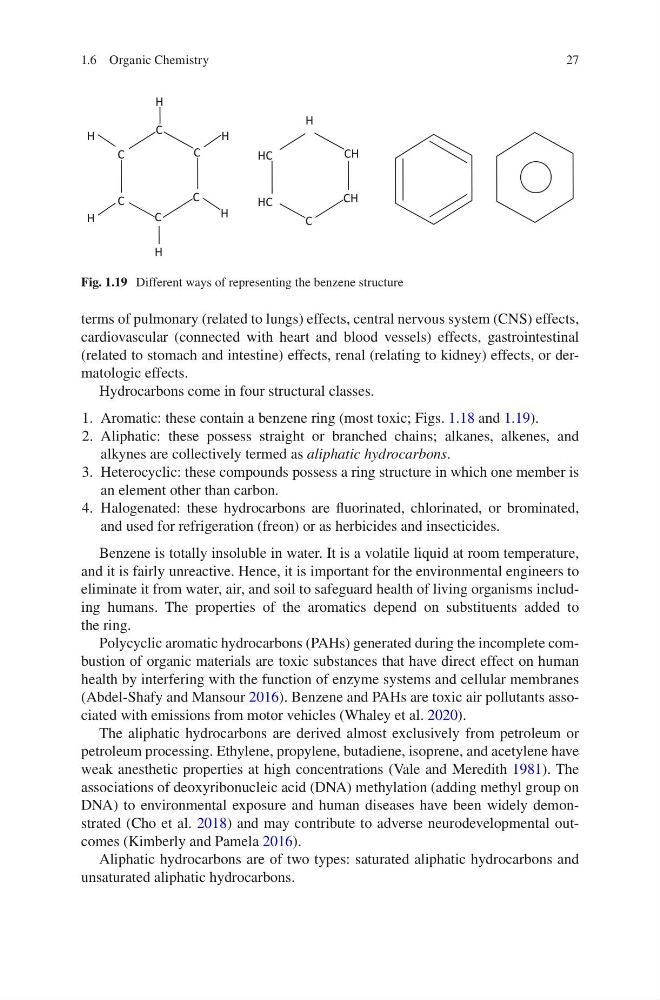
1. Aromatic: these contain a benzene ring (most toxic; Figs. 1.18 and 1.19).
2. Aliphatic: these possess straight or branched chains; alkanes, alkenes, and
alkynes are collectively termed as aliphatic hydrocarbons.
3. Heterocyclic: these compounds possess a ring structure in which one member is
an element other than carbon.
4. Halogenated: these hydrocarbons are fluorinated, chlorinated, or brominated,
and used for refrigeration (freon) or as herbicides and insecticides.
Benzene is totally insoluble in water. It is a volatile liquid at room temperature,
and it is fairly unreactive. Hence, it is important for the environmental engineers to
eliminate it from water, air, and soil to safeguard health of living organisms including humans. The properties of the aromatics depend on substituents added to
the ring.
Polycyclic aromatic hydrocarbons (PAHs) generated during the incomplete combustion of organic materials are toxic substances that have direct effect on human
health by interfering with the function of enzyme systems and cellular membranes
(Abdel-Shafy and Mansour 2016). Benzene and PAHs are toxic air pollutants associated with emissions from motor vehicles (Whaley et al. 2020).
The aliphatic hydrocarbons are derived almost exclusively from petroleum or
petroleum processing. Ethylene, propylene, butadiene, isoprene, and acetylene have
weak anesthetic properties at high concentrations (Vale and Meredith 1981). The
associations of deoxyribonucleic acid (DNA) methylation (adding methyl group on
DNA) to environmental exposure and human diseases have been widely demonstrated (Cho et al. 2018) and may contribute to adverse neurodevelopmental outcomes (Kimberly and Pamela 2016).
Aliphatic hydrocarbons are of two types: saturated aliphatic hydrocarbons and
unsaturated aliphatic hydrocarbons.
C
C
C
C
C
C
H
H
H
H
H
H
CH
CH
HC
HC
C
H
Fig. 1.19 Different ways of representing the benzene structure
1.6 Organic Chemistry
terms of pulmonary (related to lungs) effects, central nervous system (CNS) effects,
cardiovascular (connected with heart and blood vessels) effects, gastrointestinal
(related to stomach and intestine) effects, renal (relating to kidney) effects, or dermatologic effects.
Hydrocarbons come in four structural classes.
1. Aromatic: these contain a benzene ring (most toxic; Figs. 1.18 and 1.19).
2. Aliphatic: these possess straight or branched chains; alkanes, alkenes, and
alkynes are collectively termed as aliphatic hydrocarbons.
3. Heterocyclic: these compounds possess a ring structure in which one member is
an element other than carbon.
4. Halogenated: these hydrocarbons are fluorinated, chlorinated, or brominated,
and used for refrigeration (freon) or as herbicides and insecticides.
Benzene is totally insoluble in water. It is a volatile liquid at room temperature,
and it is fairly unreactive. Hence, it is important for the environmental engineers to
eliminate it from water, air, and soil to safeguard health of living organisms including humans. The properties of the aromatics depend on substituents added to
the ring.
Polycyclic aromatic hydrocarbons (PAHs) generated during the incomplete combustion of organic materials are toxic substances that have direct effect on human
health by interfering with the function of enzyme systems and cellular membranes
(Abdel-Shafy and Mansour 2016). Benzene and PAHs are toxic air pollutants associated with emissions from motor vehicles (Whaley et al. 2020).
The aliphatic hydrocarbons are derived almost exclusively from petroleum or
petroleum processing. Ethylene, propylene, butadiene, isoprene, and acetylene have
weak anesthetic properties at high concentrations (Vale and Meredith 1981). The
associations of deoxyribonucleic acid (DNA) methylation (adding methyl group on
DNA) to environmental exposure and human diseases have been widely demonstrated (Cho et al. 2018) and may contribute to adverse neurodevelopmental outcomes (Kimberly and Pamela 2016).
Aliphatic hydrocarbons are of two types: saturated aliphatic hydrocarbons and
unsaturated aliphatic hydrocarbons.
C
C
C
C
C
C
H
H
H
H
H
H
CH
CH
HC
HC
C
H
Fig. 1.19 Different ways of representing the benzene structure
1.6 Organic Chemistry