

12
Heavy metals are the generic term for metallic elements with an atomic weight
higher than 40.04 (Ming-Ho 2005). Heavy metals in the environment can affect
human health. Heavy metals in the environment reach human body through atmosphere, soil, water, and foods. Although toxicity to human health depends on concentration of toxic substance, chronic exposure to heavy metals and metalloids at
relatively low levels can cause adverse effects.
A chemical with at least one hydrogen atom that can dissociate to form an anion
and hydrogen ion (H
+
) in aqueous solution is called as an acid. A chemical that
produces one or more hydroxide ions (OH
−
) and a cation when dissolved in aqueous
solution is called a base. An acid in which the dissociable H
+
ion is attached to an
oxygen atom of a polyatomic anion is called oxoacids or oxyacids.
The pH scale provides an easy way of expressing the hydrogen ion (H+) concentration of a solution. pH is defined as negative of the logarithm to base 10 of the
concentration of hydrogen ions in moles per liter.
pH
H
= −
+
log 10
Where.
[H
+
] = hydrogen ion concentration in moles per liter.
In the absence of foreign materials, the hydrogen ion concentration is 1.0 × 10
−7
moles in pure water at 25 °C, and hence the pH of pure liquid water is 7 as per the
following calculation.
pH
10
-14
10
-0
10
-7
[H+]
1
7
1
4
1 M NaOH
1 M HCl
Pure
Water
Rain Water
Acid Rain
Sewage
Electroplating
Wastewater
Dairy Wastewater
Discharge Standard
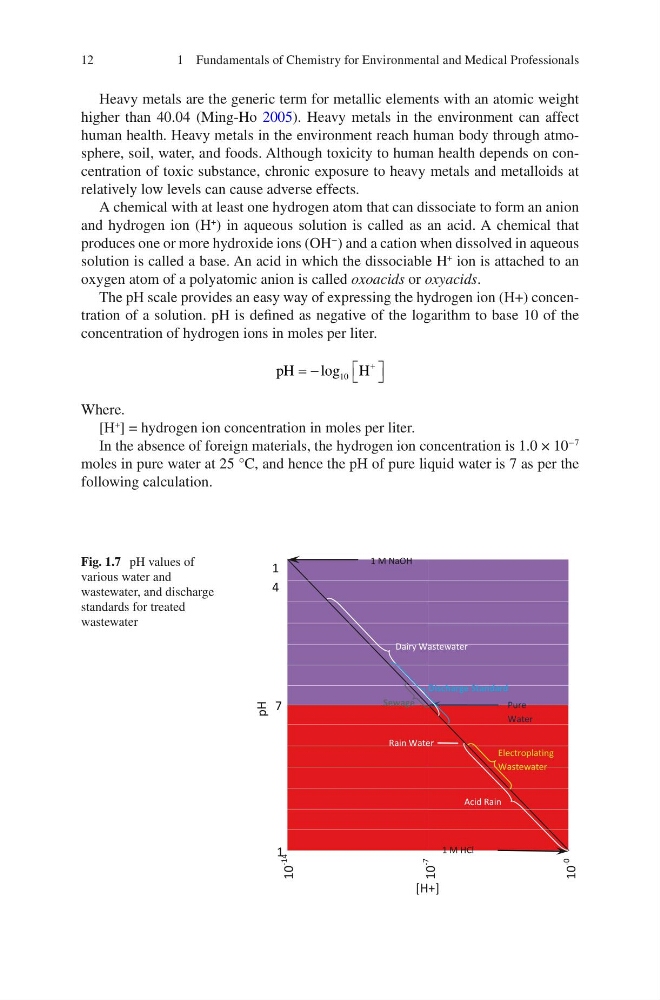
Fig. 1.7 pH values of
various water and
wastewater, and discharge
standards for treated
wastewater
1 Fundamentals of Chemistry for Environmental and Medical Professionals
Heavy metals are the generic term for metallic elements with an atomic weight
higher than 40.04 (Ming-Ho 2005). Heavy metals in the environment can affect
human health. Heavy metals in the environment reach human body through atmosphere, soil, water, and foods. Although toxicity to human health depends on concentration of toxic substance, chronic exposure to heavy metals and metalloids at
relatively low levels can cause adverse effects.
A chemical with at least one hydrogen atom that can dissociate to form an anion
and hydrogen ion (H
+
) in aqueous solution is called as an acid. A chemical that
produces one or more hydroxide ions (OH
−
) and a cation when dissolved in aqueous
solution is called a base. An acid in which the dissociable H
+
ion is attached to an
oxygen atom of a polyatomic anion is called oxoacids or oxyacids.
The pH scale provides an easy way of expressing the hydrogen ion (H+) concentration of a solution. pH is defined as negative of the logarithm to base 10 of the
concentration of hydrogen ions in moles per liter.
pH
H
= −
+
log 10
Where.
[H
+
] = hydrogen ion concentration in moles per liter.
In the absence of foreign materials, the hydrogen ion concentration is 1.0 × 10
−7
moles in pure water at 25 °C, and hence the pH of pure liquid water is 7 as per the
following calculation.
pH
10
-14
10
-0
10
-7
[H+]
1
7
1
4
1 M NaOH
1 M HCl
Pure
Water
Rain Water
Acid Rain
Sewage
Electroplating
Wastewater
Dairy Wastewater
Discharge Standard
Fig. 1.7 pH values of
various water and
wastewater, and discharge
standards for treated
wastewater
1 Fundamentals of Chemistry for Environmental and Medical Professionals