

277
Administrative measures such as social distancing, lockdown and mental health
support can play major role in ensuring occupational and workplace health. Social
distancing that may be recommended during influenza pandemics is one of the community mitigation measures. The epidemiological studies revealed that social distancing was associated with a decrease in influenza-like illness. Social distancing
can decrease virus transmission by increasing physical distance or decreasing
frequency of crowding in socially dense community settings, such as schools or
workplaces (Ahmed et al. 2018).
Several countries declared lockdown to stop the spread of COVID-19 that
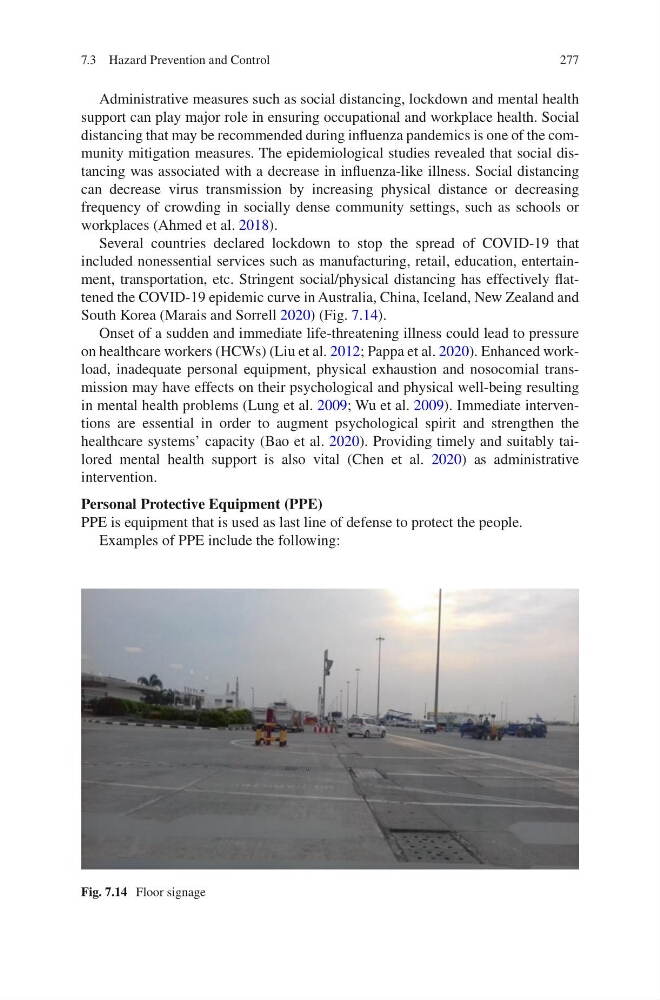
included nonessential services such as manufacturing, retail, education, entertainment, transportation, etc. Stringent social/physical distancing has effectively flattened the COVID-19 epidemic curve in Australia, China, Iceland, New Zealand and
South Korea (Marais and Sorrell 2020) (Fig. 7.14).
Onset of a sudden and immediate life-threatening illness could lead to pressure
on healthcare workers (HCWs) (Liu et al. 2012; Pappa et al. 2020). Enhanced workload, inadequate personal equipment, physical exhaustion and nosocomial transmission may have effects on their psychological and physical well-being resulting
in mental health problems (Lung et al. 2009; Wu et al. 2009). Immediate interventions are essential in order to augment psychological spirit and strengthen the
healthcare systems’ capacity (Bao et al. 2020). Providing timely and suitably tailored mental health support is also vital (Chen et al. 2020) as administrative
intervention.
Personal Protective Equipment (PPE)
PPE is equipment that is used as last line of defense to protect the people.
Examples of PPE include the following:
Fig. 7.14 Floor signage
7.3 Hazard Prevention and Control
Administrative measures such as social distancing, lockdown and mental health
support can play major role in ensuring occupational and workplace health. Social
distancing that may be recommended during influenza pandemics is one of the community mitigation measures. The epidemiological studies revealed that social distancing was associated with a decrease in influenza-like illness. Social distancing
can decrease virus transmission by increasing physical distance or decreasing
frequency of crowding in socially dense community settings, such as schools or
workplaces (Ahmed et al. 2018).
Several countries declared lockdown to stop the spread of COVID-19 that
included nonessential services such as manufacturing, retail, education, entertainment, transportation, etc. Stringent social/physical distancing has effectively flattened the COVID-19 epidemic curve in Australia, China, Iceland, New Zealand and
South Korea (Marais and Sorrell 2020) (Fig. 7.14).
Onset of a sudden and immediate life-threatening illness could lead to pressure
on healthcare workers (HCWs) (Liu et al. 2012; Pappa et al. 2020). Enhanced workload, inadequate personal equipment, physical exhaustion and nosocomial transmission may have effects on their psychological and physical well-being resulting
in mental health problems (Lung et al. 2009; Wu et al. 2009). Immediate interventions are essential in order to augment psychological spirit and strengthen the
healthcare systems’ capacity (Bao et al. 2020). Providing timely and suitably tailored mental health support is also vital (Chen et al. 2020) as administrative
intervention.
Personal Protective Equipment (PPE)
PPE is equipment that is used as last line of defense to protect the people.
Examples of PPE include the following:
Fig. 7.14 Floor signage
7.3 Hazard Prevention and Control