

273
7.3 Hazard Prevention and Control
Controlling exposures to workplace hazards is the basis to protect personnel.
Conventionally, a hierarchy of hazard prevention and controls are used as a mean of
identifying how to implement effective as well as feasible control solutions.
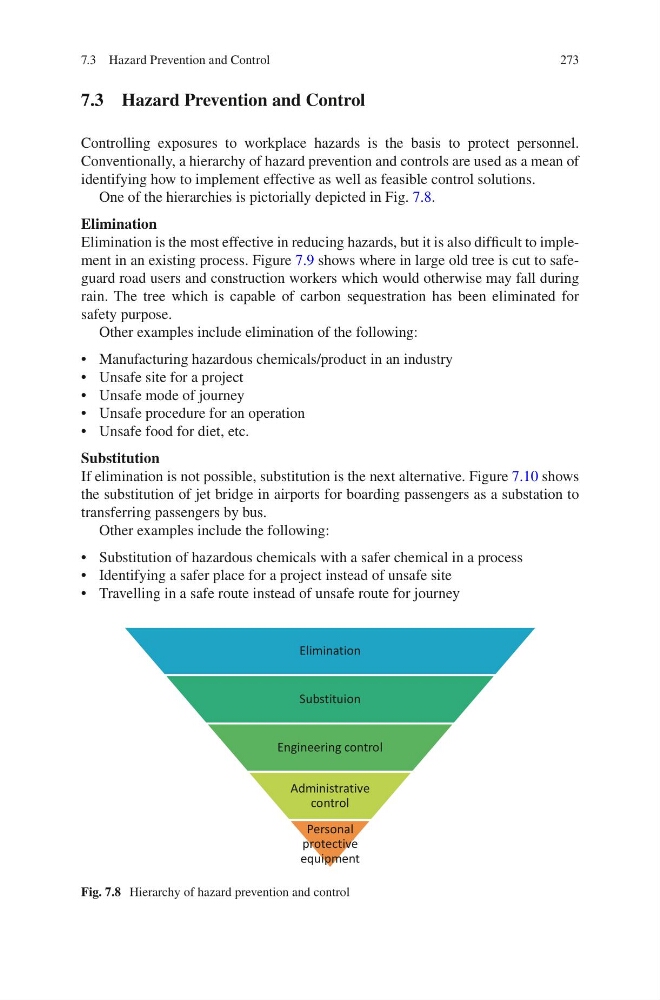
One of the hierarchies is pictorially depicted in Fig. 7.8.
Elimination
Elimination is the most effective in reducing hazards, but it is also difficult to implement in an existing process. Figure 7.9 shows where in large old tree is cut to safeguard road users and construction workers which would otherwise may fall during
rain. The tree which is capable of carbon sequestration has been eliminated for
safety purpose.
Other examples include elimination of the following:
• Manufacturing hazardous chemicals/product in an industry
• Unsafe site for a project
• Unsafe mode of journey
• Unsafe procedure for an operation
• Unsafe food for diet, etc.
Substitution
If elimination is not possible, substitution is the next alternative. Figure 7.10 shows
the substitution of jet bridge in airports for boarding passengers as a substation to
transferring passengers by bus.
Other examples include the following:
• Substitution of hazardous chemicals with a safer chemical in a process
• Identifying a safer place for a project instead of unsafe site
• Travelling in a safe route instead of unsafe route for journey
Elimination
Substituion
Engineering control
Administrative
control
Personal
protective
equipment
Fig. 7.8 Hierarchy of hazard prevention and control
7.3 Hazard Prevention and Control
7.3 Hazard Prevention and Control
Controlling exposures to workplace hazards is the basis to protect personnel.
Conventionally, a hierarchy of hazard prevention and controls are used as a mean of
identifying how to implement effective as well as feasible control solutions.
One of the hierarchies is pictorially depicted in Fig. 7.8.
Elimination
Elimination is the most effective in reducing hazards, but it is also difficult to implement in an existing process. Figure 7.9 shows where in large old tree is cut to safeguard road users and construction workers which would otherwise may fall during
rain. The tree which is capable of carbon sequestration has been eliminated for
safety purpose.
Other examples include elimination of the following:
• Manufacturing hazardous chemicals/product in an industry
• Unsafe site for a project
• Unsafe mode of journey
• Unsafe procedure for an operation
• Unsafe food for diet, etc.
Substitution
If elimination is not possible, substitution is the next alternative. Figure 7.10 shows
the substitution of jet bridge in airports for boarding passengers as a substation to
transferring passengers by bus.
Other examples include the following:
• Substitution of hazardous chemicals with a safer chemical in a process
• Identifying a safer place for a project instead of unsafe site
• Travelling in a safe route instead of unsafe route for journey
Elimination
Substituion
Engineering control
Administrative
control
Personal
protective
equipment
Fig. 7.8 Hierarchy of hazard prevention and control
7.3 Hazard Prevention and Control