

238
6.5 Impact of Solid Waste on Health
Solid waste is a reservoir of disease causative agent. The effect of solid waste on
health depends on the following:
1. Type of waste—biomedical, electronic, hazardous, municipal, radioactive,
slaughter, cremation, construction, demolition, etc.
2. Management of waste—dumping, open burning, segregation, etc.
3. Transportation of waste—manual, animal driven, motor vehicle driven, closed
vehicle, open vehicle, etc.
4. Treatment of waste—shredding, baling, stabilization, etc.
5. Disposal—landfill, open dump, incineration, ocean dump, etc.
6. Mode of transportation of toxins/infection—direct contact, air, water, vector, etc.
7. Portal of entry, portal of exit and transmission of causative agent
8. Resistance of recipient to disease
The waste constituents include physical, chemical, and biological substance that
can lead to injury, non-communicable disease, and communicable disease. The
transmission of disease causative agent can happen by direct contact, radiation,
water, air, vector, rodent, and other animals (Fig. 6.12).
Work published by Goldberg et al. (1995) suggested that men inhibiting close to
municipal solid waste landfill site at Montreal had greater risk of cancer of pancreas, kidney, liver, and non-Hodgkin’s lymphoma. Comba (2003) reported that
dwelling within a 2-km from waste incinerator located in Mantua, Italy was linked
to upsurge in risk of soft-tissue sarcomas.
The chemicals within the waste can react with each other and pathogenic
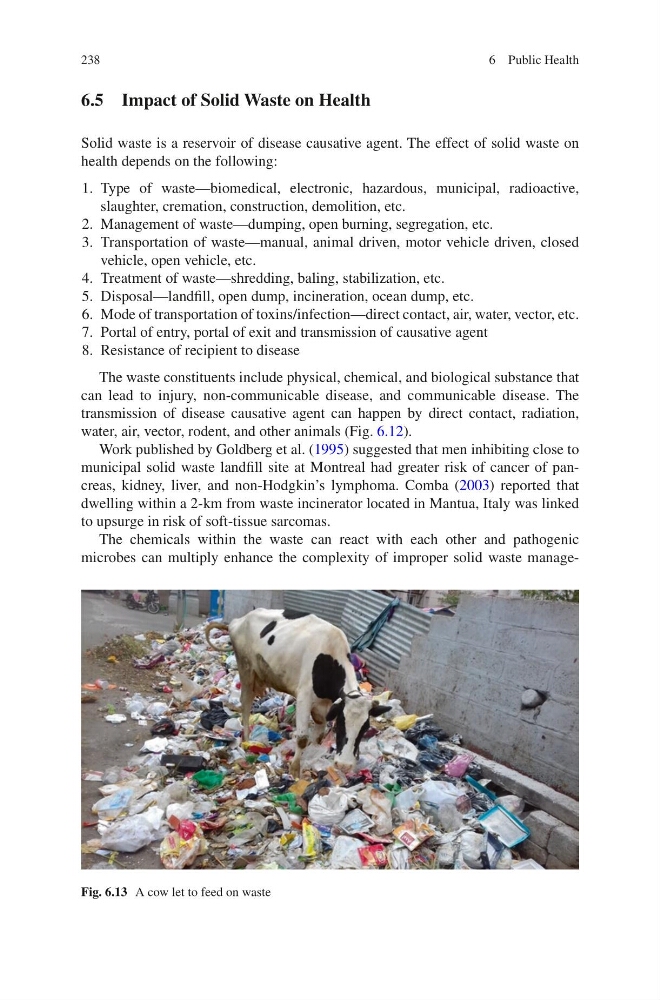
microbes can multiply enhance the complexity of improper solid waste manageFig. 6.13 A cow let to feed on waste
6 Public Health
6.5 Impact of Solid Waste on Health
Solid waste is a reservoir of disease causative agent. The effect of solid waste on
health depends on the following:
1. Type of waste—biomedical, electronic, hazardous, municipal, radioactive,
slaughter, cremation, construction, demolition, etc.
2. Management of waste—dumping, open burning, segregation, etc.
3. Transportation of waste—manual, animal driven, motor vehicle driven, closed
vehicle, open vehicle, etc.
4. Treatment of waste—shredding, baling, stabilization, etc.
5. Disposal—landfill, open dump, incineration, ocean dump, etc.
6. Mode of transportation of toxins/infection—direct contact, air, water, vector, etc.
7. Portal of entry, portal of exit and transmission of causative agent
8. Resistance of recipient to disease
The waste constituents include physical, chemical, and biological substance that
can lead to injury, non-communicable disease, and communicable disease. The
transmission of disease causative agent can happen by direct contact, radiation,
water, air, vector, rodent, and other animals (Fig. 6.12).
Work published by Goldberg et al. (1995) suggested that men inhibiting close to
municipal solid waste landfill site at Montreal had greater risk of cancer of pancreas, kidney, liver, and non-Hodgkin’s lymphoma. Comba (2003) reported that
dwelling within a 2-km from waste incinerator located in Mantua, Italy was linked
to upsurge in risk of soft-tissue sarcomas.
The chemicals within the waste can react with each other and pathogenic
microbes can multiply enhance the complexity of improper solid waste manageFig. 6.13 A cow let to feed on waste
6 Public Health