

229
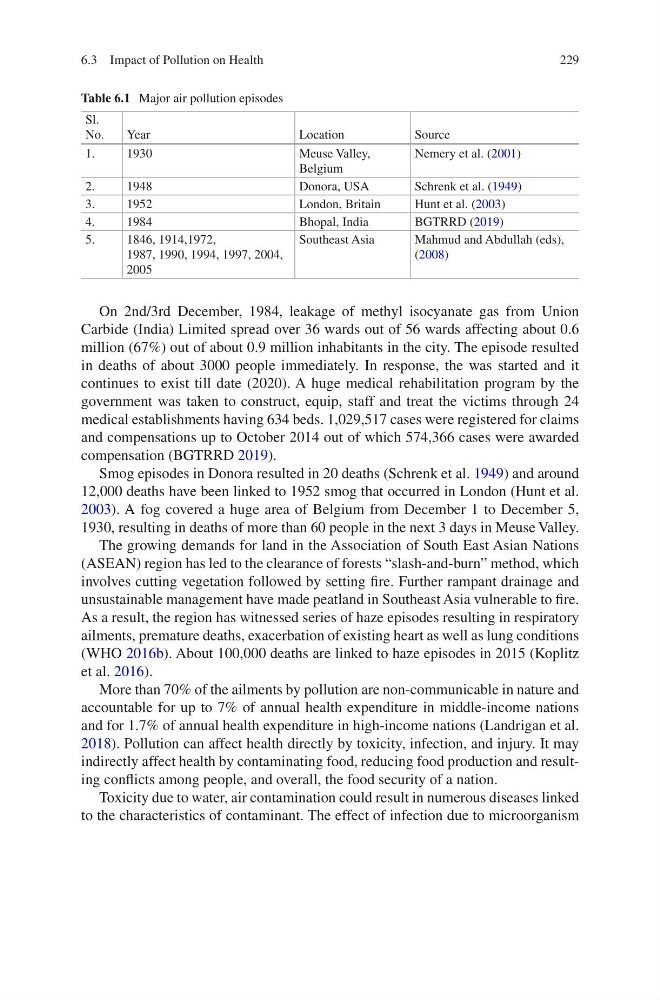
On 2nd/3rd December, 1984, leakage of methyl isocyanate gas from Union
Carbide (India) Limited spread over 36 wards out of 56 wards affecting about 0.6
million (67%) out of about 0.9 million inhabitants in the city. The episode resulted
in deaths of about 3000 people immediately. In response, the was started and it
continues to exist till date (2020). A huge medical rehabilitation program by the
government was taken to construct, equip, staff and treat the victims through 24
medical establishments having 634 beds. 1,029,517 cases were registered for claims
and compensations up to October 2014 out of which 574,366 cases were awarded
compensation (BGTRRD 2019).
Smog episodes in Donora resulted in 20 deaths (Schrenk et al. 1949) and around
12,000 deaths have been linked to 1952 smog that occurred in London (Hunt et al.
2003). A fog covered a huge area of Belgium from December 1 to December 5,
1930, resulting in deaths of more than 60 people in the next 3 days in Meuse Valley.
The growing demands for land in the Association of South East Asian Nations
(ASEAN) region has led to the clearance of forests “slash-and-burn” method, which
involves cutting vegetation followed by setting fire. Further rampant drainage and
unsustainable management have made peatland in Southeast Asia vulnerable to fire.
As a result, the region has witnessed series of haze episodes resulting in respiratory
ailments, premature deaths, exacerbation of existing heart as well as lung conditions
(WHO 2016b). About 100,000 deaths are linked to haze episodes in 2015 (Koplitz
et al. 2016).
More than 70% of the ailments by pollution are non-communicable in nature and
accountable for up to 7% of annual health expenditure in middle-income nations
and for 1.7% of annual health expenditure in high-income nations (Landrigan et al.
2018). Pollution can affect health directly by toxicity, infection, and injury. It may
indirectly affect health by contaminating food, reducing food production and resulting conflicts among people, and overall, the food security of a nation.
Toxicity due to water, air contamination could result in numerous diseases linked
to the characteristics of contaminant. The effect of infection due to microorganism
Table 6.1 Major air pollution episodes
Sl.
No.
Year
Location
Source
1.
1930
Meuse Valley,
Belgium
Nemery et al. (2001)
2.
1948
Donora, USA
Schrenk et al. (1949)
3.
1952
London, Britain
Hunt et al. (2003)
4.
1984
Bhopal, India
BGTRRD (2019)
5.
1846, 1914,1972,
1987, 1990, 1994, 1997, 2004,
2005
Southeast Asia
Mahmud and Abdullah (eds),
(2008)
6.3 Impact of Pollution on Health
On 2nd/3rd December, 1984, leakage of methyl isocyanate gas from Union
Carbide (India) Limited spread over 36 wards out of 56 wards affecting about 0.6
million (67%) out of about 0.9 million inhabitants in the city. The episode resulted
in deaths of about 3000 people immediately. In response, the was started and it
continues to exist till date (2020). A huge medical rehabilitation program by the
government was taken to construct, equip, staff and treat the victims through 24
medical establishments having 634 beds. 1,029,517 cases were registered for claims
and compensations up to October 2014 out of which 574,366 cases were awarded
compensation (BGTRRD 2019).
Smog episodes in Donora resulted in 20 deaths (Schrenk et al. 1949) and around
12,000 deaths have been linked to 1952 smog that occurred in London (Hunt et al.
2003). A fog covered a huge area of Belgium from December 1 to December 5,
1930, resulting in deaths of more than 60 people in the next 3 days in Meuse Valley.
The growing demands for land in the Association of South East Asian Nations
(ASEAN) region has led to the clearance of forests “slash-and-burn” method, which
involves cutting vegetation followed by setting fire. Further rampant drainage and
unsustainable management have made peatland in Southeast Asia vulnerable to fire.
As a result, the region has witnessed series of haze episodes resulting in respiratory
ailments, premature deaths, exacerbation of existing heart as well as lung conditions
(WHO 2016b). About 100,000 deaths are linked to haze episodes in 2015 (Koplitz
et al. 2016).
More than 70% of the ailments by pollution are non-communicable in nature and
accountable for up to 7% of annual health expenditure in middle-income nations
and for 1.7% of annual health expenditure in high-income nations (Landrigan et al.
2018). Pollution can affect health directly by toxicity, infection, and injury. It may
indirectly affect health by contaminating food, reducing food production and resulting conflicts among people, and overall, the food security of a nation.
Toxicity due to water, air contamination could result in numerous diseases linked
to the characteristics of contaminant. The effect of infection due to microorganism
Table 6.1 Major air pollution episodes
Sl.
No.
Year
Location
Source
1.
1930
Meuse Valley,
Belgium
Nemery et al. (2001)
2.
1948
Donora, USA
Schrenk et al. (1949)
3.
1952
London, Britain
Hunt et al. (2003)
4.
1984
Bhopal, India
BGTRRD (2019)
5.
1846, 1914,1972,
1987, 1990, 1994, 1997, 2004,
2005
Southeast Asia
Mahmud and Abdullah (eds),
(2008)
6.3 Impact of Pollution on Health