

193
The skin is an important interface between environment and humans; it is an
important portal of entry for disease causing agents that include huge array of chemical, physical, and biological agents (Suskind 1977).
Even minute quantity of arsenic can lead to skin hardening, organ damage as
well as cancer. Arsenic-related skin diseases that affected thousands are briefly discussed in Box 5.2.
Disease causing agents of sexually transmitted diseases include viruses, bacteria,
fungi, and protozoa (Thappa and Sivaranjini 2011). Venereal diseases can also be
transmitted by several other ways. To date, modes of transmission of HIV-1 include
sexual, percutaneous (through the skin), and perinatal (immediately before and after
birth) (Gershon et al. 1990). Children may sustain injuries from discarded needles
leading to exposure to blood-borne viruses. The important pathogens in such transmission include hepatitis B virus (HBV), hepatitis C virus (HCV) and HIV
(Gerberding 1995; American Academy of Pediatrics 2006). HIV virus that causes
AIDS transmitted through sexual contact can be spread through infected sharps in
solid waste.
Many skin diseases are linked to immunologic genetic and environmental factors. Exposure to environmental influences that affect skin include the following:
• Chemicals or infections
• Climatic determinants
• Such as UV radiation
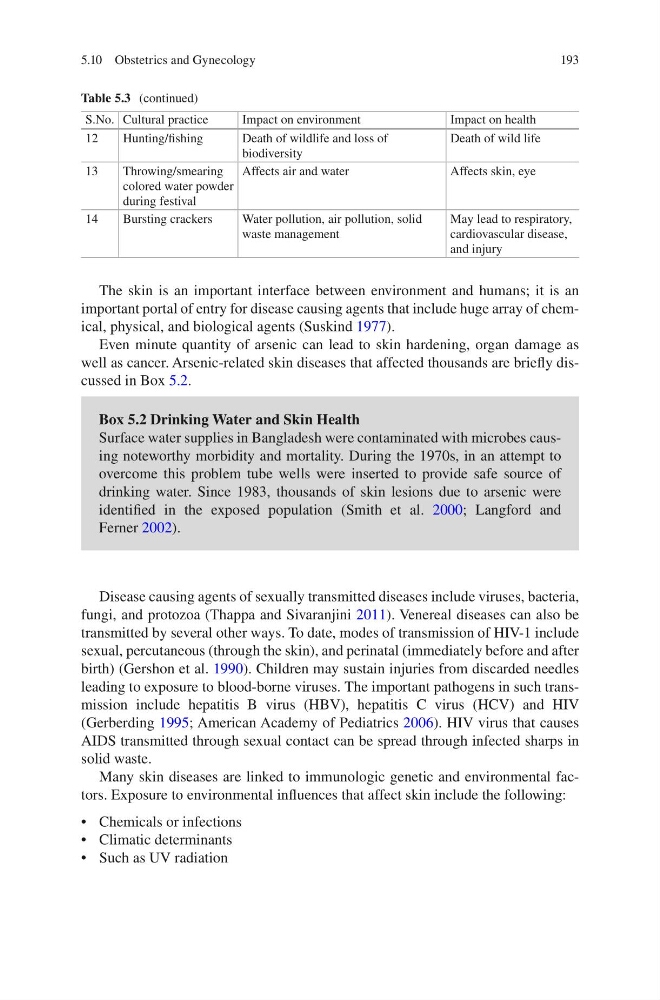
Table 5.3 (continued)
S.No. Cultural practice
Impact on environment
Impact on health
12
Hunting/fishing
Death of wildlife and loss of
biodiversity
Death of wild life
13
Throwing/smearing
colored water powder
during festival
Affects air and water
Affects skin, eye
14
Bursting crackers
Water pollution, air pollution, solid
waste management
May lead to respiratory,
cardiovascular disease,
and injury
Box 5.2 Drinking Water and Skin Health
Surface water supplies in Bangladesh were contaminated with microbes causing noteworthy morbidity and mortality. During the 1970s, in an attempt to
overcome this problem tube wells were inserted to provide safe source of
drinking water. Since 1983, thousands of skin lesions due to arsenic were
identified in the exposed population (Smith et al. 2000; Langford and
Ferner 2002).
5.10 Obstetrics and Gynecology
The skin is an important interface between environment and humans; it is an
important portal of entry for disease causing agents that include huge array of chemical, physical, and biological agents (Suskind 1977).
Even minute quantity of arsenic can lead to skin hardening, organ damage as
well as cancer. Arsenic-related skin diseases that affected thousands are briefly discussed in Box 5.2.
Disease causing agents of sexually transmitted diseases include viruses, bacteria,
fungi, and protozoa (Thappa and Sivaranjini 2011). Venereal diseases can also be
transmitted by several other ways. To date, modes of transmission of HIV-1 include
sexual, percutaneous (through the skin), and perinatal (immediately before and after
birth) (Gershon et al. 1990). Children may sustain injuries from discarded needles
leading to exposure to blood-borne viruses. The important pathogens in such transmission include hepatitis B virus (HBV), hepatitis C virus (HCV) and HIV
(Gerberding 1995; American Academy of Pediatrics 2006). HIV virus that causes
AIDS transmitted through sexual contact can be spread through infected sharps in
solid waste.
Many skin diseases are linked to immunologic genetic and environmental factors. Exposure to environmental influences that affect skin include the following:
• Chemicals or infections
• Climatic determinants
• Such as UV radiation
Table 5.3 (continued)
S.No. Cultural practice
Impact on environment
Impact on health
12
Hunting/fishing
Death of wildlife and loss of
biodiversity
Death of wild life
13
Throwing/smearing
colored water powder
during festival
Affects air and water
Affects skin, eye
14
Bursting crackers
Water pollution, air pollution, solid
waste management
May lead to respiratory,
cardiovascular disease,
and injury
Box 5.2 Drinking Water and Skin Health
Surface water supplies in Bangladesh were contaminated with microbes causing noteworthy morbidity and mortality. During the 1970s, in an attempt to
overcome this problem tube wells were inserted to provide safe source of
drinking water. Since 1983, thousands of skin lesions due to arsenic were
identified in the exposed population (Smith et al. 2000; Langford and
Ferner 2002).
5.10 Obstetrics and Gynecology