

176
With agriculture activities, the humans were exposed to pathogens, pin worms,
tapeworms, hook worms in excrement that were used as fertilizer. The agriculture
also decreased the dependence on the wild plants that combated diseases.
The development and urbanization brought more infectious disease and malnutrition. Many evidences from preserved bones as well as teeth substantiate these
changes. Tooth decay, affected 17% of samples from city residents, 8.7% from
farmers, and 3% of samples from hunter-gatherers (David et al. 2007).
While changes in the environment where humans live changed their health, some
types of illnesses seem inherent to humans. As per the evidence available in fossils
arthritis that troubles people today affected our ancestors’ 3 million years ago;
Neanderthals that lived 100,000 years ago, and preserved “iceman” who lived
5300 years ago (David et al. 2007).
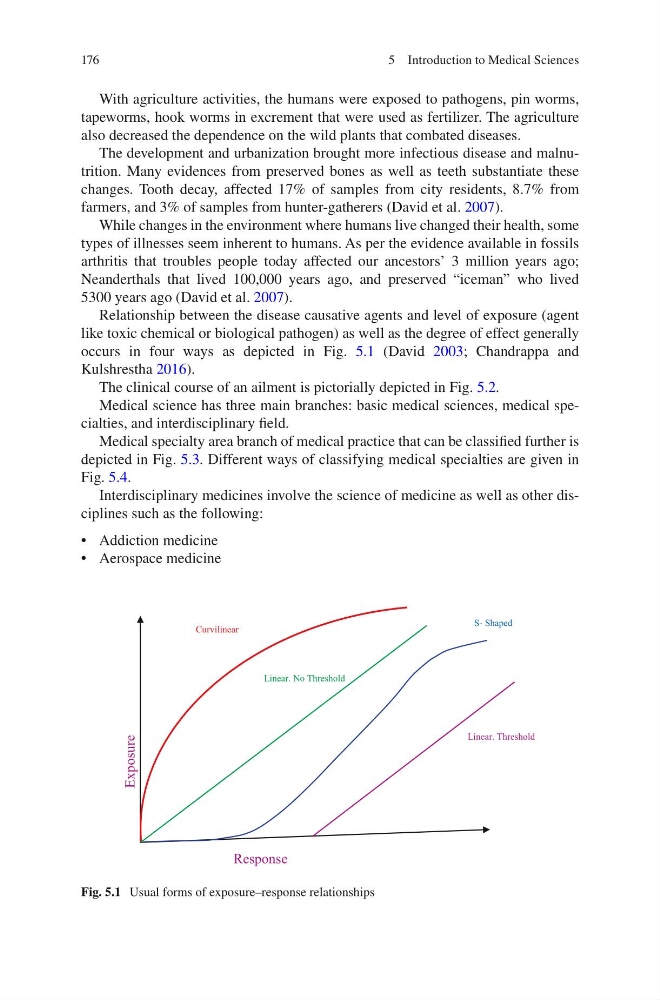
Relationship between the disease causative agents and level of exposure (agent
like toxic chemical or biological pathogen) as well as the degree of effect generally
occurs in four ways as depicted in Fig. 5.1 (David 2003; Chandrappa and
Kulshrestha 2016).
The clinical course of an ailment is pictorially depicted in Fig. 5.2.
Medical science has three main branches: basic medical sciences, medical specialties, and interdisciplinary field.
Medical specialty area branch of medical practice that can be classified further is
depicted in Fig. 5.3. Different ways of classifying medical specialties are given in
Fig. 5.4.
Interdisciplinary medicines involve the science of medicine as well as other disciplines such as the following:
• Addiction medicine
• Aerospace medicine
Linear. No Threshold
Linear. Threshold
S- Shaped
Curvilinear
Response
Exposure
Fig. 5.1 Usual forms of exposure–response relationships
5 Introduction to Medical Sciences
With agriculture activities, the humans were exposed to pathogens, pin worms,
tapeworms, hook worms in excrement that were used as fertilizer. The agriculture
also decreased the dependence on the wild plants that combated diseases.
The development and urbanization brought more infectious disease and malnutrition. Many evidences from preserved bones as well as teeth substantiate these
changes. Tooth decay, affected 17% of samples from city residents, 8.7% from
farmers, and 3% of samples from hunter-gatherers (David et al. 2007).
While changes in the environment where humans live changed their health, some
types of illnesses seem inherent to humans. As per the evidence available in fossils
arthritis that troubles people today affected our ancestors’ 3 million years ago;
Neanderthals that lived 100,000 years ago, and preserved “iceman” who lived
5300 years ago (David et al. 2007).
Relationship between the disease causative agents and level of exposure (agent
like toxic chemical or biological pathogen) as well as the degree of effect generally
occurs in four ways as depicted in Fig. 5.1 (David 2003; Chandrappa and
Kulshrestha 2016).
The clinical course of an ailment is pictorially depicted in Fig. 5.2.
Medical science has three main branches: basic medical sciences, medical specialties, and interdisciplinary field.
Medical specialty area branch of medical practice that can be classified further is
depicted in Fig. 5.3. Different ways of classifying medical specialties are given in
Fig. 5.4.
Interdisciplinary medicines involve the science of medicine as well as other disciplines such as the following:
• Addiction medicine
• Aerospace medicine
Linear. No Threshold
Linear. Threshold
S- Shaped
Curvilinear
Response
Exposure
Fig. 5.1 Usual forms of exposure–response relationships
5 Introduction to Medical Sciences