

168
(iv) High-level radioactive waste
If radioactive waste with radionuclides have a half-life of less than 31 years, it is
considered as “short-lived” otherwise the waste will be termed as “long-lived”
(IRSN 2013).
Radionuclides used in health care facilities comprise of the following:
(i) Sealed sources—radioactive substances enclosed in parts of equipment or
encapsulated in impervious or unbreakable objects, such as “seeds” pins, or
needles.
(ii) Unsealed sources—those that are applied directly and normally in liquid form
(WHO 2014).
Hazardous wastes even in low concentrations have the potential to have a noteworthy and undesirable public health impact due to their toxicological, physical, as
well as chemical characteristics (DWAF 1998). Numerous hazardous wasteproducing industries have moved to the developing nations due to the low management cost as well as non-stringent regulations resulting in the generation of
hazardous waste that is mismanaged leading to adverse impact on public health.
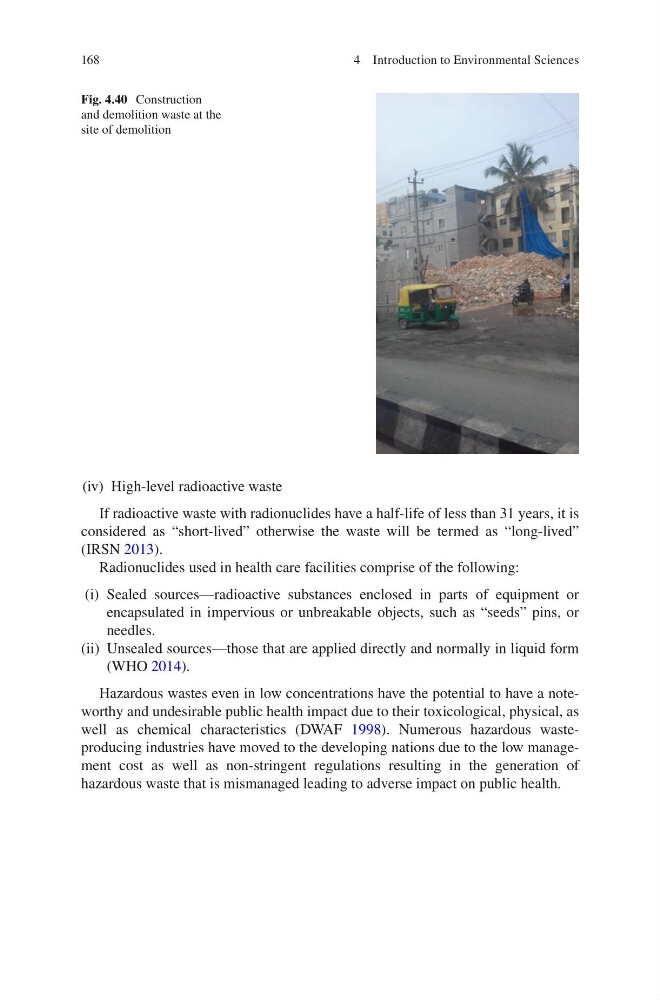
Fig. 4.40 Construction
and demolition waste at the
site of demolition
4 Introduction to Environmental Sciences
(iv) High-level radioactive waste
If radioactive waste with radionuclides have a half-life of less than 31 years, it is
considered as “short-lived” otherwise the waste will be termed as “long-lived”
(IRSN 2013).
Radionuclides used in health care facilities comprise of the following:
(i) Sealed sources—radioactive substances enclosed in parts of equipment or
encapsulated in impervious or unbreakable objects, such as “seeds” pins, or
needles.
(ii) Unsealed sources—those that are applied directly and normally in liquid form
(WHO 2014).
Hazardous wastes even in low concentrations have the potential to have a noteworthy and undesirable public health impact due to their toxicological, physical, as
well as chemical characteristics (DWAF 1998). Numerous hazardous wasteproducing industries have moved to the developing nations due to the low management cost as well as non-stringent regulations resulting in the generation of
hazardous waste that is mismanaged leading to adverse impact on public health.
Fig. 4.40 Construction
and demolition waste at the
site of demolition
4 Introduction to Environmental Sciences