

153
4.6 Solid Waste
Solid waste is a problem associated with solid wastes existing since the prehistoric
days. Both the quantities and qualities of the wastes have changed over the years
due to the invention of new technologies, products, and services. The waste characteristics depend on income, culture, geographical locations, economy, and situations like disasters.
Health impact is one of the consequences of poor solid waste management.
Improper solid waste management can lead to the following (Chandrappa and
Das 2012):
• Resource depletion
• Injury
• Epidemic
• Fire hazards
• Air pollution
• Water pollution
• Dog nuisance
• Snake/insect bite
• Food contamination
• Generation of GHGs
Table 4.2 Examples of secondary pollutants
Sl.
no. Secondary pollutant
Description
1.
Acid rain
Formed due to reaction of sulfur dioxide or nitrogen oxide
with water
2.
Ground-level ozone
Formed when hydrocarbons and oxides of nitrogen combine
in sunlight
3.
Nitrogen dioxide formed
in atmosphere
Formed due to reaction of nitric oxide with oxygen present in
air
4.
Particulate matter formed
in atmosphere
Solid particles such as sulfates formed from sulfur dioxide
and nitrates form nitrogen dioxide in atmosphere
5.
Peroxyacetyl nitrate
(PAN)
Formed when oxidized volatile organic compounds combine
with nitrogen oxide
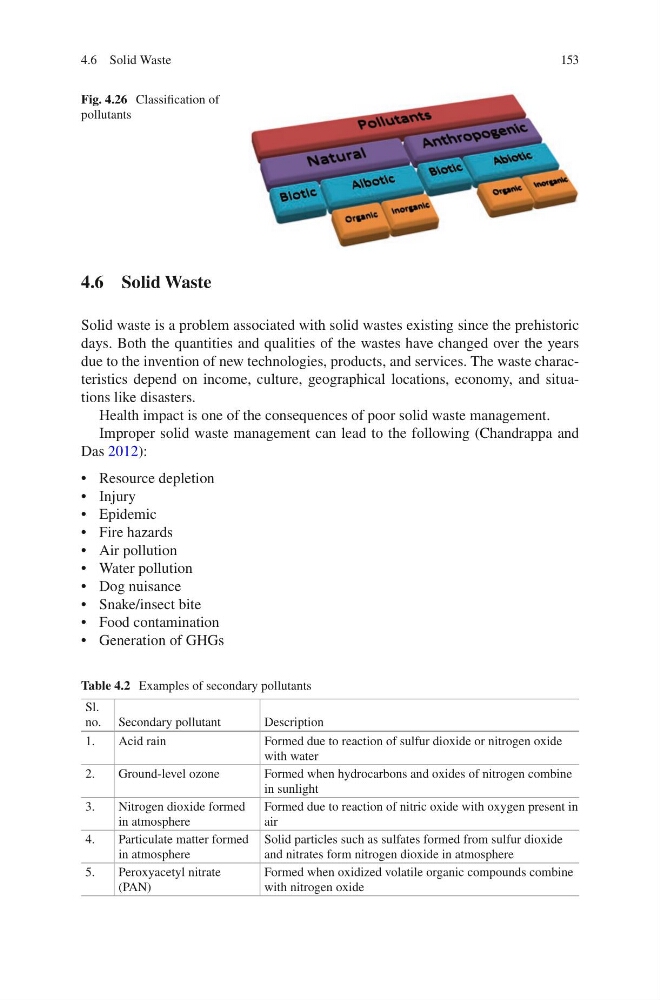
Fig. 4.26 Classification of
pollutants
4.6 Solid Waste
4.6 Solid Waste
Solid waste is a problem associated with solid wastes existing since the prehistoric
days. Both the quantities and qualities of the wastes have changed over the years
due to the invention of new technologies, products, and services. The waste characteristics depend on income, culture, geographical locations, economy, and situations like disasters.
Health impact is one of the consequences of poor solid waste management.
Improper solid waste management can lead to the following (Chandrappa and
Das 2012):
• Resource depletion
• Injury
• Epidemic
• Fire hazards
• Air pollution
• Water pollution
• Dog nuisance
• Snake/insect bite
• Food contamination
• Generation of GHGs
Table 4.2 Examples of secondary pollutants
Sl.
no. Secondary pollutant
Description
1.
Acid rain
Formed due to reaction of sulfur dioxide or nitrogen oxide
with water
2.
Ground-level ozone
Formed when hydrocarbons and oxides of nitrogen combine
in sunlight
3.
Nitrogen dioxide formed
in atmosphere
Formed due to reaction of nitric oxide with oxygen present in
air
4.
Particulate matter formed
in atmosphere
Solid particles such as sulfates formed from sulfur dioxide
and nitrates form nitrogen dioxide in atmosphere
5.
Peroxyacetyl nitrate
(PAN)
Formed when oxidized volatile organic compounds combine
with nitrogen oxide
Fig. 4.26 Classification of
pollutants
4.6 Solid Waste