

149
Not all particles in the air have the same properties. Some of the particles may be
pathogenic resulting in infection. Other particles may be radioactive resulting in
cancer in the recipient. Chemistry of particle determines the health of recipient.
While some may be carcinogenic, others may not. Particles such as acid mist may
be highly reactive and react with cells of body, damaging cells and tissues they are
associated with.
The health impact also depends on recipient organ of human body. For example,
hot particles may kill biological cells and damage tissues. While respirable particles
may enter the lungs and get absorbed affecting the cells in the immediate vicinity,
the same particles may not harm the skin the same way if they fall on nail/skin. The
chili powder in small quantity, which may not irritate skin/tongue, will irritate if it
enters the eyes. Similarly, asbestos, which do not affect the skin in small quantity,
may cause asbestosis if they enter the lungs.
Biological characteristics also determine extent of health impact based on the
recipient organs and environmental conditions. While pollen grains do not multiply,
the bacteria/fungi will multiply depending on the temperature, humidity, and nutrient supply at the portal of entry and subsequent location it moves to within the
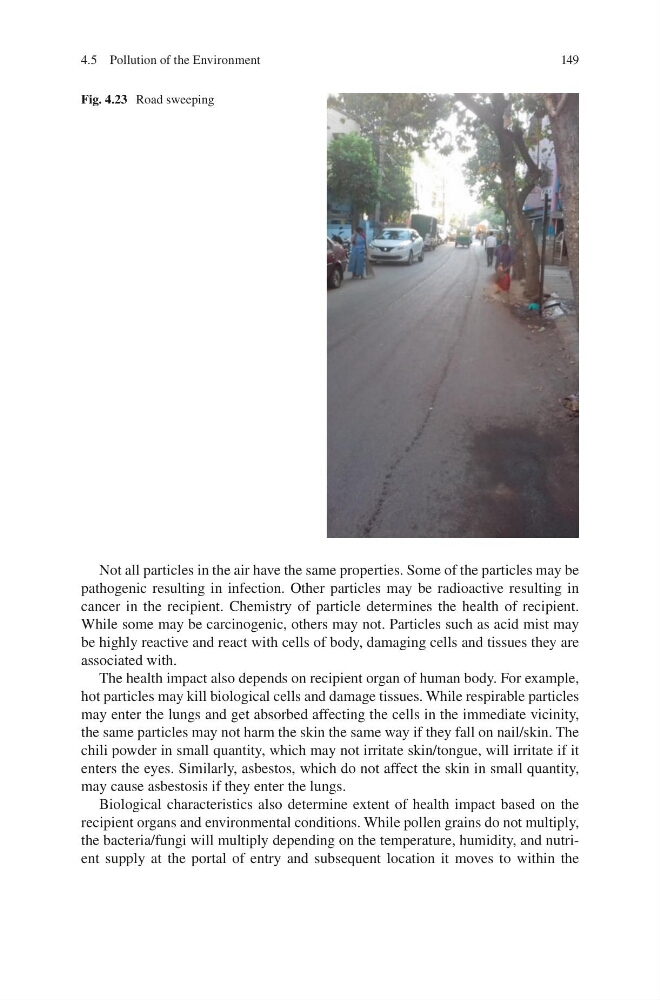
Fig. 4.23 Road sweeping
4.5 Pollution of the Environment
Not all particles in the air have the same properties. Some of the particles may be
pathogenic resulting in infection. Other particles may be radioactive resulting in
cancer in the recipient. Chemistry of particle determines the health of recipient.
While some may be carcinogenic, others may not. Particles such as acid mist may
be highly reactive and react with cells of body, damaging cells and tissues they are
associated with.
The health impact also depends on recipient organ of human body. For example,
hot particles may kill biological cells and damage tissues. While respirable particles
may enter the lungs and get absorbed affecting the cells in the immediate vicinity,
the same particles may not harm the skin the same way if they fall on nail/skin. The
chili powder in small quantity, which may not irritate skin/tongue, will irritate if it
enters the eyes. Similarly, asbestos, which do not affect the skin in small quantity,
may cause asbestosis if they enter the lungs.
Biological characteristics also determine extent of health impact based on the
recipient organs and environmental conditions. While pollen grains do not multiply,
the bacteria/fungi will multiply depending on the temperature, humidity, and nutrient supply at the portal of entry and subsequent location it moves to within the
Fig. 4.23 Road sweeping
4.5 Pollution of the Environment