

147
Venting and leakage during the extraction, transportation, and processing of natural gas result in emissions of pollutants and GHGs.
Many sources intentionally vent gases, like depressurization of equipment before
maintenance, vented storage tanks, dehydrators, and oil/gas extraction wells when
accumulated liquids are removed after hydraulic fracturing.
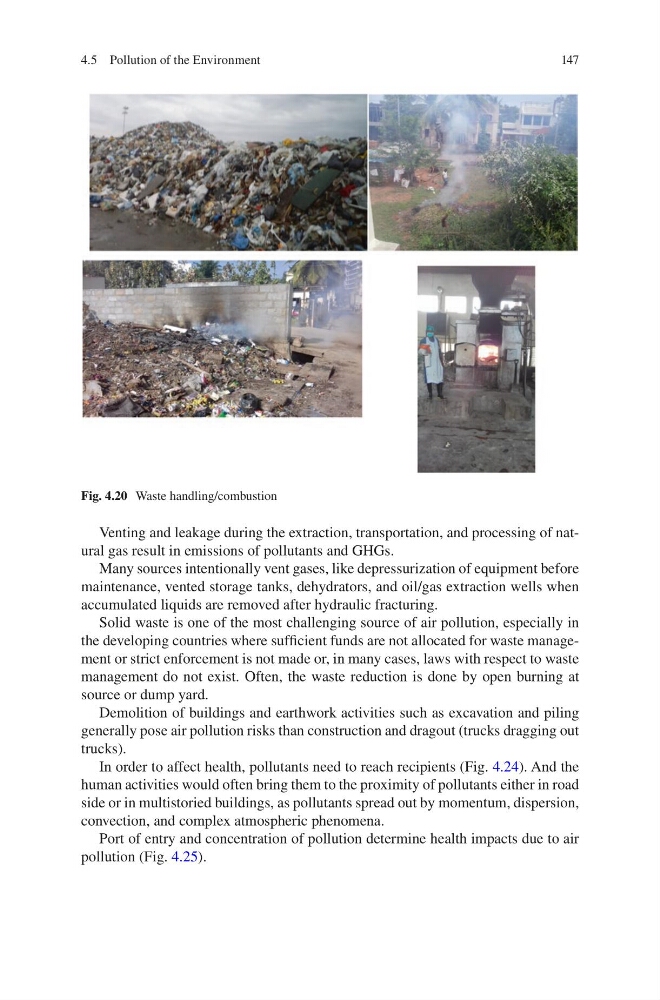
Solid waste is one of the most challenging source of air pollution, especially in
the developing countries where sufficient funds are not allocated for waste management or strict enforcement is not made or, in many cases, laws with respect to waste
management do not exist. Often, the waste reduction is done by open burning at
source or dump yard.
Demolition of buildings and earthwork activities such as excavation and piling
generally pose air pollution risks than construction and dragout (trucks dragging out
trucks).
In order to affect health, pollutants need to reach recipients (Fig. 4.24). And the
human activities would often bring them to the proximity of pollutants either in road
side or in multistoried buildings, as pollutants spread out by momentum, dispersion,
convection, and complex atmospheric phenomena.
Port of entry and concentration of pollution determine health impacts due to air
pollution (Fig. 4.25).
Fig. 4.20 Waste handling/combustion
4.5 Pollution of the Environment
Venting and leakage during the extraction, transportation, and processing of natural gas result in emissions of pollutants and GHGs.
Many sources intentionally vent gases, like depressurization of equipment before
maintenance, vented storage tanks, dehydrators, and oil/gas extraction wells when
accumulated liquids are removed after hydraulic fracturing.
Solid waste is one of the most challenging source of air pollution, especially in
the developing countries where sufficient funds are not allocated for waste management or strict enforcement is not made or, in many cases, laws with respect to waste
management do not exist. Often, the waste reduction is done by open burning at
source or dump yard.
Demolition of buildings and earthwork activities such as excavation and piling
generally pose air pollution risks than construction and dragout (trucks dragging out
trucks).
In order to affect health, pollutants need to reach recipients (Fig. 4.24). And the
human activities would often bring them to the proximity of pollutants either in road
side or in multistoried buildings, as pollutants spread out by momentum, dispersion,
convection, and complex atmospheric phenomena.
Port of entry and concentration of pollution determine health impacts due to air
pollution (Fig. 4.25).
Fig. 4.20 Waste handling/combustion
4.5 Pollution of the Environment