

139
respect political boundaries, the pollutants spread to other countries from countries
of origin.
The word “pollution” is usually associated with air, water, noise, and soil even
though the words thermal pollution, light pollution, radiation pollution, and land
pollution also occur in media and literature.
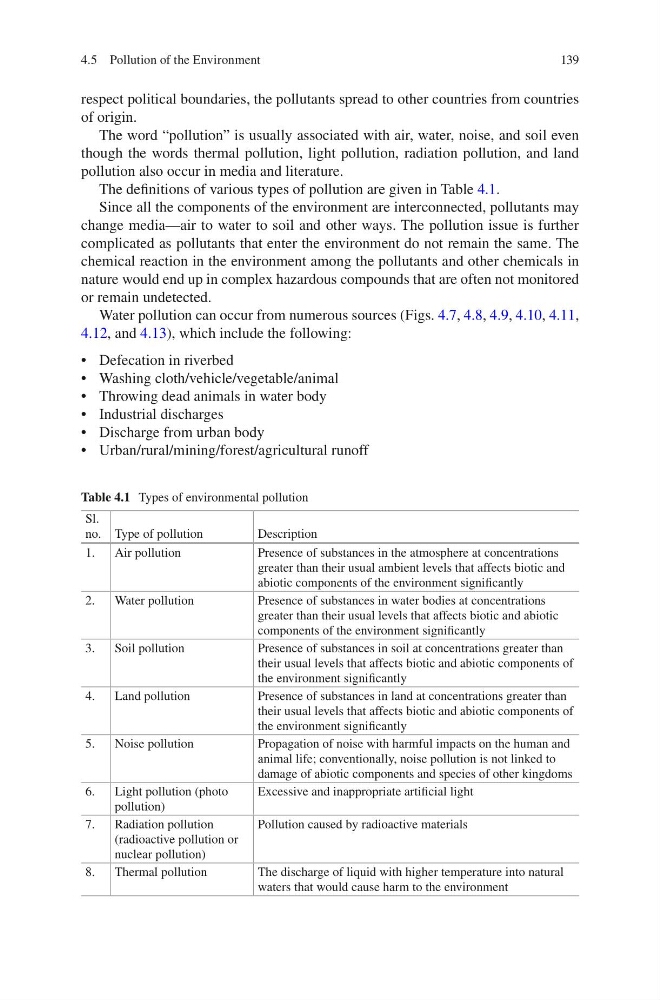
The definitions of various types of pollution are given in Table 4.1.
Since all the components of the environment are interconnected, pollutants may
change media—air to water to soil and other ways. The pollution issue is further
complicated as pollutants that enter the environment do not remain the same. The
chemical reaction in the environment among the pollutants and other chemicals in
nature would end up in complex hazardous compounds that are often not monitored
or remain undetected.
Water pollution can occur from numerous sources (Figs. 4.7, 4.8, 4.9, 4.10, 4.11,
4.12, and 4.13), which include the following:
• Defecation in riverbed
• Washing cloth/vehicle/vegetable/animal
• Throwing dead animals in water body
• Industrial discharges
• Discharge from urban body
• Urban/rural/mining/forest/agricultural runoff
Table 4.1 Types of environmental pollution
Sl.
no. Type of pollution
Description
1.
Air pollution
Presence of substances in the atmosphere at concentrations
greater than their usual ambient levels that affects biotic and
abiotic components of the environment significantly
2.
Water pollution
Presence of substances in water bodies at concentrations
greater than their usual levels that affects biotic and abiotic
components of the environment significantly
3.
Soil pollution
Presence of substances in soil at concentrations greater than
their usual levels that affects biotic and abiotic components of
the environment significantly
4.
Land pollution
Presence of substances in land at concentrations greater than
their usual levels that affects biotic and abiotic components of
the environment significantly
5.
Noise pollution
Propagation of noise with harmful impacts on the human and
animal life; conventionally, noise pollution is not linked to
damage of abiotic components and species of other kingdoms
6.
Light pollution (photo
pollution)
Excessive and inappropriate artificial light
7.
Radiation pollution
(radioactive pollution or
nuclear pollution)
Pollution caused by radioactive materials
8.
Thermal pollution
The discharge of liquid with higher temperature into natural
waters that would cause harm to the environment
4.5 Pollution of the Environment
respect political boundaries, the pollutants spread to other countries from countries
of origin.
The word “pollution” is usually associated with air, water, noise, and soil even
though the words thermal pollution, light pollution, radiation pollution, and land
pollution also occur in media and literature.
The definitions of various types of pollution are given in Table 4.1.
Since all the components of the environment are interconnected, pollutants may
change media—air to water to soil and other ways. The pollution issue is further
complicated as pollutants that enter the environment do not remain the same. The
chemical reaction in the environment among the pollutants and other chemicals in
nature would end up in complex hazardous compounds that are often not monitored
or remain undetected.
Water pollution can occur from numerous sources (Figs. 4.7, 4.8, 4.9, 4.10, 4.11,
4.12, and 4.13), which include the following:
• Defecation in riverbed
• Washing cloth/vehicle/vegetable/animal
• Throwing dead animals in water body
• Industrial discharges
• Discharge from urban body
• Urban/rural/mining/forest/agricultural runoff
Table 4.1 Types of environmental pollution
Sl.
no. Type of pollution
Description
1.
Air pollution
Presence of substances in the atmosphere at concentrations
greater than their usual ambient levels that affects biotic and
abiotic components of the environment significantly
2.
Water pollution
Presence of substances in water bodies at concentrations
greater than their usual levels that affects biotic and abiotic
components of the environment significantly
3.
Soil pollution
Presence of substances in soil at concentrations greater than
their usual levels that affects biotic and abiotic components of
the environment significantly
4.
Land pollution
Presence of substances in land at concentrations greater than
their usual levels that affects biotic and abiotic components of
the environment significantly
5.
Noise pollution
Propagation of noise with harmful impacts on the human and
animal life; conventionally, noise pollution is not linked to
damage of abiotic components and species of other kingdoms
6.
Light pollution (photo
pollution)
Excessive and inappropriate artificial light
7.
Radiation pollution
(radioactive pollution or
nuclear pollution)
Pollution caused by radioactive materials
8.
Thermal pollution
The discharge of liquid with higher temperature into natural
waters that would cause harm to the environment
4.5 Pollution of the Environment