

89
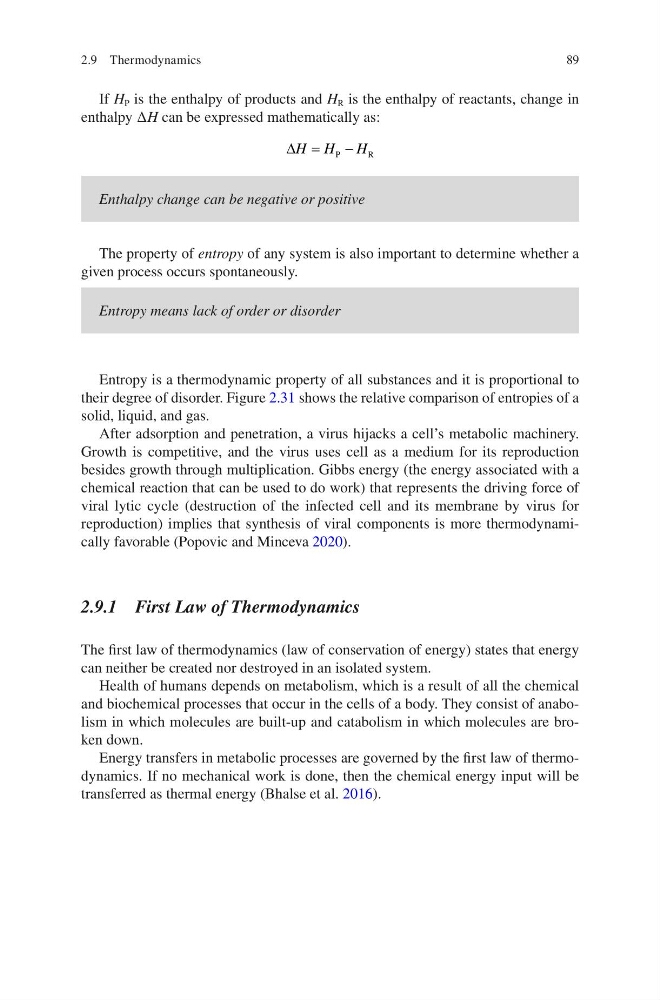
If H P is the enthalpy of products and H R is the enthalpy of reactants, change in
enthalpy ∆H can be expressed mathematically as:
∆H H H
=
−
P
R
The property of entropy of any system is also important to determine whether a
given process occurs spontaneously.
Entropy is a thermodynamic property of all substances and it is proportional to
their degree of disorder. Figure 2.31 shows the relative comparison of entropies of a
solid, liquid, and gas.
After adsorption and penetration, a virus hijacks a cell’s metabolic machinery.
Growth is competitive, and the virus uses cell as a medium for its reproduction
besides growth through multiplication. Gibbs energy (the energy associated with a
chemical reaction that can be used to do work) that represents the driving force of
viral lytic cycle (destruction of the infected cell and its membrane by virus for
reproduction) implies that synthesis of viral components is more thermodynamically favorable (Popovic and Minceva 2020).
2.9.1 First Law of Thermodynamics
The first law of thermodynamics (law of conservation of energy) states that energy
can neither be created nor destroyed in an isolated system.
Health of humans depends on metabolism, which is a result of all the chemical
and biochemical processes that occur in the cells of a body. They consist of anabolism in which molecules are built-up and catabolism in which molecules are broken down.
Energy transfers in metabolic processes are governed by the first law of thermodynamics. If no mechanical work is done, then the chemical energy input will be
transferred as thermal energy (Bhalse et al. 2016).
Enthalpy change can be negative or positive
Entropy means lack of order or disorder
2.9 Thermodynamics
If H P is the enthalpy of products and H R is the enthalpy of reactants, change in
enthalpy ∆H can be expressed mathematically as:
∆H H H
=
−
P
R
The property of entropy of any system is also important to determine whether a
given process occurs spontaneously.
Entropy is a thermodynamic property of all substances and it is proportional to
their degree of disorder. Figure 2.31 shows the relative comparison of entropies of a
solid, liquid, and gas.
After adsorption and penetration, a virus hijacks a cell’s metabolic machinery.
Growth is competitive, and the virus uses cell as a medium for its reproduction
besides growth through multiplication. Gibbs energy (the energy associated with a
chemical reaction that can be used to do work) that represents the driving force of
viral lytic cycle (destruction of the infected cell and its membrane by virus for
reproduction) implies that synthesis of viral components is more thermodynamically favorable (Popovic and Minceva 2020).
2.9.1 First Law of Thermodynamics
The first law of thermodynamics (law of conservation of energy) states that energy
can neither be created nor destroyed in an isolated system.
Health of humans depends on metabolism, which is a result of all the chemical
and biochemical processes that occur in the cells of a body. They consist of anabolism in which molecules are built-up and catabolism in which molecules are broken down.
Energy transfers in metabolic processes are governed by the first law of thermodynamics. If no mechanical work is done, then the chemical energy input will be
transferred as thermal energy (Bhalse et al. 2016).
Enthalpy change can be negative or positive
Entropy means lack of order or disorder
2.9 Thermodynamics