

60
Fundamentals of Corrosion
but there is no loss in impact strength. Consequently, impact tests cannot
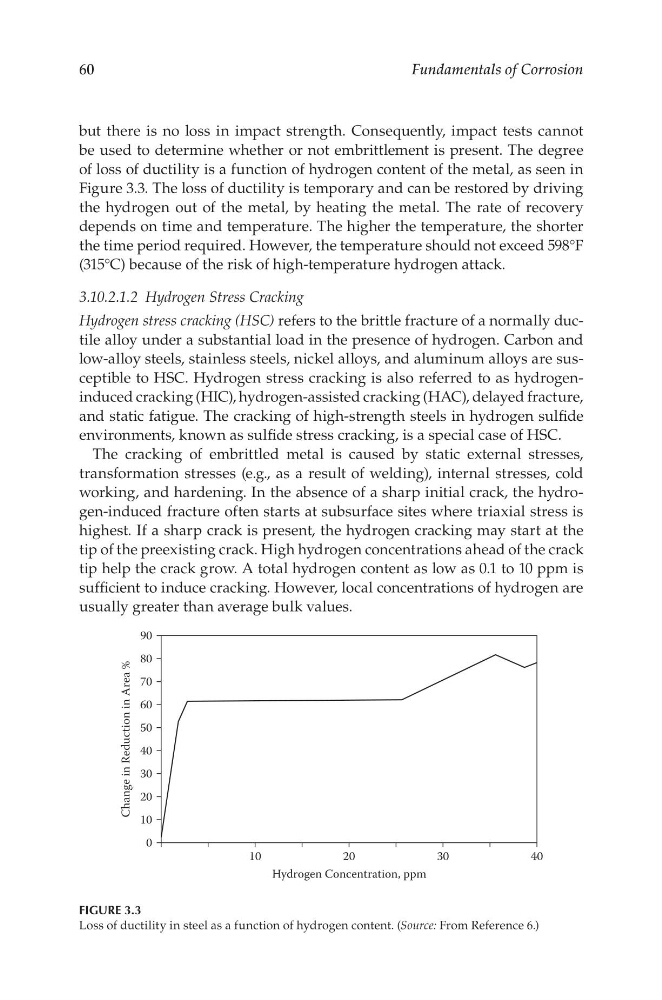
be used to determine whether or not embrittlement is present. The degree
of loss of ductility is a function of hydrogen content of the metal, as seen in
Figure 3.3. The loss of ductility is temporary and can be restored by driving
the hydrogen out of the metal, by heating the metal. The rate of recovery
depends on time and temperature. The higher the temperature, the shorter
the time period required. However, the temperature should not exceed 598°F
(315°C) because of the risk of high-temperature hydrogen attack.
3.10.2.1.2 Hydrogen Stress Cracking
Hydrogen stress cracking (HSC) refers to the brittle fracture of a normally ductile alloy under a substantial load in the presence of hydrogen. Carbon and
low-alloy steels, stainless steels, nickel alloys, and aluminum alloys are susceptible to HSC. Hydrogen stress cracking is also referred to as hydrogeninduced cracking (HIC), hydrogen-assisted cracking (HAC), delayed fracture,
and static fatigue. The cracking of high-strength steels in hydrogen sulfide
environments, known as sulfide stress cracking, is a special case of HSC.
The cracking of embrittled metal is caused by static external stresses,
transformation stresses (e.g., as a result of welding), internal stresses, cold
working, and hardening. In the absence of a sharp initial crack, the hydrogen-induced fracture often starts at subsurface sites where triaxial stress is
highest. If a sharp crack is present, the hydrogen cracking may start at the
tip of the preexisting crack. High hydrogen concentrations ahead of the crack
tip help the crack grow. A total hydrogen content as low as 0.1 to 10 ppm is
sufficient to induce cracking. However, local concentrations of hydrogen are
usually greater than average bulk values.
90
80
70
60
50
40
30
Change in Reduction in Area %
20
10
0
10
20
Hydrogen Concentration, ppm
30
40
FigurE 3.3
Loss of ductility in steel as a function of hydrogen content. (Source: From Reference 6.)
Fundamentals of Corrosion
but there is no loss in impact strength. Consequently, impact tests cannot
be used to determine whether or not embrittlement is present. The degree
of loss of ductility is a function of hydrogen content of the metal, as seen in
Figure 3.3. The loss of ductility is temporary and can be restored by driving
the hydrogen out of the metal, by heating the metal. The rate of recovery
depends on time and temperature. The higher the temperature, the shorter
the time period required. However, the temperature should not exceed 598°F
(315°C) because of the risk of high-temperature hydrogen attack.
3.10.2.1.2 Hydrogen Stress Cracking
Hydrogen stress cracking (HSC) refers to the brittle fracture of a normally ductile alloy under a substantial load in the presence of hydrogen. Carbon and
low-alloy steels, stainless steels, nickel alloys, and aluminum alloys are susceptible to HSC. Hydrogen stress cracking is also referred to as hydrogeninduced cracking (HIC), hydrogen-assisted cracking (HAC), delayed fracture,
and static fatigue. The cracking of high-strength steels in hydrogen sulfide
environments, known as sulfide stress cracking, is a special case of HSC.
The cracking of embrittled metal is caused by static external stresses,
transformation stresses (e.g., as a result of welding), internal stresses, cold
working, and hardening. In the absence of a sharp initial crack, the hydrogen-induced fracture often starts at subsurface sites where triaxial stress is
highest. If a sharp crack is present, the hydrogen cracking may start at the
tip of the preexisting crack. High hydrogen concentrations ahead of the crack
tip help the crack grow. A total hydrogen content as low as 0.1 to 10 ppm is
sufficient to induce cracking. However, local concentrations of hydrogen are
usually greater than average bulk values.
90
80
70
60
50
40
30
Change in Reduction in Area %
20
10
0
10
20
Hydrogen Concentration, ppm
30
40
FigurE 3.3
Loss of ductility in steel as a function of hydrogen content. (Source: From Reference 6.)