

56
Fundamentals of Corrosion
of zinc from brass, which is the most common example of selective leaching.
The less noble component of an alloy is usually the element that is removed,
such as zinc in brass.
“Graphite corrosion” is the term used to describe the selective leaching of
iron from gray cast iron. The process of selective leaching also takes place in
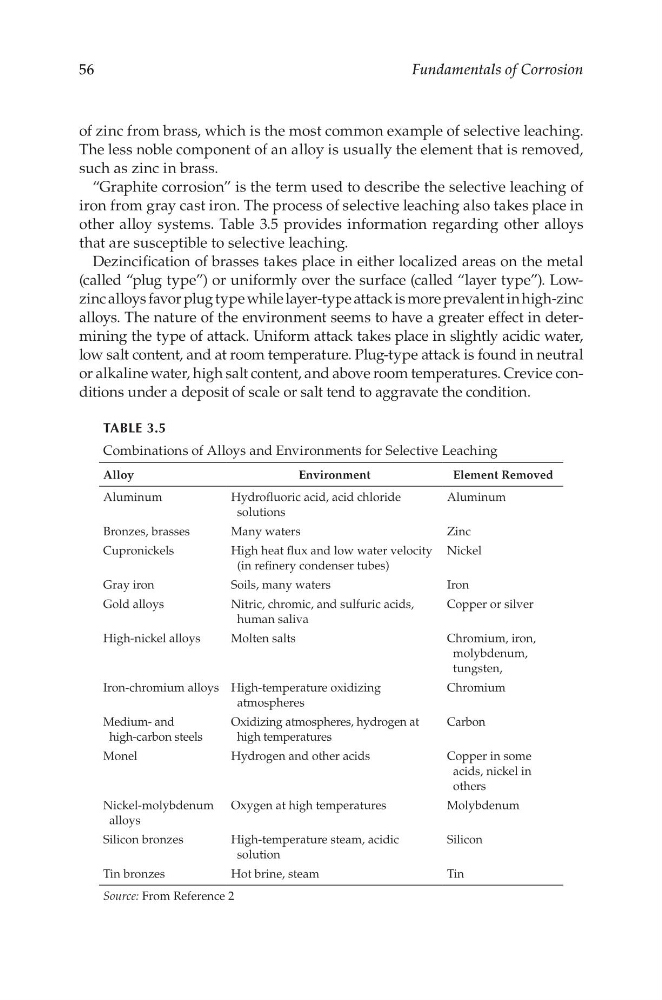
other alloy systems. Table 3.5 provides information regarding other alloys
that are susceptible to selective leaching.
Dezincification of brasses takes place in either localized areas on the metal
(called “plug type”) or uniformly over the surface (called “layer type”). Lowzinc alloys favor plug type while layer-type attack is more prevalent in high-zinc
alloys. The nature of the environment seems to have a greater effect in determining the type of attack. Uniform attack takes place in slightly acidic water,
low salt content, and at room temperature. Plug-type attack is found in neutral
or alkaline water, high salt content, and above room temperatures. Crevice conditions under a deposit of scale or salt tend to aggravate the condition.
TabLE 3.5
Combinations of Alloys and Environments for Selective Leaching
Alloy
Environment
Element Removed
Aluminum
Hydrofluoric acid, acid chloride
solutions
Aluminum
Bronzes, brasses
Many waters
Zinc
Cupronickels
High heat flux and low water velocity
(in refinery condenser tubes)
Nickel
Gray iron
Soils, many waters
Iron
Gold alloys
Nitric, chromic, and sulfuric acids,
human saliva
Copper or silver
High-nickel alloys
Molten salts
Chromium, iron,
molybdenum,
tungsten,
Iron-chromium alloys High-temperature oxidizing
atmospheres
Chromium
Medium- and
high-carbon steels
Oxidizing atmospheres, hydrogen at
high temperatures
Carbon
Monel
Hydrogen and other acids
Copper in some
acids, nickel in
others
Nickel-molybdenum
alloys
Oxygen at high temperatures
Molybdenum
Silicon bronzes
High-temperature steam, acidic
solution
Silicon
Tin bronzes
Hot brine, steam
Tin
Source: From Reference 2
Fundamentals of Corrosion
of zinc from brass, which is the most common example of selective leaching.
The less noble component of an alloy is usually the element that is removed,
such as zinc in brass.
“Graphite corrosion” is the term used to describe the selective leaching of
iron from gray cast iron. The process of selective leaching also takes place in
other alloy systems. Table 3.5 provides information regarding other alloys
that are susceptible to selective leaching.
Dezincification of brasses takes place in either localized areas on the metal
(called “plug type”) or uniformly over the surface (called “layer type”). Lowzinc alloys favor plug type while layer-type attack is more prevalent in high-zinc
alloys. The nature of the environment seems to have a greater effect in determining the type of attack. Uniform attack takes place in slightly acidic water,
low salt content, and at room temperature. Plug-type attack is found in neutral
or alkaline water, high salt content, and above room temperatures. Crevice conditions under a deposit of scale or salt tend to aggravate the condition.
TabLE 3.5
Combinations of Alloys and Environments for Selective Leaching
Alloy
Environment
Element Removed
Aluminum
Hydrofluoric acid, acid chloride
solutions
Aluminum
Bronzes, brasses
Many waters
Zinc
Cupronickels
High heat flux and low water velocity
(in refinery condenser tubes)
Nickel
Gray iron
Soils, many waters
Iron
Gold alloys
Nitric, chromic, and sulfuric acids,
human saliva
Copper or silver
High-nickel alloys
Molten salts
Chromium, iron,
molybdenum,
tungsten,
Iron-chromium alloys High-temperature oxidizing
atmospheres
Chromium
Medium- and
high-carbon steels
Oxidizing atmospheres, hydrogen at
high temperatures
Carbon
Monel
Hydrogen and other acids
Copper in some
acids, nickel in
others
Nickel-molybdenum
alloys
Oxygen at high temperatures
Molybdenum
Silicon bronzes
High-temperature steam, acidic
solution
Silicon
Tin bronzes
Hot brine, steam
Tin
Source: From Reference 2