

Forms of Metallic Corrosion
37
chloride concentrations are high, such as in seawater or in reducing solutions, a change to the active state will usually take place. Oxygen starvation
also causes a change to the active state. This occurs when there is no free
access to oxygen, such as in crevices and beneath contamination of partially fouled surfaces.
Differences in soil concentrations, such as moisture content and resistivity, can be responsible for creating anodic and cathodic areas. Where there
is a difference in concentrations of oxygen in the water or in moist soils in
contact with metal at different areas, cathodes will develop at high oxygen
concentrations, and anodes will develop at points of low oxygen concentration. Strained portions of metals tend to be anodic and unstrained portions
tend to be cathodic.
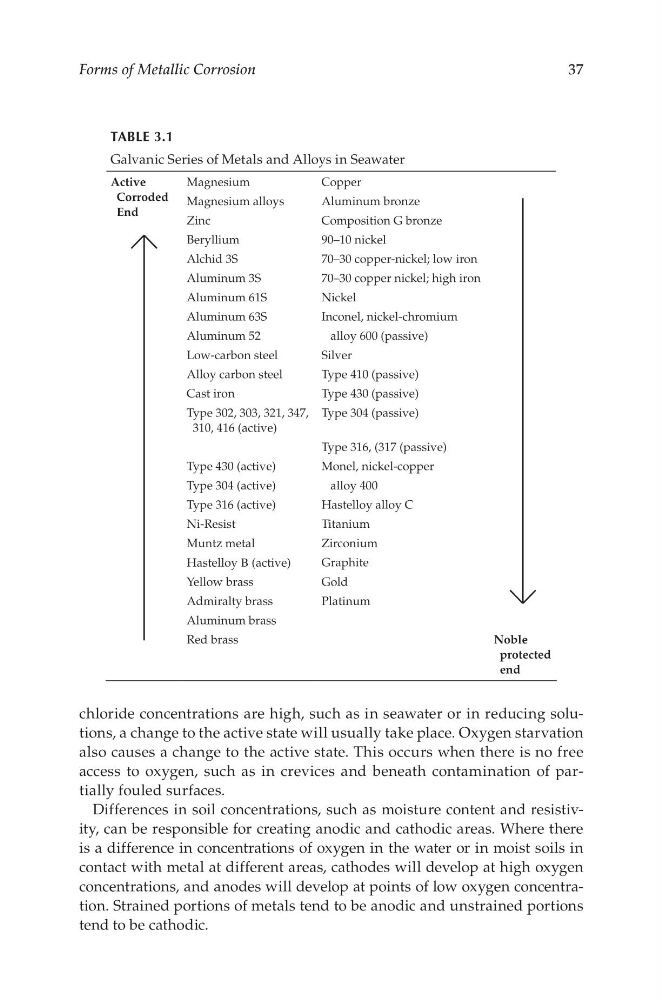
TabLE 3.1
Galvanic Series of Metals and Alloys in Seawater
Active
Corroded
End
Magnesium
Copper
Magnesium alloys
Aluminum bronze
Zinc
Composition G bronze
Beryllium
90–10 nickel
Alchid 3S
70–30 copper-nickel; low iron
Aluminum 3S
70–30 copper nickel; high iron
Aluminum 61S
Nickel
Aluminum 63S
Inconel, nickel-chromium
Aluminum 52
alloy 600 (passive)
Low-carbon steel
Silver
Alloy carbon steel
Type 410 (passive)
Cast iron
Type 430 (passive)
Type 302, 303, 321, 347,
310, 416 (active)
Type 304 (passive)
Type 316, (317 (passive)
Type 430 (active)
Monel, nickel-copper
Type 304 (active)
alloy 400
Type 316 (active)
Hastelloy alloy C
Ni-Resist
Titanium
Muntz metal
Zirconium
Hastelloy Β (active)
Graphite
Yellow brass
Gold
Admiralty brass
Platinum
Aluminum brass
Red brass
Noble
protected
end
37
chloride concentrations are high, such as in seawater or in reducing solutions, a change to the active state will usually take place. Oxygen starvation
also causes a change to the active state. This occurs when there is no free
access to oxygen, such as in crevices and beneath contamination of partially fouled surfaces.
Differences in soil concentrations, such as moisture content and resistivity, can be responsible for creating anodic and cathodic areas. Where there
is a difference in concentrations of oxygen in the water or in moist soils in
contact with metal at different areas, cathodes will develop at high oxygen
concentrations, and anodes will develop at points of low oxygen concentration. Strained portions of metals tend to be anodic and unstrained portions
tend to be cathodic.
TabLE 3.1
Galvanic Series of Metals and Alloys in Seawater
Active
Corroded
End
Magnesium
Copper
Magnesium alloys
Aluminum bronze
Zinc
Composition G bronze
Beryllium
90–10 nickel
Alchid 3S
70–30 copper-nickel; low iron
Aluminum 3S
70–30 copper nickel; high iron
Aluminum 61S
Nickel
Aluminum 63S
Inconel, nickel-chromium
Aluminum 52
alloy 600 (passive)
Low-carbon steel
Silver
Alloy carbon steel
Type 410 (passive)
Cast iron
Type 430 (passive)
Type 302, 303, 321, 347,
310, 416 (active)
Type 304 (passive)
Type 316, (317 (passive)
Type 430 (active)
Monel, nickel-copper
Type 304 (active)
alloy 400
Type 316 (active)
Hastelloy alloy C
Ni-Resist
Titanium
Muntz metal
Zirconium
Hastelloy Β (active)
Graphite
Yellow brass
Gold
Admiralty brass
Platinum
Aluminum brass
Red brass
Noble
protected
end