

16
Fundamentals of Corrosion
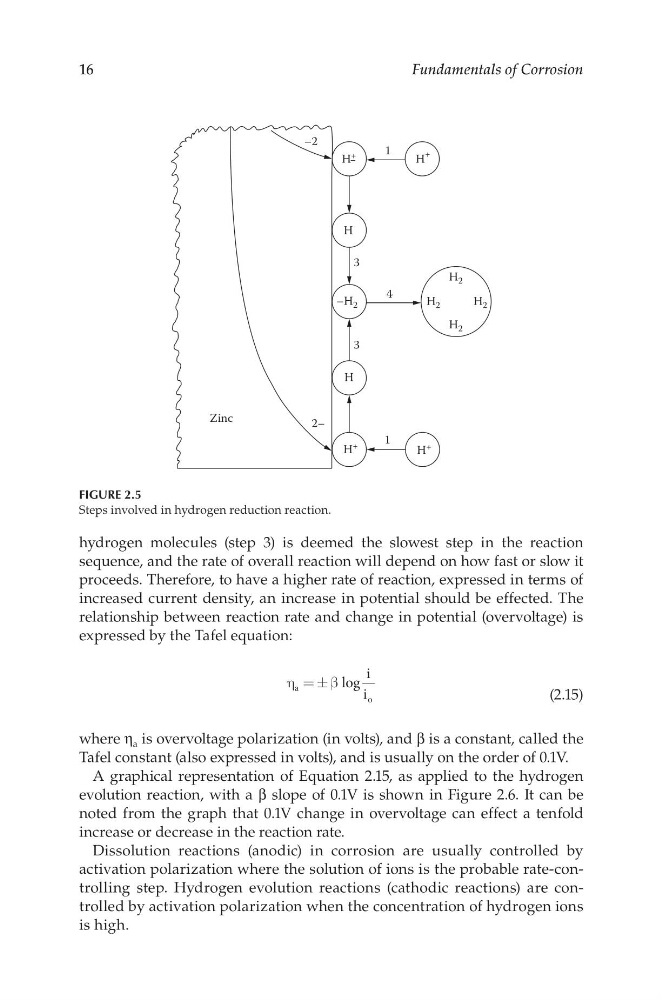
hydrogen molecules (step 3) is deemed the slowest step in the reaction
sequence, and the rate of overall reaction will depend on how fast or slow it
proceeds. Therefore, to have a higher rate of reaction, expressed in terms of
increased current density, an increase in potential should be effected. The
relationship between reaction rate and change in potential (overvoltage) is
expressed by the Tafel equation:
η
β
a
o
log
i
i
= ±
(2.15)
where η a is overvoltage polarization (in volts), and β is a constant, called the
Tafel constant (also expressed in volts), and is usually on the order of 0.1V.
A graphical representation of Equation 2.15, as applied to the hydrogen
evolution reaction, with a β slope of 0.1V is shown in Figure 2.6. It can be
noted from the graph that 0.1V change in overvoltage can effect a tenfold
increase or decrease in the reaction rate.
Dissolution reactions (anodic) in corrosion are usually controlled by
activation polarization where the solution of ions is the probable rate-controlling step. Hydrogen evolution reactions (cathodic reactions) are controlled by activation polarization when the concentration of hydrogen ions
is high.
H
+
–
H
+
H
–2
H
H +
H
+
–H 2
H 2
H 2
H 2
H 2
1
3
3
2–
Zinc
4
1
FigurE 2.5
Steps involved in hydrogen reduction reaction.
Fundamentals of Corrosion
hydrogen molecules (step 3) is deemed the slowest step in the reaction
sequence, and the rate of overall reaction will depend on how fast or slow it
proceeds. Therefore, to have a higher rate of reaction, expressed in terms of
increased current density, an increase in potential should be effected. The
relationship between reaction rate and change in potential (overvoltage) is
expressed by the Tafel equation:
η
β
a
o
log
i
i
= ±
(2.15)
where η a is overvoltage polarization (in volts), and β is a constant, called the
Tafel constant (also expressed in volts), and is usually on the order of 0.1V.
A graphical representation of Equation 2.15, as applied to the hydrogen
evolution reaction, with a β slope of 0.1V is shown in Figure 2.6. It can be
noted from the graph that 0.1V change in overvoltage can effect a tenfold
increase or decrease in the reaction rate.
Dissolution reactions (anodic) in corrosion are usually controlled by
activation polarization where the solution of ions is the probable rate-controlling step. Hydrogen evolution reactions (cathodic reactions) are controlled by activation polarization when the concentration of hydrogen ions
is high.
H
+
–
H
+
H
–2
H
H +
H
+
–H 2
H 2
H 2
H 2
H 2
1
3
3
2–
Zinc
4
1
FigurE 2.5
Steps involved in hydrogen reduction reaction.