

The Equipment Design Process
361
piping and exchangers. Coastal refineries face the added problem of seawater corrosion in the coolers.
Steam is used to heat-process hydrocarbon streams in the refinery in order
to remove gases from the hydrocarbons, but often high-pressure steam is
also produced to operate turbine generators for electricity. The discharged
low-pressure steam goes to the process units for heat or stripping purposes.
Thus, very little steam condensate is returned to the boilers, and chemical
treatment of the boiler feed water is more critical than in many utilities. In
addition, refineries burn waste by-products that are too dirty or corrosive to
sell. Thus, furnaces and the gas venting systems require more alloying or
chemical treatment than typical steam-generating plants.
Crude selection and corrosivity. If a refinery has the opportunity of choosing
or changing its crude oil supply, a crude oil corrosivity test is valuable to
ensure that the refinery will not suffer excessive corrosion or incur major cost
increases in handling a particular crude. Crude oils are analyzed primarily
for salt and sulfur (sourness) contents to estimate corrosivity. Tests have been
derived to correlate corrosion with HCl and H 2 S evolution when the crude is
heated at a controlled rate. Various correlations have been made, including:
Crude fractionator overhead corrosion with HCl evolution
•
Crude unit corrosion with H
•
2 S evolution
Heating equipment corrosion with the cumulative H
•
2 S release
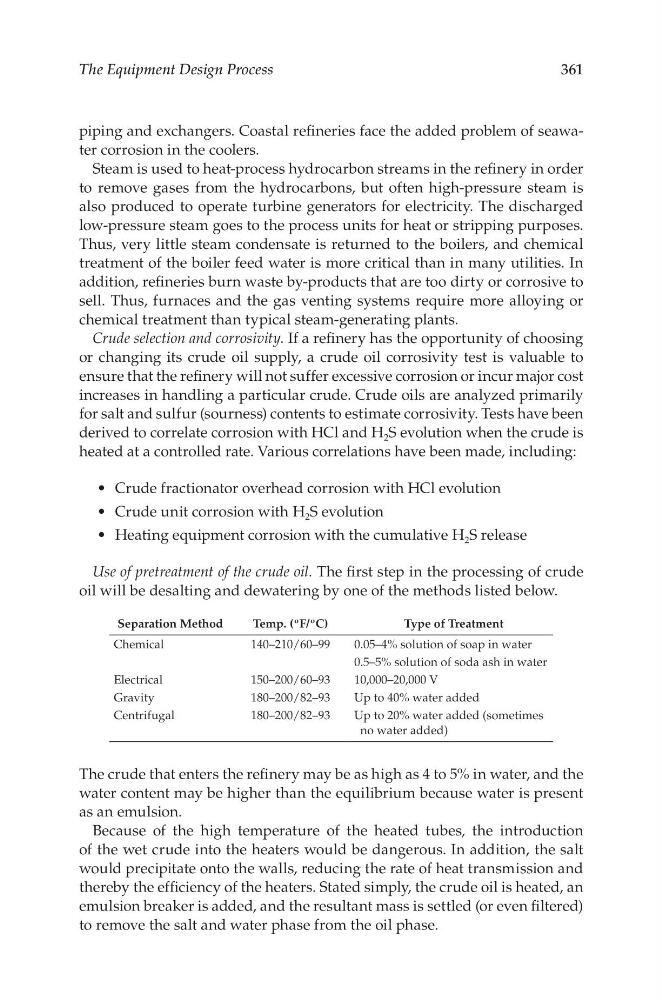
Use of pretreatment of the crude oil. The first step in the processing of crude
oil will be desalting and dewatering by one of the methods listed below.
Separation Method
Temp. (ºF/ºC)
Type of Treatment
Chemical
140–210/60–99
0.05–4% solution of soap in water
0.5–5% solution of soda ash in water
Electrical
150–200/60–93
10,000–20,000 V
Gravity
180–200/82–93
Up to 40% water added
Centrifugal
180–200/82–93
Up to 20% water added (sometimes
no water added)
The crude that enters the refinery may be as high as 4 to 5% in water, and the
water content may be higher than the equilibrium because water is present
as an emulsion.
Because of the high temperature of the heated tubes, the introduction
of the wet crude into the heaters would be dangerous. In addition, the salt
would precipitate onto the walls, reducing the rate of heat transmission and
thereby the efficiency of the heaters. Stated simply, the crude oil is heated, an
emulsion breaker is added, and the resultant mass is settled (or even filtered)
to remove the salt and water phase from the oil phase.
361
piping and exchangers. Coastal refineries face the added problem of seawater corrosion in the coolers.
Steam is used to heat-process hydrocarbon streams in the refinery in order
to remove gases from the hydrocarbons, but often high-pressure steam is
also produced to operate turbine generators for electricity. The discharged
low-pressure steam goes to the process units for heat or stripping purposes.
Thus, very little steam condensate is returned to the boilers, and chemical
treatment of the boiler feed water is more critical than in many utilities. In
addition, refineries burn waste by-products that are too dirty or corrosive to
sell. Thus, furnaces and the gas venting systems require more alloying or
chemical treatment than typical steam-generating plants.
Crude selection and corrosivity. If a refinery has the opportunity of choosing
or changing its crude oil supply, a crude oil corrosivity test is valuable to
ensure that the refinery will not suffer excessive corrosion or incur major cost
increases in handling a particular crude. Crude oils are analyzed primarily
for salt and sulfur (sourness) contents to estimate corrosivity. Tests have been
derived to correlate corrosion with HCl and H 2 S evolution when the crude is
heated at a controlled rate. Various correlations have been made, including:
Crude fractionator overhead corrosion with HCl evolution
•
Crude unit corrosion with H
•
2 S evolution
Heating equipment corrosion with the cumulative H
•
2 S release
Use of pretreatment of the crude oil. The first step in the processing of crude
oil will be desalting and dewatering by one of the methods listed below.
Separation Method
Temp. (ºF/ºC)
Type of Treatment
Chemical
140–210/60–99
0.05–4% solution of soap in water
0.5–5% solution of soda ash in water
Electrical
150–200/60–93
10,000–20,000 V
Gravity
180–200/82–93
Up to 40% water added
Centrifugal
180–200/82–93
Up to 20% water added (sometimes
no water added)
The crude that enters the refinery may be as high as 4 to 5% in water, and the
water content may be higher than the equilibrium because water is present
as an emulsion.
Because of the high temperature of the heated tubes, the introduction
of the wet crude into the heaters would be dangerous. In addition, the salt
would precipitate onto the walls, reducing the rate of heat transmission and
thereby the efficiency of the heaters. Stated simply, the crude oil is heated, an
emulsion breaker is added, and the resultant mass is settled (or even filtered)
to remove the salt and water phase from the oil phase.