

10
Fundamentals of Corrosion
of composition of the process stream inside the pipeline in a chemical plant
may lead to such a situation in practice.
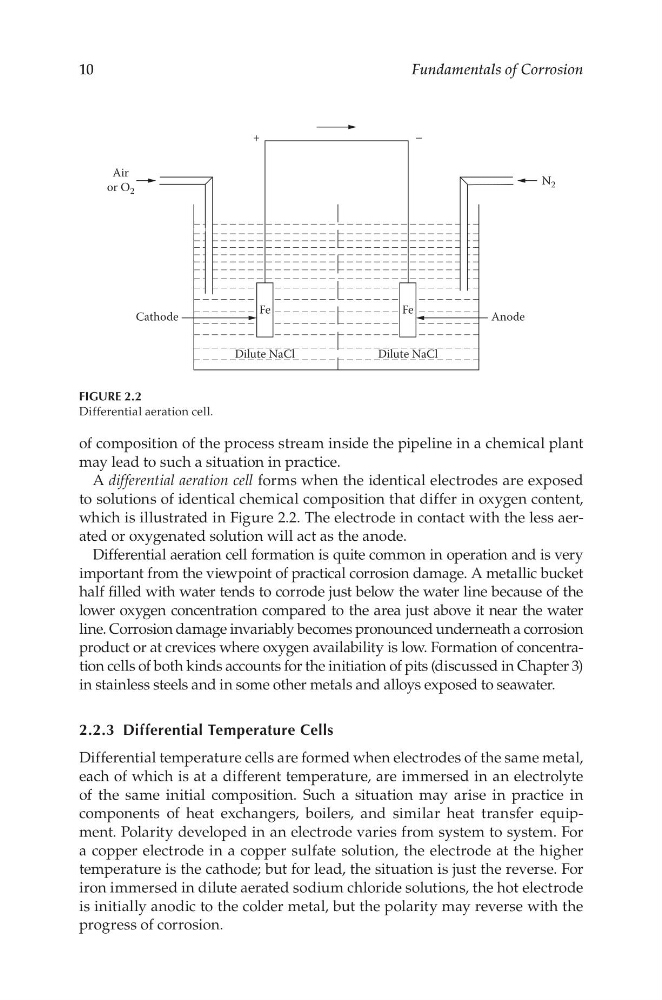
A differential aeration cell forms when the identical electrodes are exposed
to solutions of identical chemical composition that differ in oxygen content,
which is illustrated in Figure 2.2. The electrode in contact with the less aerated or oxygenated solution will act as the anode.
Differential aeration cell formation is quite common in operation and is very
important from the viewpoint of practical corrosion damage. A metallic bucket
half filled with water tends to corrode just below the water line because of the
lower oxygen concentration compared to the area just above it near the water
line. Corrosion damage invariably becomes pronounced underneath a corrosion
product or at crevices where oxygen availability is low. Formation of concentration cells of both kinds accounts for the initiation of pits (discussed in Chapter 3)
in stainless steels and in some other metals and alloys exposed to seawater.
2.2.3 Differential Temperature Cells
Differential temperature cells are formed when electrodes of the same metal,
each of which is at a different temperature, are immersed in an electrolyte
of the same initial composition. Such a situation may arise in practice in
components of heat exchangers, boilers, and similar heat transfer equipment. Polarity developed in an electrode varies from system to system. For
a copper electrode in a copper sulfate solution, the electrode at the higher
temperature is the cathode; but for lead, the situation is just the reverse. For
iron immersed in dilute aerated sodium chloride solutions, the hot electrode
is initially anodic to the colder metal, but the polarity may reverse with the
progress of corrosion.
Anode
N 2
Cathode
Air
or O 2
Dilute NaCl
Dilute NaCl
Fe
+
–
Fe
FigurE 2.2
Differential aeration cell.
Fundamentals of Corrosion
of composition of the process stream inside the pipeline in a chemical plant
may lead to such a situation in practice.
A differential aeration cell forms when the identical electrodes are exposed
to solutions of identical chemical composition that differ in oxygen content,
which is illustrated in Figure 2.2. The electrode in contact with the less aerated or oxygenated solution will act as the anode.
Differential aeration cell formation is quite common in operation and is very
important from the viewpoint of practical corrosion damage. A metallic bucket
half filled with water tends to corrode just below the water line because of the
lower oxygen concentration compared to the area just above it near the water
line. Corrosion damage invariably becomes pronounced underneath a corrosion
product or at crevices where oxygen availability is low. Formation of concentration cells of both kinds accounts for the initiation of pits (discussed in Chapter 3)
in stainless steels and in some other metals and alloys exposed to seawater.
2.2.3 Differential Temperature Cells
Differential temperature cells are formed when electrodes of the same metal,
each of which is at a different temperature, are immersed in an electrolyte
of the same initial composition. Such a situation may arise in practice in
components of heat exchangers, boilers, and similar heat transfer equipment. Polarity developed in an electrode varies from system to system. For
a copper electrode in a copper sulfate solution, the electrode at the higher
temperature is the cathode; but for lead, the situation is just the reverse. For
iron immersed in dilute aerated sodium chloride solutions, the hot electrode
is initially anodic to the colder metal, but the polarity may reverse with the
progress of corrosion.
Anode
N 2
Cathode
Air
or O 2
Dilute NaCl
Dilute NaCl
Fe
+
–
Fe
FigurE 2.2
Differential aeration cell.