

320
Fundamentals of Corrosion
10.3.2 Chemisorption
Another type of metal/inhibitor interaction is chemisorption. This process
involves charge sharing or charge transfer from the inhibitor molecules to
the metal surface in order to form a coordinate type of bond.
The chemisorption process takes place more slowly than electrostatic
adsorption and with a higher activation energy. It depends on the temperature, and higher degrees of inhibition should be expected at higher temperatures. Chemisorption is specific for certain metals and is not completely
reversible. The bonding occurring with electron transfer clearly depends
on the nature of the metal and the nature of the organic inhibitor. In fact,
electron transfer is typical for metals having vacant, low-energy electron
orbitals. Concerning inhibitors, electron transfer can be expected with
compounds having relatively loosely bound electrons. This situation may
arise because of the presence in the adsorbed inhibitor of multiple bonds
or aromatic rings, whose electrons have π character. Clearly, even the presence of heteroatoms with one lone pair of electrons in the adsorbed molecule will favor electron transfer. Most organic inhibitors are substances
with at least one functional group regarded as the reaction center for the
chemisorption process. In this case, the strength of the adsorption bond
is related to the heteroatom electron density and to the functional group
polarizability. For example, the inhibition efficiency of a homologous series
of organic substances differing only in the heteroatom is usually in the following sequence:
P > Se > S > N > O
An interpretation may be found in the easier polarizability and lower
electronegativity of the elements on the left in the above sequence. On
this basis, a surface bond of a Lewis acid-base type, normally with the
inhibitor as the electron donor and the metal as the electron acceptor, has
been postulated.
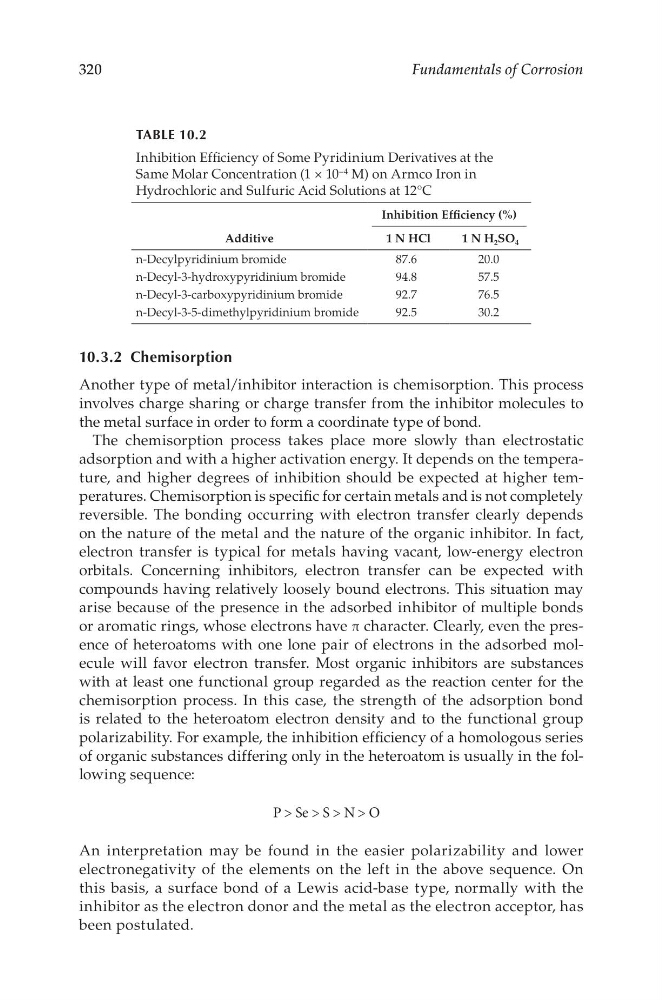
TabLE 10.2
Inhibition Efficiency of Some Pyridinium Derivatives at the
Same Molar Concentration (1 × 10 –4 M) on Armco Iron in
Hydrochloric and Sulfuric Acid Solutions at 12°C
Additive
Inhibition Efficiency (%)
1 N HCl
1 N H 2 SO 4
n-Decylpyridinium bromide
87.6
20.0
n-Decyl-3-hydroxypyridinium bromide
94.8
57.5
n-Decyl-3-carboxypyridinium bromide
92.7
76.5
n-Decyl-3-5-dimethylpyridinium bromide
92.5
30.2
Fundamentals of Corrosion
10.3.2 Chemisorption
Another type of metal/inhibitor interaction is chemisorption. This process
involves charge sharing or charge transfer from the inhibitor molecules to
the metal surface in order to form a coordinate type of bond.
The chemisorption process takes place more slowly than electrostatic
adsorption and with a higher activation energy. It depends on the temperature, and higher degrees of inhibition should be expected at higher temperatures. Chemisorption is specific for certain metals and is not completely
reversible. The bonding occurring with electron transfer clearly depends
on the nature of the metal and the nature of the organic inhibitor. In fact,
electron transfer is typical for metals having vacant, low-energy electron
orbitals. Concerning inhibitors, electron transfer can be expected with
compounds having relatively loosely bound electrons. This situation may
arise because of the presence in the adsorbed inhibitor of multiple bonds
or aromatic rings, whose electrons have π character. Clearly, even the presence of heteroatoms with one lone pair of electrons in the adsorbed molecule will favor electron transfer. Most organic inhibitors are substances
with at least one functional group regarded as the reaction center for the
chemisorption process. In this case, the strength of the adsorption bond
is related to the heteroatom electron density and to the functional group
polarizability. For example, the inhibition efficiency of a homologous series
of organic substances differing only in the heteroatom is usually in the following sequence:
P > Se > S > N > O
An interpretation may be found in the easier polarizability and lower
electronegativity of the elements on the left in the above sequence. On
this basis, a surface bond of a Lewis acid-base type, normally with the
inhibitor as the electron donor and the metal as the electron acceptor, has
been postulated.
TabLE 10.2
Inhibition Efficiency of Some Pyridinium Derivatives at the
Same Molar Concentration (1 × 10 –4 M) on Armco Iron in
Hydrochloric and Sulfuric Acid Solutions at 12°C
Additive
Inhibition Efficiency (%)
1 N HCl
1 N H 2 SO 4
n-Decylpyridinium bromide
87.6
20.0
n-Decyl-3-hydroxypyridinium bromide
94.8
57.5
n-Decyl-3-carboxypyridinium bromide
92.7
76.5
n-Decyl-3-5-dimethylpyridinium bromide
92.5
30.2