

Corrosion Inhibitors
317
of the pipes clogged with rust or to remove limestone crust from inside the
boiler tubes. Typical examples of pickling inhibitors are quinolin ethiodide,
o- and p-tolythiourea, hexamethylene tetramine, formaldehyde, and p-thiocresol. They are added in concentrations of 0.01 to 0.1%. Organic inhibitors
are also added to oils, greases, and waxes used as slushing compounds to
temporarily protect steel surfaces from rusting during shipment or storage.
10.2.3 Precipitation inhibitors (Cathodic inhibitors)
Precipitation inhibitors are compounds that cause the formation of precipitates on the surface of the metal, thereby providing a protective film.
Cathodic inhibitors interfere with the cathodic processes and the rate of corrosion thereby decreases. They fall into three catergories: cathodic precipitates, oxygen scavengers, and hydrogen evolution poisons.
Calcium and magnesium carbonates, which are often present in natural
waters, can be precipitated to form protective cathodic deposits with the
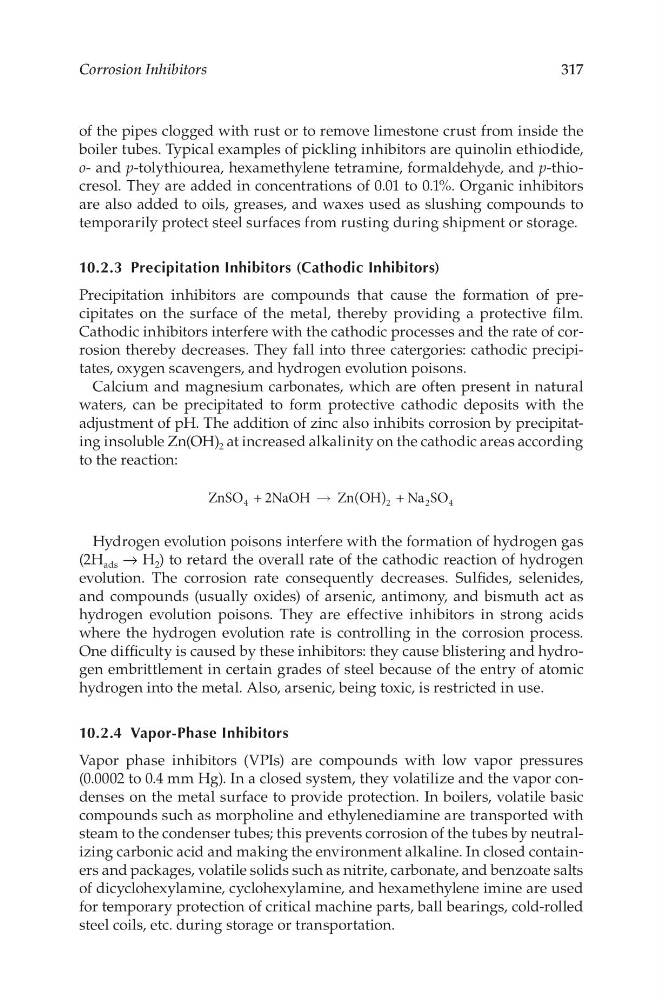
adjustment of pH. The addition of zinc also inhibits corrosion by precipitating insoluble Zn(OH) 2 at increased alkalinity on the cathodic areas according
to the reaction:
ZnSO + 2NaOH
Zn(OH) + Na SO
4
2
2
4
→
Hydrogen evolution poisons interfere with the formation of hydrogen gas
(2H ads → H 2 ) to retard the overall rate of the cathodic reaction of hydrogen
evolution. The corrosion rate consequently decreases. Sulfides, selenides,
and compounds (usually oxides) of arsenic, antimony, and bismuth act as
hydrogen evolution poisons. They are effective inhibitors in strong acids
where the hydrogen evolution rate is controlling in the corrosion process.
One difficulty is caused by these inhibitors: they cause blistering and hydrogen embrittlement in certain grades of steel because of the entry of atomic
hydrogen into the metal. Also, arsenic, being toxic, is restricted in use.
10.2.4 Vapor-Phase inhibitors
Vapor phase inhibitors (VPIs) are compounds with low vapor pressures
(0.0002 to 0.4 mm Hg). In a closed system, they volatilize and the vapor condenses on the metal surface to provide protection. In boilers, volatile basic
compounds such as morpholine and ethylenediamine are transported with
steam to the condenser tubes; this prevents corrosion of the tubes by neutralizing carbonic acid and making the environment alkaline. In closed containers and packages, volatile solids such as nitrite, carbonate, and benzoate salts
of dicyclohexylamine, cyclohexylamine, and hexamethylene imine are used
for temporary protection of critical machine parts, ball bearings, cold-rolled
steel coils, etc. during storage or transportation.
317
of the pipes clogged with rust or to remove limestone crust from inside the
boiler tubes. Typical examples of pickling inhibitors are quinolin ethiodide,
o- and p-tolythiourea, hexamethylene tetramine, formaldehyde, and p-thiocresol. They are added in concentrations of 0.01 to 0.1%. Organic inhibitors
are also added to oils, greases, and waxes used as slushing compounds to
temporarily protect steel surfaces from rusting during shipment or storage.
10.2.3 Precipitation inhibitors (Cathodic inhibitors)
Precipitation inhibitors are compounds that cause the formation of precipitates on the surface of the metal, thereby providing a protective film.
Cathodic inhibitors interfere with the cathodic processes and the rate of corrosion thereby decreases. They fall into three catergories: cathodic precipitates, oxygen scavengers, and hydrogen evolution poisons.
Calcium and magnesium carbonates, which are often present in natural
waters, can be precipitated to form protective cathodic deposits with the
adjustment of pH. The addition of zinc also inhibits corrosion by precipitating insoluble Zn(OH) 2 at increased alkalinity on the cathodic areas according
to the reaction:
ZnSO + 2NaOH
Zn(OH) + Na SO
4
2
2
4
→
Hydrogen evolution poisons interfere with the formation of hydrogen gas
(2H ads → H 2 ) to retard the overall rate of the cathodic reaction of hydrogen
evolution. The corrosion rate consequently decreases. Sulfides, selenides,
and compounds (usually oxides) of arsenic, antimony, and bismuth act as
hydrogen evolution poisons. They are effective inhibitors in strong acids
where the hydrogen evolution rate is controlling in the corrosion process.
One difficulty is caused by these inhibitors: they cause blistering and hydrogen embrittlement in certain grades of steel because of the entry of atomic
hydrogen into the metal. Also, arsenic, being toxic, is restricted in use.
10.2.4 Vapor-Phase inhibitors
Vapor phase inhibitors (VPIs) are compounds with low vapor pressures
(0.0002 to 0.4 mm Hg). In a closed system, they volatilize and the vapor condenses on the metal surface to provide protection. In boilers, volatile basic
compounds such as morpholine and ethylenediamine are transported with
steam to the condenser tubes; this prevents corrosion of the tubes by neutralizing carbonic acid and making the environment alkaline. In closed containers and packages, volatile solids such as nitrite, carbonate, and benzoate salts
of dicyclohexylamine, cyclohexylamine, and hexamethylene imine are used
for temporary protection of critical machine parts, ball bearings, cold-rolled
steel coils, etc. during storage or transportation.