

6
Fundamentals of Corrosion
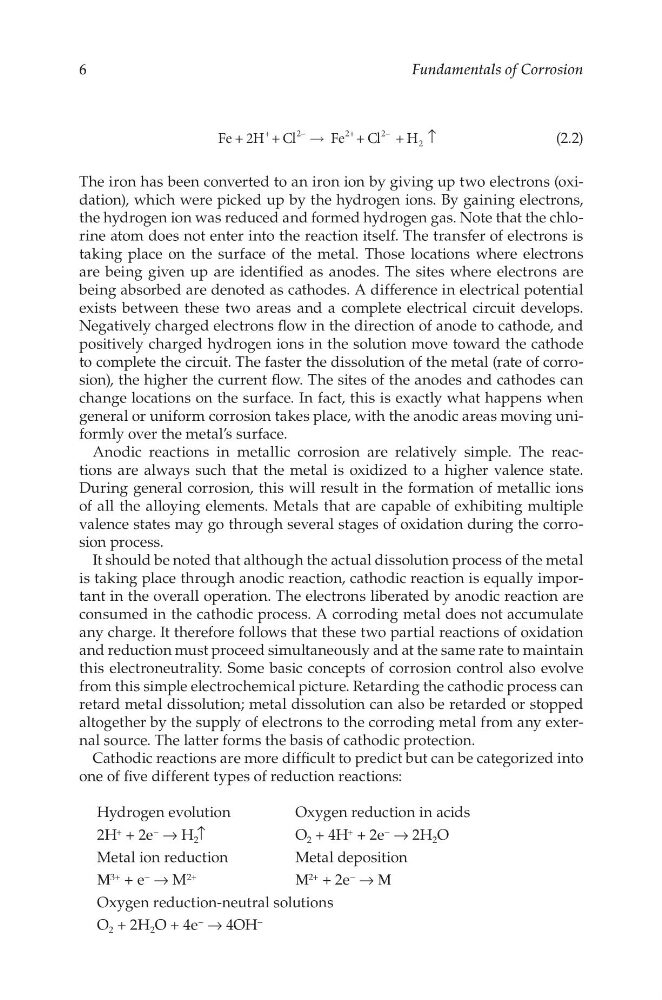
Fe + 2H + Cl
Fe + Cl +H
+
2 –
2 +
2 –
2
→
↑
(2.2)
The iron has been converted to an iron ion by giving up two electrons (oxidation), which were picked up by the hydrogen ions. By gaining electrons,
the hydrogen ion was reduced and formed hydrogen gas. Note that the chlorine atom does not enter into the reaction itself. The transfer of electrons is
taking place on the surface of the metal. Those locations where electrons
are being given up are identified as anodes. The sites where electrons are
being absorbed are denoted as cathodes. A difference in electrical potential
exists between these two areas and a complete electrical circuit develops.
Negatively charged electrons flow in the direction of anode to cathode, and
positively charged hydrogen ions in the solution move toward the cathode
to complete the circuit. The faster the dissolution of the metal (rate of corrosion), the higher the current flow. The sites of the anodes and cathodes can
change locations on the surface. In fact, this is exactly what happens when
general or uniform corrosion takes place, with the anodic areas moving uniformly over the metal’s surface.
Anodic reactions in metallic corrosion are relatively simple. The reactions are always such that the metal is oxidized to a higher valence state.
During general corrosion, this will result in the formation of metallic ions
of all the alloying elements. Metals that are capable of exhibiting multiple
valence states may go through several stages of oxidation during the corrosion process.
It should be noted that although the actual dissolution process of the metal
is taking place through anodic reaction, cathodic reaction is equally important in the overall operation. The electrons liberated by anodic reaction are
consumed in the cathodic process. A corroding metal does not accumulate
any charge. It therefore follows that these two partial reactions of oxidation
and reduction must proceed simultaneously and at the same rate to maintain
this electroneutrality. Some basic concepts of corrosion control also evolve
from this simple electrochemical picture. Retarding the cathodic process can
retard metal dissolution; metal dissolution can also be retarded or stopped
altogether by the supply of electrons to the corroding metal from any external source. The latter forms the basis of cathodic protection.
Cathodic reactions are more difficult to predict but can be categorized into
one of five different types of reduction reactions:
Hydrogen evolution
Oxygen reduction in acids
2H + + 2e − → H 2 ↑
O 2 + 4H + + 2e − → 2H 2 O
Metal ion reduction
Metal deposition
Μ 3+ + e − → M 2+
Μ 2+ + 2e − → Μ
Oxygen reduction-neutral solutions
O 2 + 2H 2 O + 4e − → 4OH −
Fundamentals of Corrosion
Fe + 2H + Cl
Fe + Cl +H
+
2 –
2 +
2 –
2
→
↑
(2.2)
The iron has been converted to an iron ion by giving up two electrons (oxidation), which were picked up by the hydrogen ions. By gaining electrons,
the hydrogen ion was reduced and formed hydrogen gas. Note that the chlorine atom does not enter into the reaction itself. The transfer of electrons is
taking place on the surface of the metal. Those locations where electrons
are being given up are identified as anodes. The sites where electrons are
being absorbed are denoted as cathodes. A difference in electrical potential
exists between these two areas and a complete electrical circuit develops.
Negatively charged electrons flow in the direction of anode to cathode, and
positively charged hydrogen ions in the solution move toward the cathode
to complete the circuit. The faster the dissolution of the metal (rate of corrosion), the higher the current flow. The sites of the anodes and cathodes can
change locations on the surface. In fact, this is exactly what happens when
general or uniform corrosion takes place, with the anodic areas moving uniformly over the metal’s surface.
Anodic reactions in metallic corrosion are relatively simple. The reactions are always such that the metal is oxidized to a higher valence state.
During general corrosion, this will result in the formation of metallic ions
of all the alloying elements. Metals that are capable of exhibiting multiple
valence states may go through several stages of oxidation during the corrosion process.
It should be noted that although the actual dissolution process of the metal
is taking place through anodic reaction, cathodic reaction is equally important in the overall operation. The electrons liberated by anodic reaction are
consumed in the cathodic process. A corroding metal does not accumulate
any charge. It therefore follows that these two partial reactions of oxidation
and reduction must proceed simultaneously and at the same rate to maintain
this electroneutrality. Some basic concepts of corrosion control also evolve
from this simple electrochemical picture. Retarding the cathodic process can
retard metal dissolution; metal dissolution can also be retarded or stopped
altogether by the supply of electrons to the corroding metal from any external source. The latter forms the basis of cathodic protection.
Cathodic reactions are more difficult to predict but can be categorized into
one of five different types of reduction reactions:
Hydrogen evolution
Oxygen reduction in acids
2H + + 2e − → H 2 ↑
O 2 + 4H + + 2e − → 2H 2 O
Metal ion reduction
Metal deposition
Μ 3+ + e − → M 2+
Μ 2+ + 2e − → Μ
Oxygen reduction-neutral solutions
O 2 + 2H 2 O + 4e − → 4OH −