

Corrosion of Metallic Coatings
275
affecting the service life of the coating. A thicker tin layer prolongs the service life of a tin can. The function of the alloy layer (FeSn) is to reduce the
active area of steel by covering it because it is inert in acid fruit products.
When some parts of the steel substrate are exposed, the corrosion of the
tin layer is accelerated by galvanic coupling with the steel. The corrosion
potential of the alloy layer is between that of the tin layer and that of the
steel. A less defective layer exhibits a potential closer to that of the tin layer.
3
pH
2
1
0
–40
–20
Potential Differnce E
Sn – E
Fe + mV
20
40
0
4
5
6
7
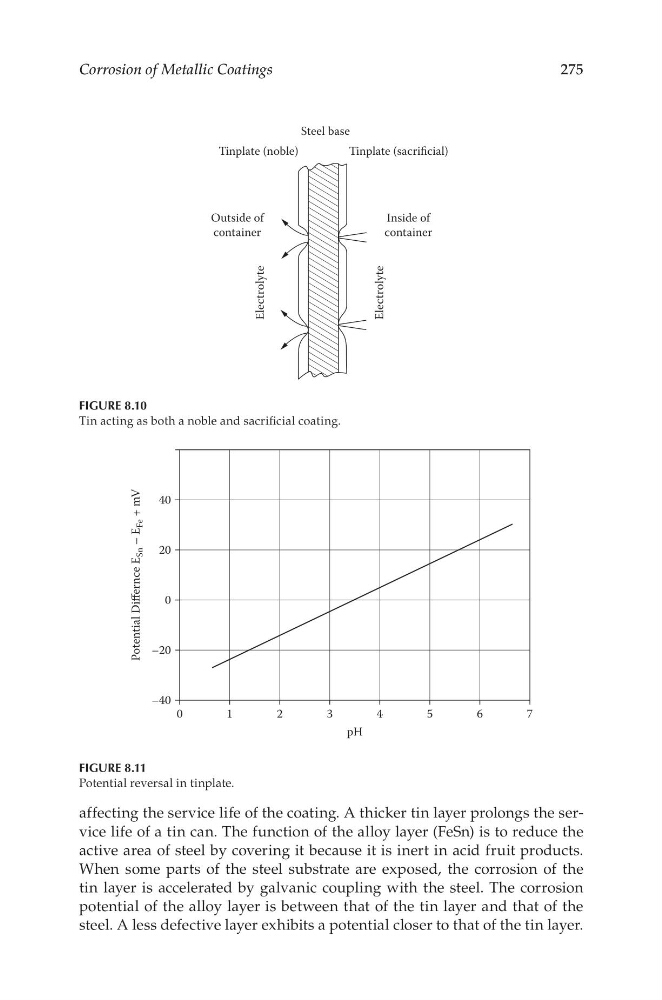
FigurE 8.11
Potential reversal in tinplate.
Electrolyte
Inside of
container
Outside of
container
Tinplate (noble)
Tinplate (sacrificial)
Steel base
Electrolyte
FigurE 8.10
Tin acting as both a noble and sacrificial coating.
275
affecting the service life of the coating. A thicker tin layer prolongs the service life of a tin can. The function of the alloy layer (FeSn) is to reduce the
active area of steel by covering it because it is inert in acid fruit products.
When some parts of the steel substrate are exposed, the corrosion of the
tin layer is accelerated by galvanic coupling with the steel. The corrosion
potential of the alloy layer is between that of the tin layer and that of the
steel. A less defective layer exhibits a potential closer to that of the tin layer.
3
pH
2
1
0
–40
–20
Potential Differnce E
Sn – E
Fe + mV
20
40
0
4
5
6
7
FigurE 8.11
Potential reversal in tinplate.
Electrolyte
Inside of
container
Outside of
container
Tinplate (noble)
Tinplate (sacrificial)
Steel base
Electrolyte
FigurE 8.10
Tin acting as both a noble and sacrificial coating.