

272
Fundamentals of Corrosion
point, which is discouraging. However, it occurred to investigators that this
apparent disadvantage of bright nickel could be put to good use.
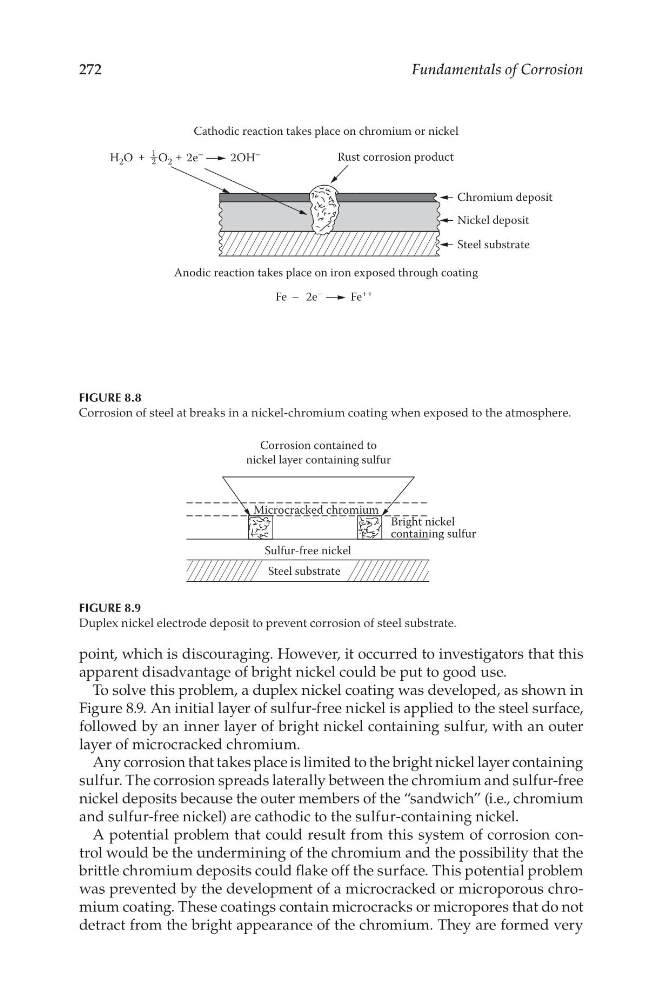
To solve this problem, a duplex nickel coating was developed, as shown in
Figure 8.9. An initial layer of sulfur-free nickel is applied to the steel surface,
followed by an inner layer of bright nickel containing sulfur, with an outer
layer of microcracked chromium.
Any corrosion that takes place is limited to the bright nickel layer containing
sulfur. The corrosion spreads laterally between the chromium and sulfur-free
nickel deposits because the outer members of the “sandwich” (i.e., chromium
and sulfur-free nickel) are cathodic to the sulfur-containing nickel.
A potential problem that could result from this system of corrosion control would be the undermining of the chromium and the possibility that the
brittle chromium deposits could flake off the surface. This potential problem
was prevented by the development of a microcracked or microporous chromium coating. These coatings contain microcracks or micropores that do not
detract from the bright appearance of the chromium. They are formed very
Anodic reaction takes place on iron exposed through coating
Cathodic reaction takes place on chromium or nickel
Rust corrosion product
Chromium deposit
Nickel deposit
Steel substrate
Fe
Fe
++
– 2e
–
H 2 O
2 e
–
2OH
–
+
+
O 2
1
2
FigurE 8.8
Corrosion of steel at breaks in a nickel-chromium coating when exposed to the atmosphere.
Steel substrate
Corrosion contained to
nickel layer containing sulfur
Sulfur-free nickel
Bright nickel
containing sulfur
Microcracked chromium
FigurE 8.9
Duplex nickel electrode deposit to prevent corrosion of steel substrate.
Fundamentals of Corrosion
point, which is discouraging. However, it occurred to investigators that this
apparent disadvantage of bright nickel could be put to good use.
To solve this problem, a duplex nickel coating was developed, as shown in
Figure 8.9. An initial layer of sulfur-free nickel is applied to the steel surface,
followed by an inner layer of bright nickel containing sulfur, with an outer
layer of microcracked chromium.
Any corrosion that takes place is limited to the bright nickel layer containing
sulfur. The corrosion spreads laterally between the chromium and sulfur-free
nickel deposits because the outer members of the “sandwich” (i.e., chromium
and sulfur-free nickel) are cathodic to the sulfur-containing nickel.
A potential problem that could result from this system of corrosion control would be the undermining of the chromium and the possibility that the
brittle chromium deposits could flake off the surface. This potential problem
was prevented by the development of a microcracked or microporous chromium coating. These coatings contain microcracks or micropores that do not
detract from the bright appearance of the chromium. They are formed very
Anodic reaction takes place on iron exposed through coating
Cathodic reaction takes place on chromium or nickel
Rust corrosion product
Chromium deposit
Nickel deposit
Steel substrate
Fe
Fe
++
– 2e
–
H 2 O
2 e
–
2OH
–
+
+
O 2
1
2
FigurE 8.8
Corrosion of steel at breaks in a nickel-chromium coating when exposed to the atmosphere.
Steel substrate
Corrosion contained to
nickel layer containing sulfur
Sulfur-free nickel
Bright nickel
containing sulfur
Microcracked chromium
FigurE 8.9
Duplex nickel electrode deposit to prevent corrosion of steel substrate.