

262
Fundamentals of Corrosion
η
c
=
−
2 3
1
.
log
RT
nF
i
i L
(8.5)
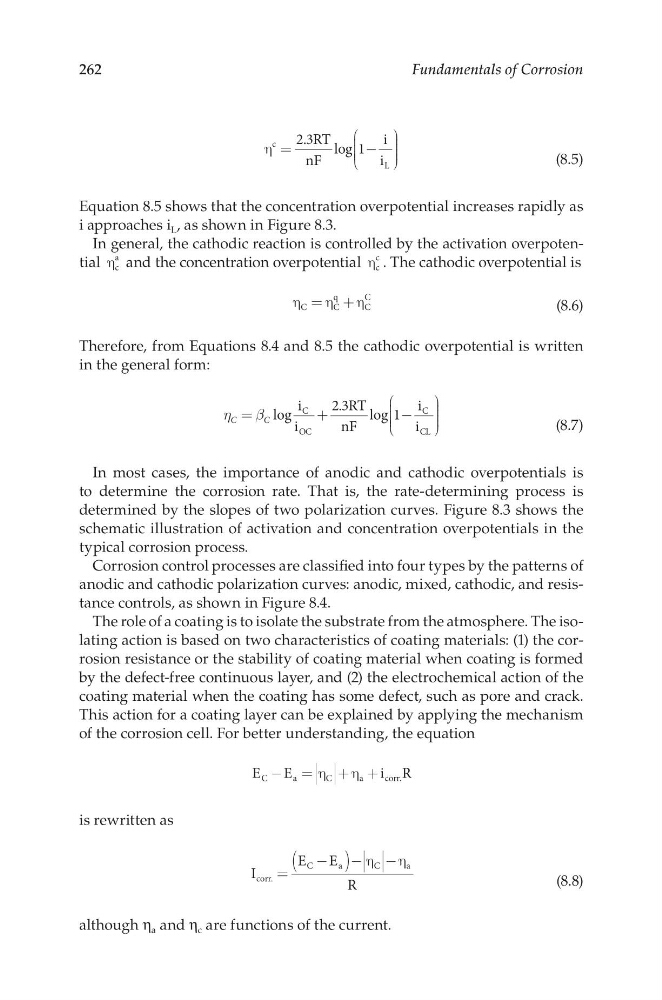
Equation 8.5 shows that the concentration overpotential increases rapidly as
i approaches i L , as shown in Figure 8.3.
In general, the cathodic reaction is controlled by the activation overpotential η c
a and the concentration overpotential η c
c . The cathodic overpotential is
η
η
η
C
C
q
C
C
= +
(8.6)
Therefore, from Equations 8.4 and 8.5 the cathodic overpotential is written
in the general form:
η
β
C
C
=
+
−
log
.
log
i
i
RT
nF
i
i
C
OC
C
CL
2 3
1
(8.7)
In most cases, the importance of anodic and cathodic overpotentials is
to determine the corrosion rate. That is, the rate-determining process is
determined by the slopes of two polarization curves. Figure 8.3 shows the
schematic illustration of activation and concentration overpotentials in the
typical corrosion process.
Corrosion control processes are classified into four types by the patterns of
anodic and cathodic polarization curves: anodic, mixed, cathodic, and resistance controls, as shown in Figure 8.4.
The role of a coating is to isolate the substrate from the atmosphere. The isolating action is based on two characteristics of coating materials: (1) the corrosion resistance or the stability of coating material when coating is formed
by the defect-free continuous layer, and (2) the electrochemical action of the
coating material when the coating has some defect, such as pore and crack.
This action for a coating layer can be explained by applying the mechanism
of the corrosion cell. For better understanding, the equation
E
E
C
a
C
a
− =
+ +
η
η i R
corr.
is rewritten as
I corr. =
−
(
) − −
E
E
R
C
a
C
a
η
η
(8.8)
although η a and η c are functions of the current.
Fundamentals of Corrosion
η
c
=
−
2 3
1
.
log
RT
nF
i
i L
(8.5)
Equation 8.5 shows that the concentration overpotential increases rapidly as
i approaches i L , as shown in Figure 8.3.
In general, the cathodic reaction is controlled by the activation overpotential η c
a and the concentration overpotential η c
c . The cathodic overpotential is
η
η
η
C
C
q
C
C
= +
(8.6)
Therefore, from Equations 8.4 and 8.5 the cathodic overpotential is written
in the general form:
η
β
C
C
=
+
−
log
.
log
i
i
RT
nF
i
i
C
OC
C
CL
2 3
1
(8.7)
In most cases, the importance of anodic and cathodic overpotentials is
to determine the corrosion rate. That is, the rate-determining process is
determined by the slopes of two polarization curves. Figure 8.3 shows the
schematic illustration of activation and concentration overpotentials in the
typical corrosion process.
Corrosion control processes are classified into four types by the patterns of
anodic and cathodic polarization curves: anodic, mixed, cathodic, and resistance controls, as shown in Figure 8.4.
The role of a coating is to isolate the substrate from the atmosphere. The isolating action is based on two characteristics of coating materials: (1) the corrosion resistance or the stability of coating material when coating is formed
by the defect-free continuous layer, and (2) the electrochemical action of the
coating material when the coating has some defect, such as pore and crack.
This action for a coating layer can be explained by applying the mechanism
of the corrosion cell. For better understanding, the equation
E
E
C
a
C
a
− =
+ +
η
η i R
corr.
is rewritten as
I corr. =
−
(
) − −
E
E
R
C
a
C
a
η
η
(8.8)
although η a and η c are functions of the current.