

260
Fundamentals of Corrosion
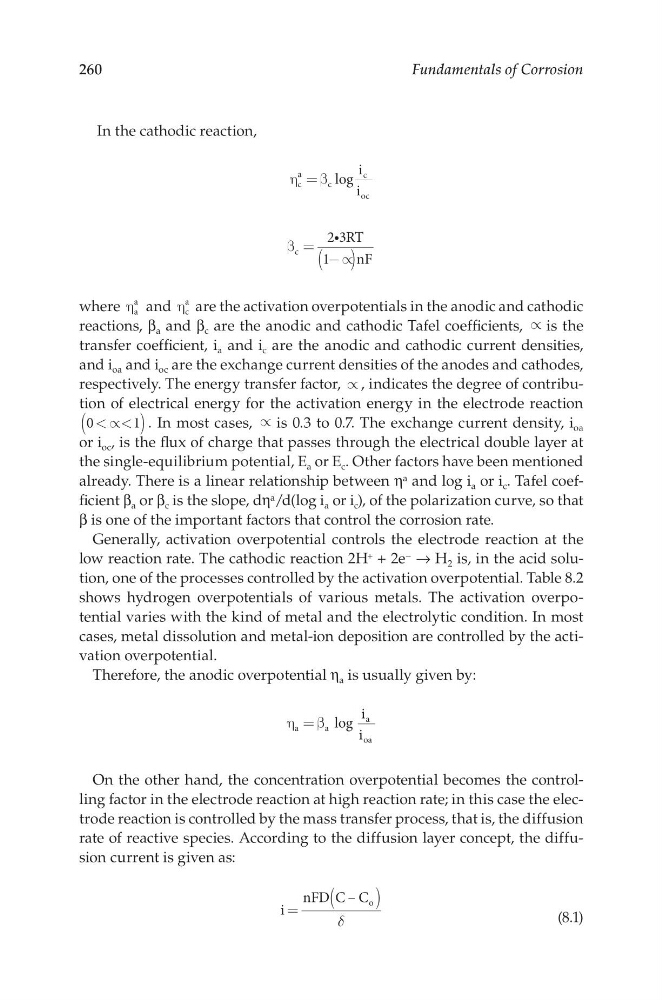
In the cathodic reaction,
η
β
c
a
c
= log
i
i
c
oc
β c = − ∝
( )
2 3
1
i RT
nF
where η a
a and η c
a are the activation overpotentials in the anodic and cathodic
reactions, β a and β c are the anodic and cathodic Tafel coefficients, ∝ is the
transfer coefficient, i a and i c are the anodic and cathodic current densities,
and i oa and i oc are the exchange current densities of the anodes and cathodes,
respectively. The energy transfer factor, ∝ , indicates the degree of contribution of electrical energy for the activation energy in the electrode reaction
0
1
< ∝<
(
)
. In most cases, ∝ is 0.3 to 0.7. The exchange current density, i oa
or i oc , is the flux of charge that passes through the electrical double layer at
the single-equilibrium potential, E a or E c . Other factors have been mentioned
already. There is a linear relationship between η a and log i a or i c . Tafel coefficient β a or β c is the slope, dη a /d(log i a or i c ), of the polarization curve, so that
β is one of the important factors that control the corrosion rate.
Generally, activation overpotential controls the electrode reaction at the
low reaction rate. The cathodic reaction 2H + + 2e − → H 2 is, in the acid solution, one of the processes controlled by the activation overpotential. Table 8.2
shows hydrogen overpotentials of various metals. The activation overpotential varies with the kind of metal and the electrolytic condition. In most
cases, metal dissolution and metal-ion deposition are controlled by the activation overpotential.
Therefore, the anodic overpotential η a is usually given by:
η
β
a
a
= log
i
i
a
oa
On the other hand, the concentration overpotential becomes the controlling factor in the electrode reaction at high reaction rate; in this case the electrode reaction is controlled by the mass transfer process, that is, the diffusion
rate of reactive species. According to the diffusion layer concept, the diffusion current is given as:
i
nFD C – C o
=
(
)
δ
(8.1)
Fundamentals of Corrosion
In the cathodic reaction,
η
β
c
a
c
= log
i
i
c
oc
β c = − ∝
( )
2 3
1
i RT
nF
where η a
a and η c
a are the activation overpotentials in the anodic and cathodic
reactions, β a and β c are the anodic and cathodic Tafel coefficients, ∝ is the
transfer coefficient, i a and i c are the anodic and cathodic current densities,
and i oa and i oc are the exchange current densities of the anodes and cathodes,
respectively. The energy transfer factor, ∝ , indicates the degree of contribution of electrical energy for the activation energy in the electrode reaction
0
1
< ∝<
(
)
. In most cases, ∝ is 0.3 to 0.7. The exchange current density, i oa
or i oc , is the flux of charge that passes through the electrical double layer at
the single-equilibrium potential, E a or E c . Other factors have been mentioned
already. There is a linear relationship between η a and log i a or i c . Tafel coefficient β a or β c is the slope, dη a /d(log i a or i c ), of the polarization curve, so that
β is one of the important factors that control the corrosion rate.
Generally, activation overpotential controls the electrode reaction at the
low reaction rate. The cathodic reaction 2H + + 2e − → H 2 is, in the acid solution, one of the processes controlled by the activation overpotential. Table 8.2
shows hydrogen overpotentials of various metals. The activation overpotential varies with the kind of metal and the electrolytic condition. In most
cases, metal dissolution and metal-ion deposition are controlled by the activation overpotential.
Therefore, the anodic overpotential η a is usually given by:
η
β
a
a
= log
i
i
a
oa
On the other hand, the concentration overpotential becomes the controlling factor in the electrode reaction at high reaction rate; in this case the electrode reaction is controlled by the mass transfer process, that is, the diffusion
rate of reactive species. According to the diffusion layer concept, the diffusion current is given as:
i
nFD C – C o
=
(
)
δ
(8.1)