

238
Fundamentals of Corrosion
7.7.3 Curing
For a coating to be effective, it must be properly cured. Unless this is allowed
to take place, the coating will not provide the protection required nor have
the expected lifetime.
Most organic resins are liquid, which cure or dry to form solid films. They
are classified as thermoplastic or thermosetting. Thermoplastic resins dry by
solvent evaporation and will soften when heated and harden when cooled.
Thermosetting resins will not soften when heated after they are cured. Most
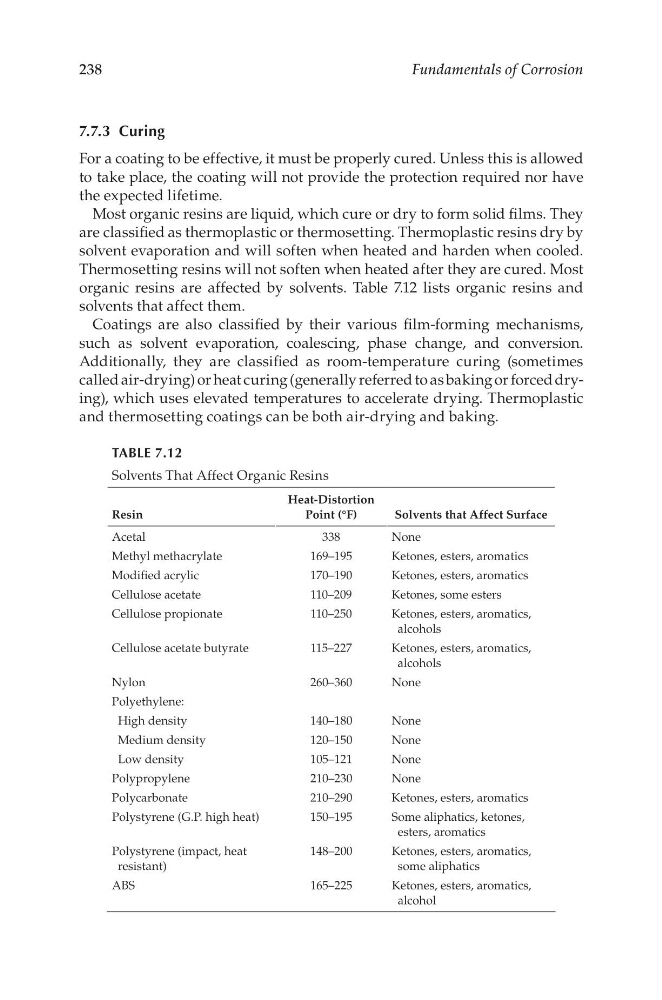
organic resins are affected by solvents. Table 7.12 lists organic resins and
solvents that affect them.
Coatings are also classified by their various film-forming mechanisms,
such as solvent evaporation, coalescing, phase change, and conversion.
Additionally, they are classified as room-temperature curing (sometimes
called air-drying) or heat curing (generally referred to as baking or forced drying), which uses elevated temperatures to accelerate drying. Thermoplastic
and thermosetting coatings can be both air-drying and baking.
TabLE 7.12
Solvents That Affect Organic Resins
Resin
Heat-Distortion
Point (°F)
Solvents that Affect Surface
Acetal
338
None
Methyl methacrylate
169–195
Ketones, esters, aromatics
Modified acrylic
170–190
Ketones, esters, aromatics
Cellulose acetate
110–209
Ketones, some esters
Cellulose propionate
110–250
Ketones, esters, aromatics,
alcohols
Cellulose acetate butyrate
115–227
Ketones, esters, aromatics,
alcohols
Nylon
260–360
None
Polyethylene:
High density
140–180
None
Medium density
120–150
None
Low density
105–121
None
Polypropylene
210–230
None
Polycarbonate
210–290
Ketones, esters, aromatics
Polystyrene (G.P. high heat)
150–195
Some aliphatics, ketones,
esters, aromatics
Polystyrene (impact, heat
resistant)
148–200
Ketones, esters, aromatics,
some aliphatics
ABS
165–225
Ketones, esters, aromatics,
alcohol
Fundamentals of Corrosion
7.7.3 Curing
For a coating to be effective, it must be properly cured. Unless this is allowed
to take place, the coating will not provide the protection required nor have
the expected lifetime.
Most organic resins are liquid, which cure or dry to form solid films. They
are classified as thermoplastic or thermosetting. Thermoplastic resins dry by
solvent evaporation and will soften when heated and harden when cooled.
Thermosetting resins will not soften when heated after they are cured. Most
organic resins are affected by solvents. Table 7.12 lists organic resins and
solvents that affect them.
Coatings are also classified by their various film-forming mechanisms,
such as solvent evaporation, coalescing, phase change, and conversion.
Additionally, they are classified as room-temperature curing (sometimes
called air-drying) or heat curing (generally referred to as baking or forced drying), which uses elevated temperatures to accelerate drying. Thermoplastic
and thermosetting coatings can be both air-drying and baking.
TabLE 7.12
Solvents That Affect Organic Resins
Resin
Heat-Distortion
Point (°F)
Solvents that Affect Surface
Acetal
338
None
Methyl methacrylate
169–195
Ketones, esters, aromatics
Modified acrylic
170–190
Ketones, esters, aromatics
Cellulose acetate
110–209
Ketones, some esters
Cellulose propionate
110–250
Ketones, esters, aromatics,
alcohols
Cellulose acetate butyrate
115–227
Ketones, esters, aromatics,
alcohols
Nylon
260–360
None
Polyethylene:
High density
140–180
None
Medium density
120–150
None
Low density
105–121
None
Polypropylene
210–230
None
Polycarbonate
210–290
Ketones, esters, aromatics
Polystyrene (G.P. high heat)
150–195
Some aliphatics, ketones,
esters, aromatics
Polystyrene (impact, heat
resistant)
148–200
Ketones, esters, aromatics,
some aliphatics
ABS
165–225
Ketones, esters, aromatics,
alcohol