

228
Fundamentals of Corrosion
Sodium etch.
•
Highly reactive chemicals must be used to etch difficult
surfaces to coat as the various fluoroplastics and some thermoplastic polyesters. A typical solution used contains 2 to 4 parts metallic
sodium dispersed in a mixture of 10 to 12 parts naphthalene and 85
to 87 parts tetrahydrofuran.
Immersion time is 15 min at ambient temperatures, followed by a thorough rinsing with a kerosene solvent and rinsing with water.
Sodium hydroxide etch.
•
Thermoplastic polyesters, polyamides, and
polysulfone can be effectively treated using a mixture of 20 parts by
weight of sodium hydroxide and 80 parts by weight of water. The
plastic is immersed in the 175 to 200°F (24 to 93°C) bath for a period
of 2 to 10 min.
Satinizing.
•
DuPont developed this process for the treatment of its
homo-polymer-grade acetal (U.S. Patent 3,235,426). A heated solution
of dioxane, para-toluene sulfonic acid, perchlorethylene, and a thickening agent is prepared, into which parts are dipped. After the dip
cycle, parts are heat-treated, rinsed, and dried in accordance with a
prescribed procedure.
Phenol etch.
•
An 80% solution of phenol is used to etch nylon. The
solution is brushed onto the surface at room temperature and then
allowed to dry for approximately 20 min at 150°F (66°C).
Sodium hypochlorite etch.
•
The newer thermoplastic rubbers and several of the thermoplastic polymers can be chlorinated on the surface
by applying the following solution (parts by weight):
15% sodium hypochlorite
2–3 parts by weight
Concentrated hydrochloric acid
1–2 parts by weight
Water
95–97 parts by weight
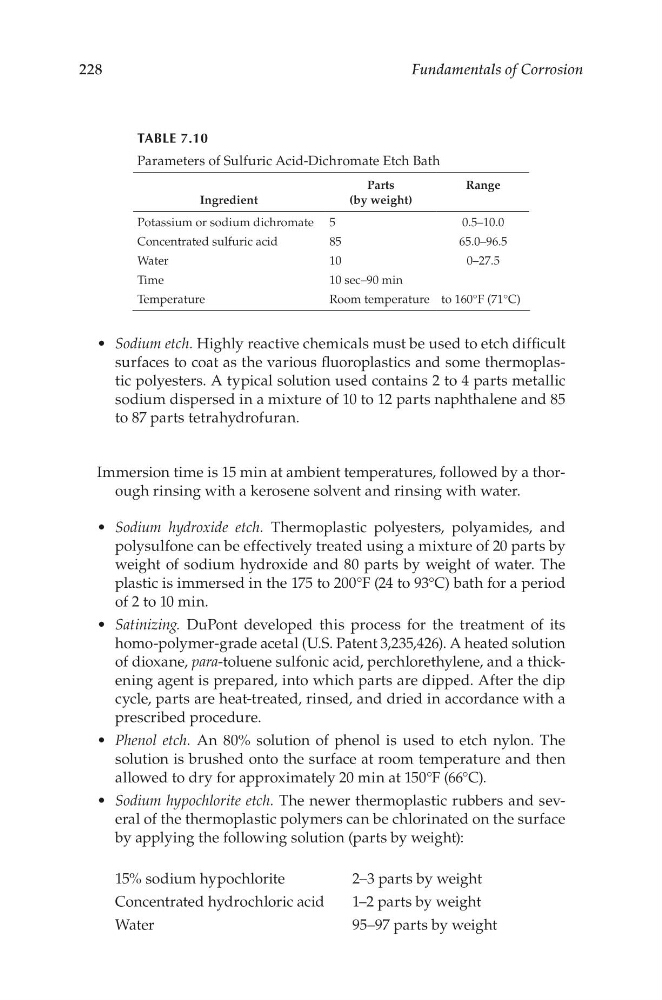
TabLE 7.10
Parameters of Sulfuric Acid-Dichromate Etch Bath
Ingredient
Parts
(by weight)
Range
Potassium or sodium dichromate 5
0.5–10.0
Concentrated sulfuric acid
85
65.0–96.5
Water
10
0–27.5
Time
10 sec–90 min
Temperature
Room temperature to 160°F (71°C)
Fundamentals of Corrosion
Sodium etch.
•
Highly reactive chemicals must be used to etch difficult
surfaces to coat as the various fluoroplastics and some thermoplastic polyesters. A typical solution used contains 2 to 4 parts metallic
sodium dispersed in a mixture of 10 to 12 parts naphthalene and 85
to 87 parts tetrahydrofuran.
Immersion time is 15 min at ambient temperatures, followed by a thorough rinsing with a kerosene solvent and rinsing with water.
Sodium hydroxide etch.
•
Thermoplastic polyesters, polyamides, and
polysulfone can be effectively treated using a mixture of 20 parts by
weight of sodium hydroxide and 80 parts by weight of water. The
plastic is immersed in the 175 to 200°F (24 to 93°C) bath for a period
of 2 to 10 min.
Satinizing.
•
DuPont developed this process for the treatment of its
homo-polymer-grade acetal (U.S. Patent 3,235,426). A heated solution
of dioxane, para-toluene sulfonic acid, perchlorethylene, and a thickening agent is prepared, into which parts are dipped. After the dip
cycle, parts are heat-treated, rinsed, and dried in accordance with a
prescribed procedure.
Phenol etch.
•
An 80% solution of phenol is used to etch nylon. The
solution is brushed onto the surface at room temperature and then
allowed to dry for approximately 20 min at 150°F (66°C).
Sodium hypochlorite etch.
•
The newer thermoplastic rubbers and several of the thermoplastic polymers can be chlorinated on the surface
by applying the following solution (parts by weight):
15% sodium hypochlorite
2–3 parts by weight
Concentrated hydrochloric acid
1–2 parts by weight
Water
95–97 parts by weight
TabLE 7.10
Parameters of Sulfuric Acid-Dichromate Etch Bath
Ingredient
Parts
(by weight)
Range
Potassium or sodium dichromate 5
0.5–10.0
Concentrated sulfuric acid
85
65.0–96.5
Water
10
0–27.5
Time
10 sec–90 min
Temperature
Room temperature to 160°F (71°C)