

Corrosion of Paint
221
Oily soils must be removed before any other surface preparation is undertaken. Otherwise these soils might spread over the surface. These soils
can also contaminate abrasive cleaning media and tools. Oily soils can be
removed faster using liquid cleaners that impinge on the surface or in agitation immersion baths. It is often necessary to heat liquid cleaners to facilitate
soil removal.
Coating application, in the most basic terms, is the preparation of the surface to receive the paint and the application of the paint in the proper manner
to the specified thickness. The surface preparation specified is predicated by
the coating system to be applied. It is usually a good idea to specify a “standard” surface preparation method. The most common standard methods are
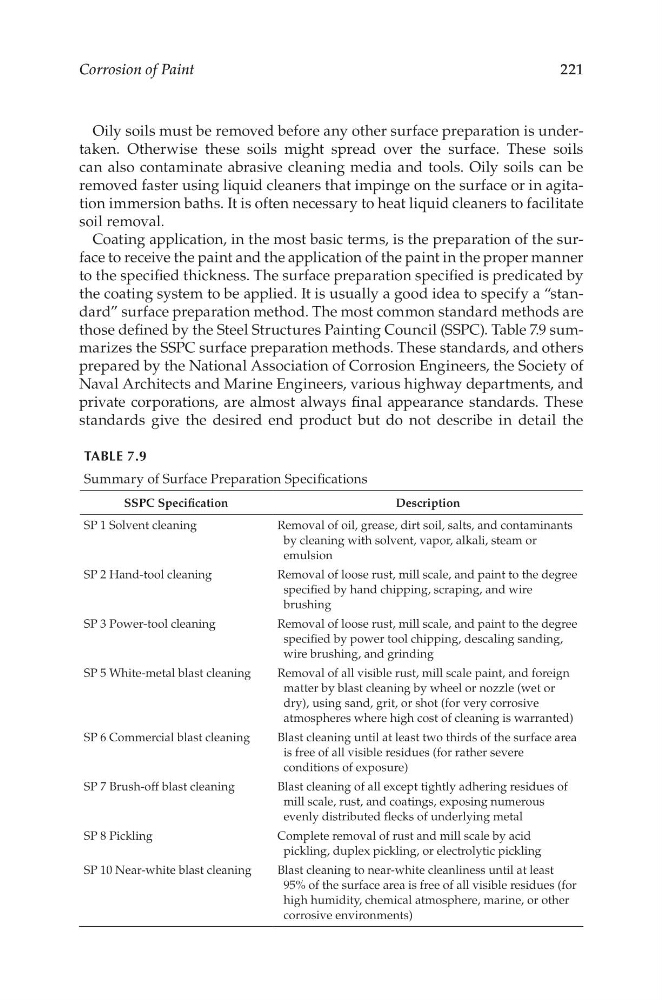
those defined by the Steel Structures Painting Council (SSPC). Table 7.9 summarizes the SSPC surface preparation methods. These standards, and others
prepared by the National Association of Corrosion Engineers, the Society of
Naval Architects and Marine Engineers, various highway departments, and
private corporations, are almost always final appearance standards. These
standards give the desired end product but do not describe in detail the
TabLE 7.9
Summary of Surface Preparation Specifications
SSPC Specification
Description
SP 1 Solvent cleaning
Removal of oil, grease, dirt soil, salts, and contaminants
by cleaning with solvent, vapor, alkali, steam or
emulsion
SP 2 Hand-tool cleaning
Removal of loose rust, mill scale, and paint to the degree
specified by hand chipping, scraping, and wire
brushing
SP 3 Power-tool cleaning
Removal of loose rust, mill scale, and paint to the degree
specified by power tool chipping, descaling sanding,
wire brushing, and grinding
SP 5 White-metal blast cleaning
Removal of all visible rust, mill scale paint, and foreign
matter by blast cleaning by wheel or nozzle (wet or
dry), using sand, grit, or shot (for very corrosive
atmospheres where high cost of cleaning is warranted)
SP 6 Commercial blast cleaning
Blast cleaning until at least two thirds of the surface area
is free of all visible residues (for rather severe
conditions of exposure)
SP 7 Brush-off blast cleaning
Blast cleaning of all except tightly adhering residues of
mill scale, rust, and coatings, exposing numerous
evenly distributed flecks of underlying metal
SP 8 Pickling
Complete removal of rust and mill scale by acid
pickling, duplex pickling, or electrolytic pickling
SP 10 Near-white blast cleaning
Blast cleaning to near-white cleanliness until at least
95% of the surface area is free of all visible residues (for
high humidity, chemical atmosphere, marine, or other
corrosive environments)
221
Oily soils must be removed before any other surface preparation is undertaken. Otherwise these soils might spread over the surface. These soils
can also contaminate abrasive cleaning media and tools. Oily soils can be
removed faster using liquid cleaners that impinge on the surface or in agitation immersion baths. It is often necessary to heat liquid cleaners to facilitate
soil removal.
Coating application, in the most basic terms, is the preparation of the surface to receive the paint and the application of the paint in the proper manner
to the specified thickness. The surface preparation specified is predicated by
the coating system to be applied. It is usually a good idea to specify a “standard” surface preparation method. The most common standard methods are
those defined by the Steel Structures Painting Council (SSPC). Table 7.9 summarizes the SSPC surface preparation methods. These standards, and others
prepared by the National Association of Corrosion Engineers, the Society of
Naval Architects and Marine Engineers, various highway departments, and
private corporations, are almost always final appearance standards. These
standards give the desired end product but do not describe in detail the
TabLE 7.9
Summary of Surface Preparation Specifications
SSPC Specification
Description
SP 1 Solvent cleaning
Removal of oil, grease, dirt soil, salts, and contaminants
by cleaning with solvent, vapor, alkali, steam or
emulsion
SP 2 Hand-tool cleaning
Removal of loose rust, mill scale, and paint to the degree
specified by hand chipping, scraping, and wire
brushing
SP 3 Power-tool cleaning
Removal of loose rust, mill scale, and paint to the degree
specified by power tool chipping, descaling sanding,
wire brushing, and grinding
SP 5 White-metal blast cleaning
Removal of all visible rust, mill scale paint, and foreign
matter by blast cleaning by wheel or nozzle (wet or
dry), using sand, grit, or shot (for very corrosive
atmospheres where high cost of cleaning is warranted)
SP 6 Commercial blast cleaning
Blast cleaning until at least two thirds of the surface area
is free of all visible residues (for rather severe
conditions of exposure)
SP 7 Brush-off blast cleaning
Blast cleaning of all except tightly adhering residues of
mill scale, rust, and coatings, exposing numerous
evenly distributed flecks of underlying metal
SP 8 Pickling
Complete removal of rust and mill scale by acid
pickling, duplex pickling, or electrolytic pickling
SP 10 Near-white blast cleaning
Blast cleaning to near-white cleanliness until at least
95% of the surface area is free of all visible residues (for
high humidity, chemical atmosphere, marine, or other
corrosive environments)