

208
Fundamentals of Corrosion
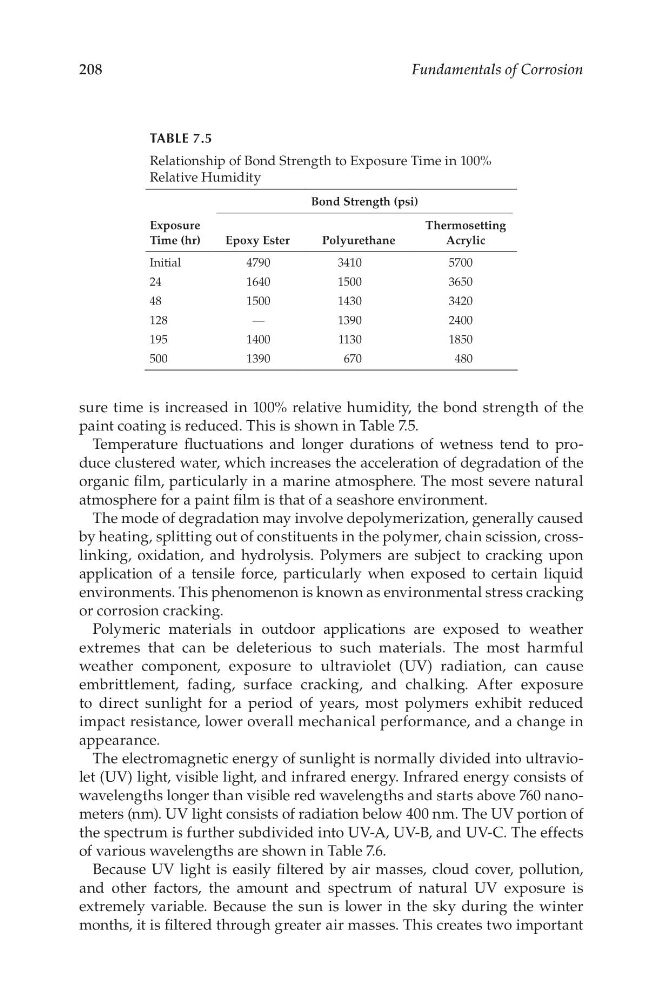
sure time is increased in 100% relative humidity, the bond strength of the
paint coating is reduced. This is shown in Table 7.5.
Temperature fluctuations and longer durations of wetness tend to produce clustered water, which increases the acceleration of degradation of the
organic film, particularly in a marine atmosphere. The most severe natural
atmosphere for a paint film is that of a seashore environment.
The mode of degradation may involve depolymerization, generally caused
by heating, splitting out of constituents in the polymer, chain scission, crosslinking, oxidation, and hydrolysis. Polymers are subject to cracking upon
application of a tensile force, particularly when exposed to certain liquid
environments. This phenomenon is known as environmental stress cracking
or corrosion cracking.
Polymeric materials in outdoor applications are exposed to weather
extremes that can be deleterious to such materials. The most harmful
weather component, exposure to ultraviolet (UV) radiation, can cause
embrittlement, fading, surface cracking, and chalking. After exposure
to direct sunlight for a period of years, most polymers exhibit reduced
impact resistance, lower overall mechanical performance, and a change in
appearance.
The electromagnetic energy of sunlight is normally divided into ultraviolet (UV) light, visible light, and infrared energy. Infrared energy consists of
wavelengths longer than visible red wavelengths and starts above 760 nanometers (nm). UV light consists of radiation below 400 nm. The UV portion of
the spectrum is further subdivided into UV-A, UV-B, and UV-C. The effects
of various wavelengths are shown in Table 7.6.
Because UV light is easily filtered by air masses, cloud cover, pollution,
and other factors, the amount and spectrum of natural UV exposure is
extremely variable. Because the sun is lower in the sky during the winter
months, it is filtered through greater air masses. This creates two important
TabLE 7.5
Relationship of Bond Strength to Exposure Time in 100%
Relative Humidity
Exposure
Time (hr)
Bond Strength (psi)
Epoxy Ester
Polyurethane
Thermosetting
Acrylic
Initial
4790
3410
5700
24
1640
1500
3650
48
1500
1430
3420
128
—
1390
2400
195
1400
1130
1850
500
1390
670
480
Fundamentals of Corrosion
sure time is increased in 100% relative humidity, the bond strength of the
paint coating is reduced. This is shown in Table 7.5.
Temperature fluctuations and longer durations of wetness tend to produce clustered water, which increases the acceleration of degradation of the
organic film, particularly in a marine atmosphere. The most severe natural
atmosphere for a paint film is that of a seashore environment.
The mode of degradation may involve depolymerization, generally caused
by heating, splitting out of constituents in the polymer, chain scission, crosslinking, oxidation, and hydrolysis. Polymers are subject to cracking upon
application of a tensile force, particularly when exposed to certain liquid
environments. This phenomenon is known as environmental stress cracking
or corrosion cracking.
Polymeric materials in outdoor applications are exposed to weather
extremes that can be deleterious to such materials. The most harmful
weather component, exposure to ultraviolet (UV) radiation, can cause
embrittlement, fading, surface cracking, and chalking. After exposure
to direct sunlight for a period of years, most polymers exhibit reduced
impact resistance, lower overall mechanical performance, and a change in
appearance.
The electromagnetic energy of sunlight is normally divided into ultraviolet (UV) light, visible light, and infrared energy. Infrared energy consists of
wavelengths longer than visible red wavelengths and starts above 760 nanometers (nm). UV light consists of radiation below 400 nm. The UV portion of
the spectrum is further subdivided into UV-A, UV-B, and UV-C. The effects
of various wavelengths are shown in Table 7.6.
Because UV light is easily filtered by air masses, cloud cover, pollution,
and other factors, the amount and spectrum of natural UV exposure is
extremely variable. Because the sun is lower in the sky during the winter
months, it is filtered through greater air masses. This creates two important
TabLE 7.5
Relationship of Bond Strength to Exposure Time in 100%
Relative Humidity
Exposure
Time (hr)
Bond Strength (psi)
Epoxy Ester
Polyurethane
Thermosetting
Acrylic
Initial
4790
3410
5700
24
1640
1500
3650
48
1500
1430
3420
128
—
1390
2400
195
1400
1130
1850
500
1390
670
480