

Corrosion of Paint
199
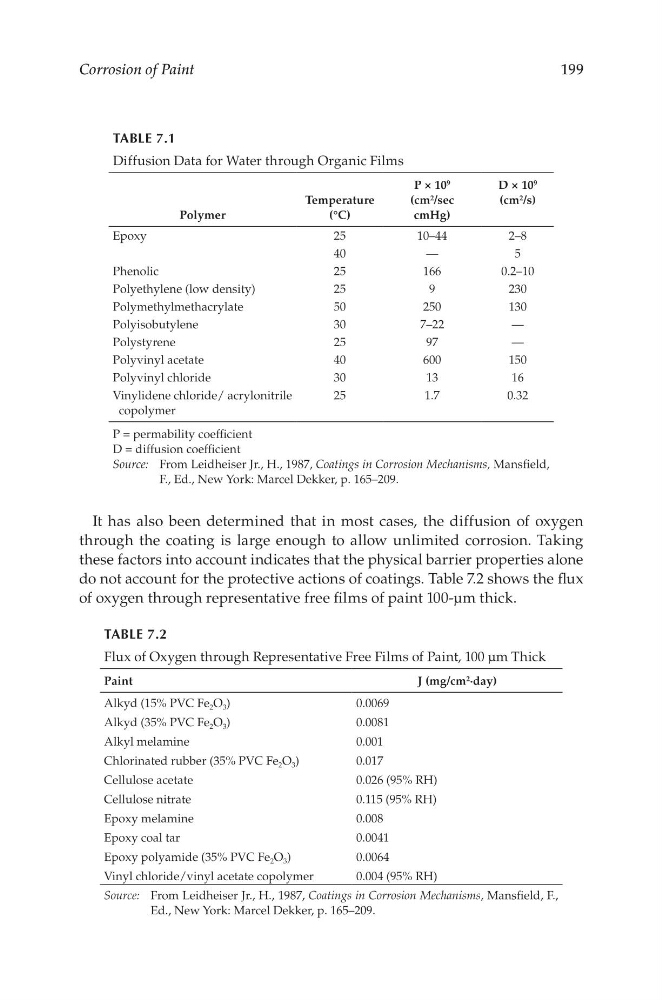
It has also been determined that in most cases, the diffusion of oxygen
through the coating is large enough to allow unlimited corrosion. Taking
these factors into account indicates that the physical barrier properties alone
do not account for the protective actions of coatings. Table 7.2 shows the flux
of oxygen through representative free films of paint 100-μm thick.
TabLE 7.1
Diffusion Data for Water through Organic Films
Polymer
Temperature
(°C)
P × 10 9
(cm 2 /sec
cmHg)
D × 10 9
(cm 2 /s)
Epoxy
25
10–44
2–8
40
—
5
Phenolic
25
166
0.2–10
Polyethylene (low density)
25
9
230
Polymethylmethacrylate
50
250
130
Polyisobutylene
30
7–22
—
Polystyrene
25
97
—
Polyvinyl acetate
40
600
150
Polyvinyl chloride
30
13
16
Vinylidene chloride/ acrylonitrile
copolymer
25
1.7
0.32
P = permability coefficient
D = diffusion coefficient
Source: From Leidheiser Jr., H., 1987, Coatings in Corrosion Mechanisms, Mansfield,
F., Ed., New York: Marcel Dekker, p. 165–209.
TabLE 7.2
Flux of Oxygen through Representative Free Films of Paint, 100 µm Thick
Paint
J (mg/cm 2 ·day)
Alkyd (15% PVC Fe 2 O 3 )
0.0069
Alkyd (35% PVC Fe 2 O 3 )
0.0081
Alkyl melamine
0.001
Chlorinated rubber (35% PVC Fe 2 O 3 )
0.017
Cellulose acetate
0.026 (95% RH)
Cellulose nitrate
0.115 (95% RH)
Epoxy melamine
0.008
Epoxy coal tar
0.0041
Epoxy polyamide (35% PVC Fe 2 O 3 )
0.0064
Vinyl chloride/vinyl acetate copolymer
0.004 (95% RH)
Source: From Leidheiser Jr., H., 1987, Coatings in Corrosion Mechanisms, Mansfield, F.,
Ed., New York: Marcel Dekker, p. 165–209.
199
It has also been determined that in most cases, the diffusion of oxygen
through the coating is large enough to allow unlimited corrosion. Taking
these factors into account indicates that the physical barrier properties alone
do not account for the protective actions of coatings. Table 7.2 shows the flux
of oxygen through representative free films of paint 100-μm thick.
TabLE 7.1
Diffusion Data for Water through Organic Films
Polymer
Temperature
(°C)
P × 10 9
(cm 2 /sec
cmHg)
D × 10 9
(cm 2 /s)
Epoxy
25
10–44
2–8
40
—
5
Phenolic
25
166
0.2–10
Polyethylene (low density)
25
9
230
Polymethylmethacrylate
50
250
130
Polyisobutylene
30
7–22
—
Polystyrene
25
97
—
Polyvinyl acetate
40
600
150
Polyvinyl chloride
30
13
16
Vinylidene chloride/ acrylonitrile
copolymer
25
1.7
0.32
P = permability coefficient
D = diffusion coefficient
Source: From Leidheiser Jr., H., 1987, Coatings in Corrosion Mechanisms, Mansfield,
F., Ed., New York: Marcel Dekker, p. 165–209.
TabLE 7.2
Flux of Oxygen through Representative Free Films of Paint, 100 µm Thick
Paint
J (mg/cm 2 ·day)
Alkyd (15% PVC Fe 2 O 3 )
0.0069
Alkyd (35% PVC Fe 2 O 3 )
0.0081
Alkyl melamine
0.001
Chlorinated rubber (35% PVC Fe 2 O 3 )
0.017
Cellulose acetate
0.026 (95% RH)
Cellulose nitrate
0.115 (95% RH)
Epoxy melamine
0.008
Epoxy coal tar
0.0041
Epoxy polyamide (35% PVC Fe 2 O 3 )
0.0064
Vinyl chloride/vinyl acetate copolymer
0.004 (95% RH)
Source: From Leidheiser Jr., H., 1987, Coatings in Corrosion Mechanisms, Mansfield, F.,
Ed., New York: Marcel Dekker, p. 165–209.