

190
Fundamentals of Corrosion
The magnitude of any of the effects will be a function of the combination of
permeant and polymer in actual service.
6.2.3.2 Absorption
Polymers have the potential to absorb varying amounts of corrodents that
they come in contact with, particularly organic liquids. This can result in
swelling, cracking, and penetration to the substrate. Swelling can cause softening of the polymer, introduce high stresses, and precipitate failure of the
bond. If the polymer has a high absorption rate, permeation will probably
take place. An approximation of the expected permeation and/or absorption
of the polymer can be based on the absorption of water. This data is usually
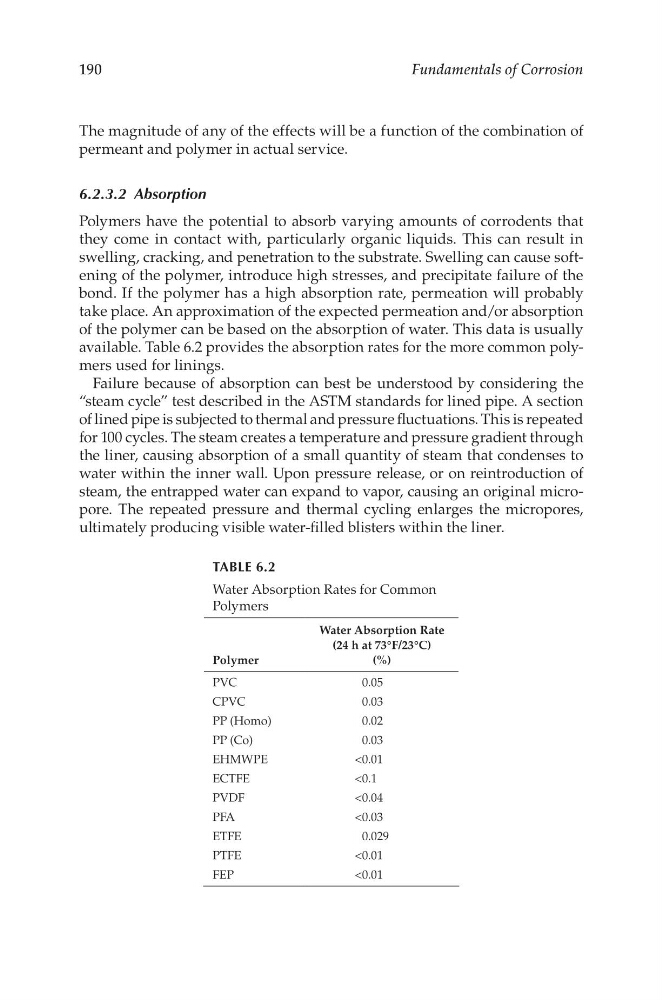
available. Table 6.2 provides the absorption rates for the more common polymers used for linings.
Failure because of absorption can best be understood by considering the
“steam cycle” test described in the ASTM standards for lined pipe. A section
of lined pipe is subjected to thermal and pressure fluctuations. This is repeated
for 100 cycles. The steam creates a temperature and pressure gradient through
the liner, causing absorption of a small quantity of steam that condenses to
water within the inner wall. Upon pressure release, or on reintroduction of
steam, the entrapped water can expand to vapor, causing an original micropore. The repeated pressure and thermal cycling enlarges the micropores,
ultimately producing visible water-filled blisters within the liner.
TabLE 6.2
Water Absorption Rates for Common
Polymers
Polymer
Water Absorption Rate
(24 h at 73°F/23°C)
(%)
PVC
0.05
CPVC
0.03
PP (Homo)
0.02
PP (Co)
0.03
EHMWPE
<0.01
ECTFE
<0.1
PVDF
<0.04
PFA
<0.03
ETFE
0.029
PTFE
<0.01
FEP
<0.01
Fundamentals of Corrosion
The magnitude of any of the effects will be a function of the combination of
permeant and polymer in actual service.
6.2.3.2 Absorption
Polymers have the potential to absorb varying amounts of corrodents that
they come in contact with, particularly organic liquids. This can result in
swelling, cracking, and penetration to the substrate. Swelling can cause softening of the polymer, introduce high stresses, and precipitate failure of the
bond. If the polymer has a high absorption rate, permeation will probably
take place. An approximation of the expected permeation and/or absorption
of the polymer can be based on the absorption of water. This data is usually
available. Table 6.2 provides the absorption rates for the more common polymers used for linings.
Failure because of absorption can best be understood by considering the
“steam cycle” test described in the ASTM standards for lined pipe. A section
of lined pipe is subjected to thermal and pressure fluctuations. This is repeated
for 100 cycles. The steam creates a temperature and pressure gradient through
the liner, causing absorption of a small quantity of steam that condenses to
water within the inner wall. Upon pressure release, or on reintroduction of
steam, the entrapped water can expand to vapor, causing an original micropore. The repeated pressure and thermal cycling enlarges the micropores,
ultimately producing visible water-filled blisters within the liner.
TabLE 6.2
Water Absorption Rates for Common
Polymers
Polymer
Water Absorption Rate
(24 h at 73°F/23°C)
(%)
PVC
0.05
CPVC
0.03
PP (Homo)
0.02
PP (Co)
0.03
EHMWPE
<0.01
ECTFE
<0.1
PVDF
<0.04
PFA
<0.03
ETFE
0.029
PTFE
<0.01
FEP
<0.01