

Corrosion of Linings
187
selected that is experienced and knowledgeable in the handling, welding,
and forming of the specific fluoropolymer sheet.
Special equipment is also required, such as machines that fuse flat sheets
in limited widths into massive sheets, heated forming tools for flanges and
fittings, and forming machines that make heads with a minimum number
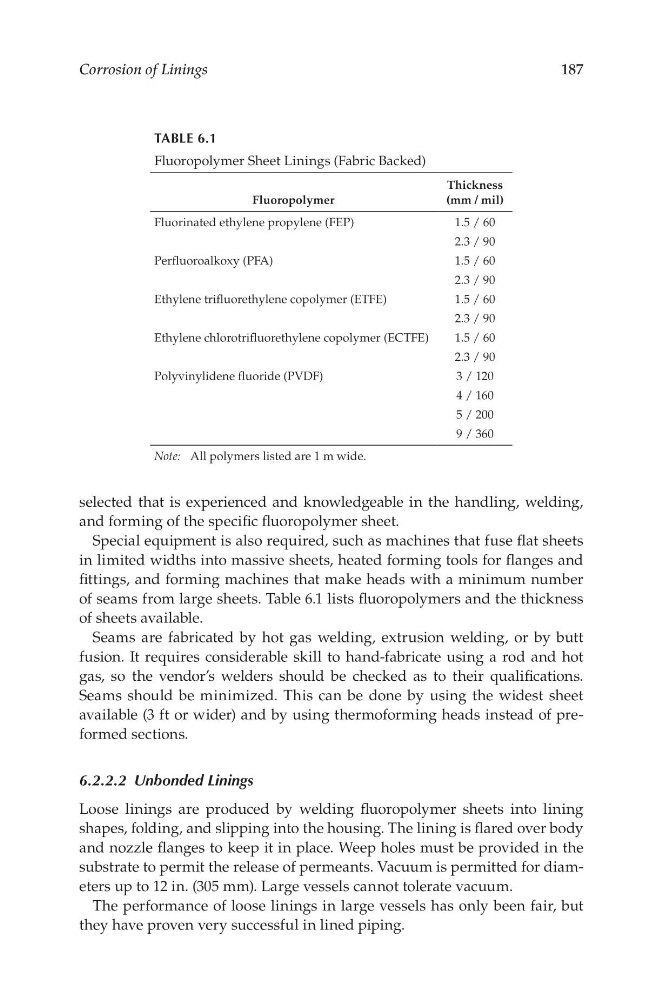
of seams from large sheets. Table 6.1 lists fluoropolymers and the thickness
of sheets available.
Seams are fabricated by hot gas welding, extrusion welding, or by butt
fusion. It requires considerable skill to hand-fabricate using a rod and hot
gas, so the vendor’s welders should be checked as to their qualifications.
Seams should be minimized. This can be done by using the widest sheet
available (3 ft or wider) and by using thermoforming heads instead of preformed sections.
6.2.2.2 Unbonded Linings
Loose linings are produced by welding fluoropolymer sheets into lining
shapes, folding, and slipping into the housing. The lining is flared over body
and nozzle flanges to keep it in place. Weep holes must be provided in the
substrate to permit the release of permeants. Vacuum is permitted for diameters up to 12 in. (305 mm). Large vessels cannot tolerate vacuum.
The performance of loose linings in large vessels has only been fair, but
they have proven very successful in lined piping.
TabLE 6.1
Fluoropolymer Sheet Linings (Fabric Backed)
Fluoropolymer
Thickness
(mm / mil)
Fluorinated ethylene propylene (FEP)
1.5 / 60
2.3 / 90
Perfluoroalkoxy (PFA)
1.5 / 60
2.3 / 90
Ethylene trifluorethylene copolymer (ETFE)
1.5 / 60
2.3 / 90
Ethylene chlorotrifluorethylene copolymer (ECTFE)
1.5 / 60
2.3 / 90
Polyvinylidene fluoride (PVDF)
3 / 120
4 / 160
5 / 200
9 / 360
Note: All polymers listed are 1 m wide.
187
selected that is experienced and knowledgeable in the handling, welding,
and forming of the specific fluoropolymer sheet.
Special equipment is also required, such as machines that fuse flat sheets
in limited widths into massive sheets, heated forming tools for flanges and
fittings, and forming machines that make heads with a minimum number
of seams from large sheets. Table 6.1 lists fluoropolymers and the thickness
of sheets available.
Seams are fabricated by hot gas welding, extrusion welding, or by butt
fusion. It requires considerable skill to hand-fabricate using a rod and hot
gas, so the vendor’s welders should be checked as to their qualifications.
Seams should be minimized. This can be done by using the widest sheet
available (3 ft or wider) and by using thermoforming heads instead of preformed sections.
6.2.2.2 Unbonded Linings
Loose linings are produced by welding fluoropolymer sheets into lining
shapes, folding, and slipping into the housing. The lining is flared over body
and nozzle flanges to keep it in place. Weep holes must be provided in the
substrate to permit the release of permeants. Vacuum is permitted for diameters up to 12 in. (305 mm). Large vessels cannot tolerate vacuum.
The performance of loose linings in large vessels has only been fair, but
they have proven very successful in lined piping.
TabLE 6.1
Fluoropolymer Sheet Linings (Fabric Backed)
Fluoropolymer
Thickness
(mm / mil)
Fluorinated ethylene propylene (FEP)
1.5 / 60
2.3 / 90
Perfluoroalkoxy (PFA)
1.5 / 60
2.3 / 90
Ethylene trifluorethylene copolymer (ETFE)
1.5 / 60
2.3 / 90
Ethylene chlorotrifluorethylene copolymer (ECTFE)
1.5 / 60
2.3 / 90
Polyvinylidene fluoride (PVDF)
3 / 120
4 / 160
5 / 200
9 / 360
Note: All polymers listed are 1 m wide.