

176
Fundamentals of Corrosion
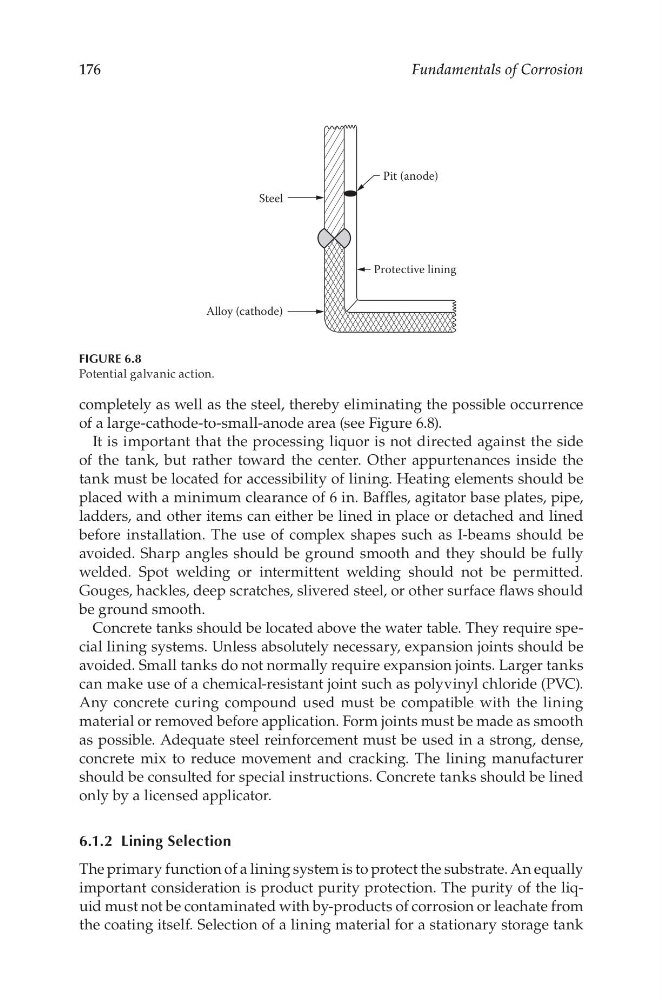
completely as well as the steel, thereby eliminating the possible occurrence
of a large-cathode-to-small-anode area (see Figure 6.8).
It is important that the processing liquor is not directed against the side
of the tank, but rather toward the center. Other appurtenances inside the
tank must be located for accessibility of lining. Heating elements should be
placed with a minimum clearance of 6 in. Baffles, agitator base plates, pipe,
ladders, and other items can either be lined in place or detached and lined
before installation. The use of complex shapes such as I-beams should be
avoided. Sharp angles should be ground smooth and they should be fully
welded. Spot welding or intermittent welding should not be permitted.
Gouges, hackles, deep scratches, slivered steel, or other surface flaws should
be ground smooth.
Concrete tanks should be located above the water table. They require special lining systems. Unless absolutely necessary, expansion joints should be
avoided. Small tanks do not normally require expansion joints. Larger tanks
can make use of a chemical-resistant joint such as polyvinyl chloride (PVC).
Any concrete curing compound used must be compatible with the lining
material or removed before application. Form joints must be made as smooth
as possible. Adequate steel reinforcement must be used in a strong, dense,
concrete mix to reduce movement and cracking. The lining manufacturer
should be consulted for special instructions. Concrete tanks should be lined
only by a licensed applicator.
6.1.2 Lining Selection
The primary function of a lining system is to protect the substrate. An equally
important consideration is product purity protection. The purity of the liquid must not be contaminated with by-products of corrosion or leachate from
the coating itself. Selection of a lining material for a stationary storage tank
Alloy (cathode)
Steel
Pit (anode)
Protective lining
FigurE 6.8
Potential galvanic action.
Fundamentals of Corrosion
completely as well as the steel, thereby eliminating the possible occurrence
of a large-cathode-to-small-anode area (see Figure 6.8).
It is important that the processing liquor is not directed against the side
of the tank, but rather toward the center. Other appurtenances inside the
tank must be located for accessibility of lining. Heating elements should be
placed with a minimum clearance of 6 in. Baffles, agitator base plates, pipe,
ladders, and other items can either be lined in place or detached and lined
before installation. The use of complex shapes such as I-beams should be
avoided. Sharp angles should be ground smooth and they should be fully
welded. Spot welding or intermittent welding should not be permitted.
Gouges, hackles, deep scratches, slivered steel, or other surface flaws should
be ground smooth.
Concrete tanks should be located above the water table. They require special lining systems. Unless absolutely necessary, expansion joints should be
avoided. Small tanks do not normally require expansion joints. Larger tanks
can make use of a chemical-resistant joint such as polyvinyl chloride (PVC).
Any concrete curing compound used must be compatible with the lining
material or removed before application. Form joints must be made as smooth
as possible. Adequate steel reinforcement must be used in a strong, dense,
concrete mix to reduce movement and cracking. The lining manufacturer
should be consulted for special instructions. Concrete tanks should be lined
only by a licensed applicator.
6.1.2 Lining Selection
The primary function of a lining system is to protect the substrate. An equally
important consideration is product purity protection. The purity of the liquid must not be contaminated with by-products of corrosion or leachate from
the coating itself. Selection of a lining material for a stationary storage tank
Alloy (cathode)
Steel
Pit (anode)
Protective lining
FigurE 6.8
Potential galvanic action.