

Corrosion of Polymer (Plastic) Materials
165
The failure due to absorption can best be understood by considering
the “steam cycle” test described in ASTM standards for lined pipe. A section of lined pipe is subjected to thermal and pressure fluctuations. This is
repeated for 100 cycles. The steam creates a temperature and pressure gradient through the liner, causing an absorption of a small quantity of steam,
which condenses to water within the inner wall. Upon pressure release or on
introduction of steam, the entrapped water can expand to vapor, causing an
original micropore. The repeated pressure and thermal cycling enlarges the
pores, ultimately producing visible water-filled blisters within the liner.
In an actual process, the polymer may absorb process fluids, and repeated
temperature or pressure cycling can cause blisters. Eventually, a corrodent
may find its way to the substrate.
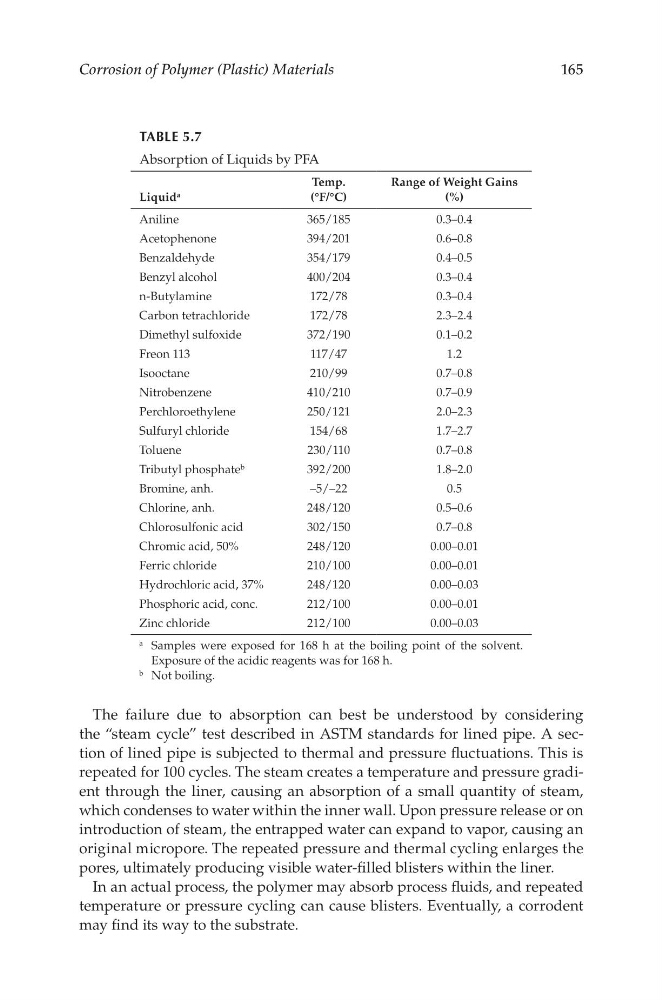
TabLE 5.7
Absorption of Liquids by PFA
Liquid a
Temp.
(°F/°C)
Range of Weight Gains
(%)
Aniline
365/185
0.3–0.4
Acetophenone
394/201
0.6–0.8
Benzaldehyde
354/179
0.4–0.5
Benzyl alcohol
400/204
0.3–0.4
n-Butylamine
172/78
0.3–0.4
Carbon tetrachloride
172/78
2.3–2.4
Dimethyl sulfoxide
372/190
0.1–0.2
Freon 113
117/47
1.2
Isooctane
210/99
0.7–0.8
Nitrobenzene
410/210
0.7–0.9
Perchloroethylene
250/121
2.0–2.3
Sulfuryl chloride
154/68
1.7–2.7
Toluene
230/110
0.7–0.8
Tributyl phosphate b
392/200
1.8–2.0
Bromine, anh.
–5/–22
0.5
Chlorine, anh.
248/120
0.5–0.6
Chlorosulfonic acid
302/150
0.7–0.8
Chromic acid, 50%
248/120
0.00–0.01
Ferric chloride
210/100
0.00–0.01
Hydrochloric acid, 37%
248/120
0.00–0.03
Phosphoric acid, conc.
212/100
0.00–0.01
Zinc chloride
212/100
0.00–0.03
a Samples were exposed for 168 h at the boiling point of the solvent.
Exposure of the acidic reagents was for 168 h.
b Not boiling.
165
The failure due to absorption can best be understood by considering
the “steam cycle” test described in ASTM standards for lined pipe. A section of lined pipe is subjected to thermal and pressure fluctuations. This is
repeated for 100 cycles. The steam creates a temperature and pressure gradient through the liner, causing an absorption of a small quantity of steam,
which condenses to water within the inner wall. Upon pressure release or on
introduction of steam, the entrapped water can expand to vapor, causing an
original micropore. The repeated pressure and thermal cycling enlarges the
pores, ultimately producing visible water-filled blisters within the liner.
In an actual process, the polymer may absorb process fluids, and repeated
temperature or pressure cycling can cause blisters. Eventually, a corrodent
may find its way to the substrate.
TabLE 5.7
Absorption of Liquids by PFA
Liquid a
Temp.
(°F/°C)
Range of Weight Gains
(%)
Aniline
365/185
0.3–0.4
Acetophenone
394/201
0.6–0.8
Benzaldehyde
354/179
0.4–0.5
Benzyl alcohol
400/204
0.3–0.4
n-Butylamine
172/78
0.3–0.4
Carbon tetrachloride
172/78
2.3–2.4
Dimethyl sulfoxide
372/190
0.1–0.2
Freon 113
117/47
1.2
Isooctane
210/99
0.7–0.8
Nitrobenzene
410/210
0.7–0.9
Perchloroethylene
250/121
2.0–2.3
Sulfuryl chloride
154/68
1.7–2.7
Toluene
230/110
0.7–0.8
Tributyl phosphate b
392/200
1.8–2.0
Bromine, anh.
–5/–22
0.5
Chlorine, anh.
248/120
0.5–0.6
Chlorosulfonic acid
302/150
0.7–0.8
Chromic acid, 50%
248/120
0.00–0.01
Ferric chloride
210/100
0.00–0.01
Hydrochloric acid, 37%
248/120
0.00–0.03
Phosphoric acid, conc.
212/100
0.00–0.01
Zinc chloride
212/100
0.00–0.03
a Samples were exposed for 168 h at the boiling point of the solvent.
Exposure of the acidic reagents was for 168 h.
b Not boiling.