

162
Fundamentals of Corrosion
There is no relationship between permeation and the passage of materials
through cracks and voids, although in both cases migrating chemicals travel
through the polymer from one side to the other.
Some control can be exercised over permeation, which is affected by:
1. Temperature and pressure
2. The permeant concentration
3. The thickness of the polymer
Increasing the temperature will increase the permeation rate because the solubility of the permeant in the polymer will increase and, as the temperature
rises, polymer chain movement is stimulated, permitting more permeant to
diffuse among the chains more easily. The permeation rate of many gases
increases linearly with the partial pressure gradient, and the same effect is
experienced with the concentration gradient of liquids. If the permeant is
highly soluble in the polymer, the permeability increases may not be linear. The thickness will generally decrease permeation by the square of the
thickness.
The density of the polymer as well as the thickness will have an effect on
the permeation rate. The greater the density of the polymer, the fewer voids
through which permeation can take place. A comparision of the density of
sheets produced from different polymers does not provide any indication of
the relative permeation rates. However, a comparision of the density of sheets
produced from the same polymer will provide an indication of the relative
permeation rates. The denser the sheet, the lower the permeation rate.
The thickness of a lining affects the permeation rate. For general corrosion
resistance, thicknesses of 0.010 to 0.020 inches are usually satisfactory, depending on the combination of the lining material and the specific corrodent. When
mechanical factors such as thinning to cold flow, mechanical abuse, and permeation rates are a consideration, thicker linings may be required.
Increasing the lining thickness will normally decrease permeation by the
square of the thickness. Although this would appear to be the approach to
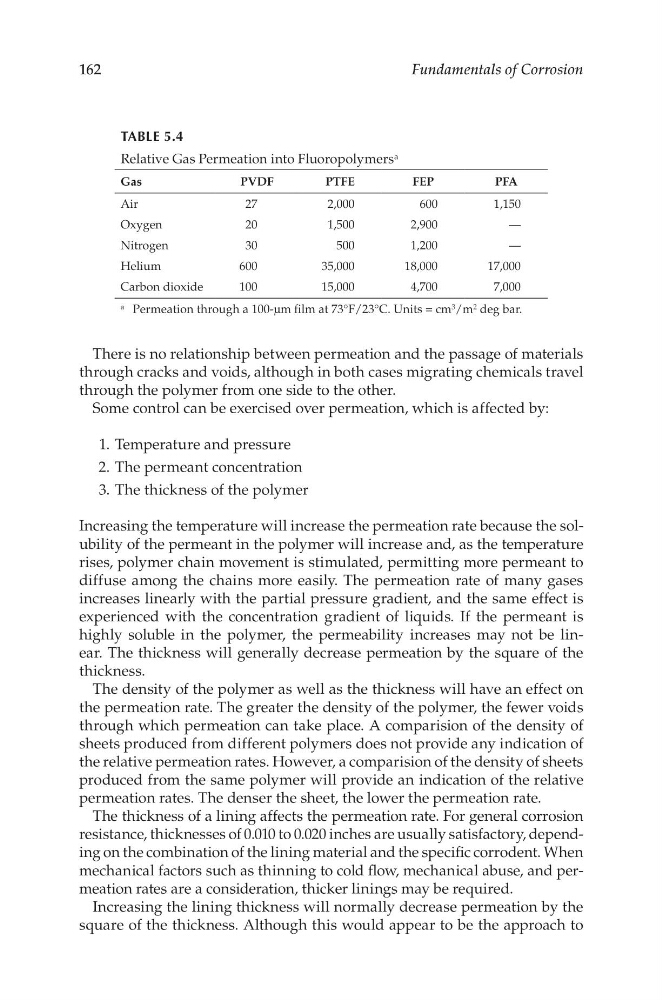
TabLE 5.4
Relative Gas Permeation into Fluoropolymers a
Gas
PVDF
PTFE
FEP
PFA
Air
27
2,000
600
1,150
Oxygen
20
1,500
2,900
—
Nitrogen
30
500
1,200
—
Helium
600
35,000
18,000
17,000
Carbon dioxide
100
15,000
4,700
7,000
a Permeation through a 100-μm film at 73°F/23°C. Units = cm 3 /m 2 deg bar.
Fundamentals of Corrosion
There is no relationship between permeation and the passage of materials
through cracks and voids, although in both cases migrating chemicals travel
through the polymer from one side to the other.
Some control can be exercised over permeation, which is affected by:
1. Temperature and pressure
2. The permeant concentration
3. The thickness of the polymer
Increasing the temperature will increase the permeation rate because the solubility of the permeant in the polymer will increase and, as the temperature
rises, polymer chain movement is stimulated, permitting more permeant to
diffuse among the chains more easily. The permeation rate of many gases
increases linearly with the partial pressure gradient, and the same effect is
experienced with the concentration gradient of liquids. If the permeant is
highly soluble in the polymer, the permeability increases may not be linear. The thickness will generally decrease permeation by the square of the
thickness.
The density of the polymer as well as the thickness will have an effect on
the permeation rate. The greater the density of the polymer, the fewer voids
through which permeation can take place. A comparision of the density of
sheets produced from different polymers does not provide any indication of
the relative permeation rates. However, a comparision of the density of sheets
produced from the same polymer will provide an indication of the relative
permeation rates. The denser the sheet, the lower the permeation rate.
The thickness of a lining affects the permeation rate. For general corrosion
resistance, thicknesses of 0.010 to 0.020 inches are usually satisfactory, depending on the combination of the lining material and the specific corrodent. When
mechanical factors such as thinning to cold flow, mechanical abuse, and permeation rates are a consideration, thicker linings may be required.
Increasing the lining thickness will normally decrease permeation by the
square of the thickness. Although this would appear to be the approach to
TabLE 5.4
Relative Gas Permeation into Fluoropolymers a
Gas
PVDF
PTFE
FEP
PFA
Air
27
2,000
600
1,150
Oxygen
20
1,500
2,900
—
Nitrogen
30
500
1,200
—
Helium
600
35,000
18,000
17,000
Carbon dioxide
100
15,000
4,700
7,000
a Permeation through a 100-μm film at 73°F/23°C. Units = cm 3 /m 2 deg bar.