

Atmospheric Corrosion
139
4.8.3.2 Coating Selection
The coating to be selected will depend on the atmospheric conditions to be
encountered. Not only will the normal atmospheric pollutants have to be
considered but any special local pollutants will also have to be taken into
account. Also to be considered are the local weather conditions, which will
result in minimum and maximum temperatures as the seasons change. There
are many monolithic surfacings or coatings from which to choose. Any selection must be based on the resistance required, life expectancy, maintenance
costs, and initial costs, including necessary surface preparation.
The most common monolithic surfacings are formulated from the following resins:
1. Epoxy, including epoxy novalac
2. Polyester
3. Vinyl ester, including vinyl ester novalac
4. Acrylic
5. Urethane
Monolithic surfacings are installed at thicknesses of 1/16 in. (1.5 mm) to 1/2
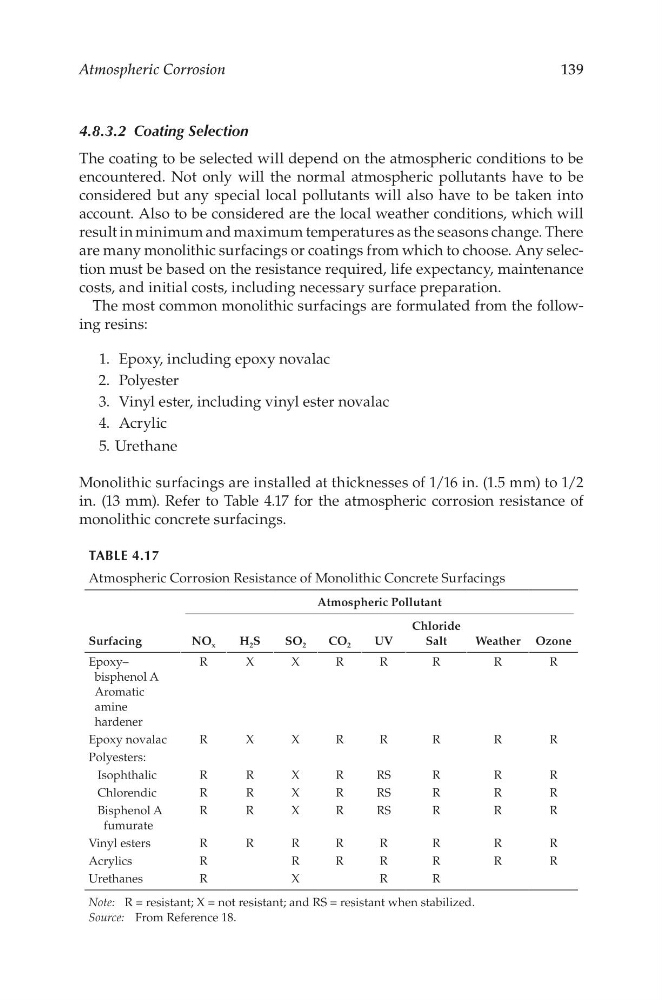
in. (13 mm). Refer to Table 4.17 for the atmospheric corrosion resistance of
monolithic concrete surfacings.
TabLE 4.17
Atmospheric Corrosion Resistance of Monolithic Concrete Surfacings
Surfacing
Atmospheric Pollutant
NO x
H 2 S
SO 2
CO 2
UV
Chloride
Salt
Weather Ozone
Epoxy–
bisphenol A
Aromatic
amine
hardener
R
X
X
R
R
R
R
R
Epoxy novalac
R
X
X
R
R
R
R
R
Polyesters:
Isophthalic
R
R
X
R
RS
R
R
R
Chlorendic
R
R
X
R
RS
R
R
R
Bisphenol A
fumurate
R
R
X
R
RS
R
R
R
Vinyl esters
R
R
R
R
R
R
R
R
Acrylics
R
R
R
R
R
R
R
Urethanes
R
X
R
R
Note: R = resistant; X = not resistant; and RS = resistant when stabilized.
Source: From Reference 18.
139
4.8.3.2 Coating Selection
The coating to be selected will depend on the atmospheric conditions to be
encountered. Not only will the normal atmospheric pollutants have to be
considered but any special local pollutants will also have to be taken into
account. Also to be considered are the local weather conditions, which will
result in minimum and maximum temperatures as the seasons change. There
are many monolithic surfacings or coatings from which to choose. Any selection must be based on the resistance required, life expectancy, maintenance
costs, and initial costs, including necessary surface preparation.
The most common monolithic surfacings are formulated from the following resins:
1. Epoxy, including epoxy novalac
2. Polyester
3. Vinyl ester, including vinyl ester novalac
4. Acrylic
5. Urethane
Monolithic surfacings are installed at thicknesses of 1/16 in. (1.5 mm) to 1/2
in. (13 mm). Refer to Table 4.17 for the atmospheric corrosion resistance of
monolithic concrete surfacings.
TabLE 4.17
Atmospheric Corrosion Resistance of Monolithic Concrete Surfacings
Surfacing
Atmospheric Pollutant
NO x
H 2 S
SO 2
CO 2
UV
Chloride
Salt
Weather Ozone
Epoxy–
bisphenol A
Aromatic
amine
hardener
R
X
X
R
R
R
R
R
Epoxy novalac
R
X
X
R
R
R
R
R
Polyesters:
Isophthalic
R
R
X
R
RS
R
R
R
Chlorendic
R
R
X
R
RS
R
R
R
Bisphenol A
fumurate
R
R
X
R
RS
R
R
R
Vinyl esters
R
R
R
R
R
R
R
R
Acrylics
R
R
R
R
R
R
R
Urethanes
R
X
R
R
Note: R = resistant; X = not resistant; and RS = resistant when stabilized.
Source: From Reference 18.