

Atmospheric Corrosion
127
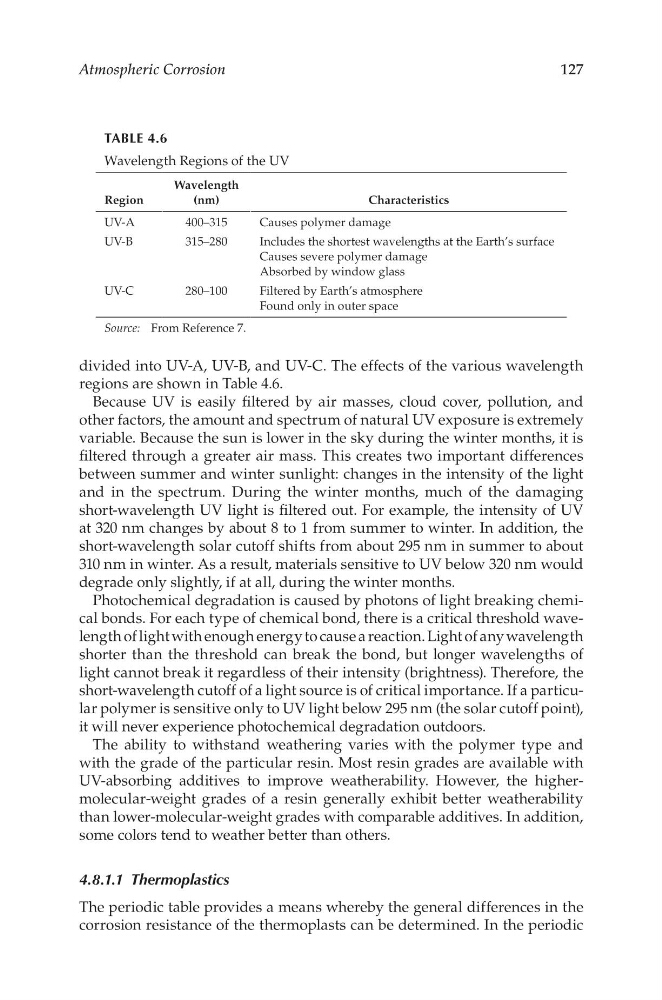
divided into UV-A, UV-B, and UV-C. The effects of the various wavelength
regions are shown in Table 4.6.
Because UV is easily filtered by air masses, cloud cover, pollution, and
other factors, the amount and spectrum of natural UV exposure is extremely
variable. Because the sun is lower in the sky during the winter months, it is
filtered through a greater air mass. This creates two important differences
between summer and winter sunlight: changes in the intensity of the light
and in the spectrum. During the winter months, much of the damaging
short-wavelength UV light is filtered out. For example, the intensity of UV
at 320 nm changes by about 8 to 1 from summer to winter. In addition, the
short-wavelength solar cutoff shifts from about 295 nm in summer to about
310 nm in winter. As a result, materials sensitive to UV below 320 nm would
degrade only slightly, if at all, during the winter months.
Photochemical degradation is caused by photons of light breaking chemical bonds. For each type of chemical bond, there is a critical threshold wavelength of light with enough energy to cause a reaction. Light of any wavelength
shorter than the threshold can break the bond, but longer wavelengths of
light cannot break it regardless of their intensity (brightness). Therefore, the
short-wavelength cutoff of a light source is of critical importance. If a particular polymer is sensitive only to UV light below 295 nm (the solar cutoff point),
it will never experience photochemical degradation outdoors.
The ability to withstand weathering varies with the polymer type and
with the grade of the particular resin. Most resin grades are available with
UV-absorbing additives to improve weatherability. However, the highermolecular-weight grades of a resin generally exhibit better weatherability
than lower-molecular-weight grades with comparable additives. In addition,
some colors tend to weather better than others.
4.8.1.1 Thermoplastics
The periodic table provides a means whereby the general differences in the
corrosion resistance of the thermoplasts can be determined. In the periodic
TabLE 4.6
Wavelength Regions of the UV
Region
Wavelength
(nm)
Characteristics
UV-A
400–315
Causes polymer damage
UV-B
315–280
Includes the shortest wavelengths at the Earth’s surface
Causes severe polymer damage
Absorbed by window glass
UV-C
280–100
Filtered by Earth’s atmosphere
Found only in outer space
Source: From Reference 7.
127
divided into UV-A, UV-B, and UV-C. The effects of the various wavelength
regions are shown in Table 4.6.
Because UV is easily filtered by air masses, cloud cover, pollution, and
other factors, the amount and spectrum of natural UV exposure is extremely
variable. Because the sun is lower in the sky during the winter months, it is
filtered through a greater air mass. This creates two important differences
between summer and winter sunlight: changes in the intensity of the light
and in the spectrum. During the winter months, much of the damaging
short-wavelength UV light is filtered out. For example, the intensity of UV
at 320 nm changes by about 8 to 1 from summer to winter. In addition, the
short-wavelength solar cutoff shifts from about 295 nm in summer to about
310 nm in winter. As a result, materials sensitive to UV below 320 nm would
degrade only slightly, if at all, during the winter months.
Photochemical degradation is caused by photons of light breaking chemical bonds. For each type of chemical bond, there is a critical threshold wavelength of light with enough energy to cause a reaction. Light of any wavelength
shorter than the threshold can break the bond, but longer wavelengths of
light cannot break it regardless of their intensity (brightness). Therefore, the
short-wavelength cutoff of a light source is of critical importance. If a particular polymer is sensitive only to UV light below 295 nm (the solar cutoff point),
it will never experience photochemical degradation outdoors.
The ability to withstand weathering varies with the polymer type and
with the grade of the particular resin. Most resin grades are available with
UV-absorbing additives to improve weatherability. However, the highermolecular-weight grades of a resin generally exhibit better weatherability
than lower-molecular-weight grades with comparable additives. In addition,
some colors tend to weather better than others.
4.8.1.1 Thermoplastics
The periodic table provides a means whereby the general differences in the
corrosion resistance of the thermoplasts can be determined. In the periodic
TabLE 4.6
Wavelength Regions of the UV
Region
Wavelength
(nm)
Characteristics
UV-A
400–315
Causes polymer damage
UV-B
315–280
Includes the shortest wavelengths at the Earth’s surface
Causes severe polymer damage
Absorbed by window glass
UV-C
280–100
Filtered by Earth’s atmosphere
Found only in outer space
Source: From Reference 7.