

Atmospheric Corrosion
123
Although atmospheric corrosion of ferrous metals is related first to the
amount of moisture in the air (relative humidity), atmospheric moisture
alone has no influence on the corrosion of stainless steel. Of primary importance are the effects of such atmospheric contaminants as particulate chlorides and iron-based dust. Sulfur-based acids will promote corrosion while
oxides of nitrogen improve the resistance. Contaminants such as hydrocarbons, ammonia, and the oxides of carbon have no effect.
4.7.8.1 Austenitic Grades
Of all the stainless steels, the austenitic grades are the most widely used
for corrosion resistance. By adding substantial quantities of nickel to highchromium alloys, the austenite is stabilized at room temperature. This
group of alloys contains 16 to 26% chromium and 6 to 22% nickel, while the
carbon content is kept low (0.08%) to minimize carbide precipitation. The
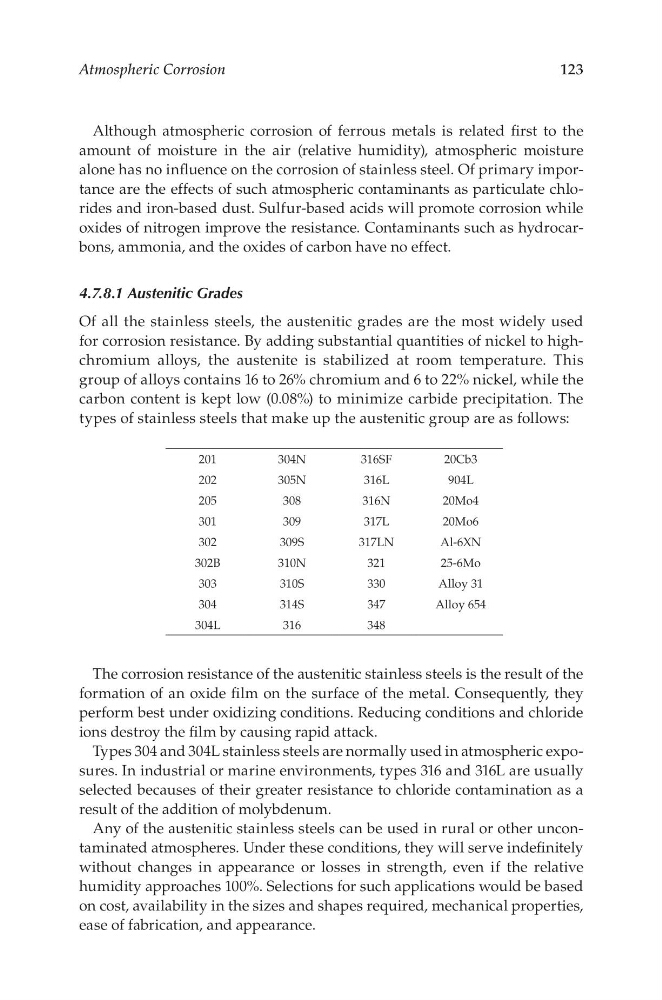
types of stainless steels that make up the austenitic group are as follows:
201
304N
316SF
20Cb3
202
305N
316L
904L
205
308
316N
20Mo4
301
309
317L
20Mo6
302
309S
317LN
Al-6XN
302B
310N
321
25-6Mo
303
310S
330
Alloy 31
304
314S
347
Alloy 654
304L
316
348
The corrosion resistance of the austenitic stainless steels is the result of the
formation of an oxide film on the surface of the metal. Consequently, they
perform best under oxidizing conditions. Reducing conditions and chloride
ions destroy the film by causing rapid attack.
Types 304 and 304L stainless steels are normally used in atmospheric exposures. In industrial or marine environments, types 316 and 316L are usually
selected becauses of their greater resistance to chloride contamination as a
result of the addition of molybdenum.
Any of the austenitic stainless steels can be used in rural or other uncontaminated atmospheres. Under these conditions, they will serve indefinitely
without changes in appearance or losses in strength, even if the relative
humidity approaches 100%. Selections for such applications would be based
on cost, availability in the sizes and shapes required, mechanical properties,
ease of fabrication, and appearance.
123
Although atmospheric corrosion of ferrous metals is related first to the
amount of moisture in the air (relative humidity), atmospheric moisture
alone has no influence on the corrosion of stainless steel. Of primary importance are the effects of such atmospheric contaminants as particulate chlorides and iron-based dust. Sulfur-based acids will promote corrosion while
oxides of nitrogen improve the resistance. Contaminants such as hydrocarbons, ammonia, and the oxides of carbon have no effect.
4.7.8.1 Austenitic Grades
Of all the stainless steels, the austenitic grades are the most widely used
for corrosion resistance. By adding substantial quantities of nickel to highchromium alloys, the austenite is stabilized at room temperature. This
group of alloys contains 16 to 26% chromium and 6 to 22% nickel, while the
carbon content is kept low (0.08%) to minimize carbide precipitation. The
types of stainless steels that make up the austenitic group are as follows:
201
304N
316SF
20Cb3
202
305N
316L
904L
205
308
316N
20Mo4
301
309
317L
20Mo6
302
309S
317LN
Al-6XN
302B
310N
321
25-6Mo
303
310S
330
Alloy 31
304
314S
347
Alloy 654
304L
316
348
The corrosion resistance of the austenitic stainless steels is the result of the
formation of an oxide film on the surface of the metal. Consequently, they
perform best under oxidizing conditions. Reducing conditions and chloride
ions destroy the film by causing rapid attack.
Types 304 and 304L stainless steels are normally used in atmospheric exposures. In industrial or marine environments, types 316 and 316L are usually
selected becauses of their greater resistance to chloride contamination as a
result of the addition of molybdenum.
Any of the austenitic stainless steels can be used in rural or other uncontaminated atmospheres. Under these conditions, they will serve indefinitely
without changes in appearance or losses in strength, even if the relative
humidity approaches 100%. Selections for such applications would be based
on cost, availability in the sizes and shapes required, mechanical properties,
ease of fabrication, and appearance.