

94
Fundamentals of Corrosion
The dry deposition velocity is defined as the ratio of deposition rate, or
surface flux, of any gaseous compound and the concentration of the same
compound in the atmosphere. It can be expressed as the inverse of the sum
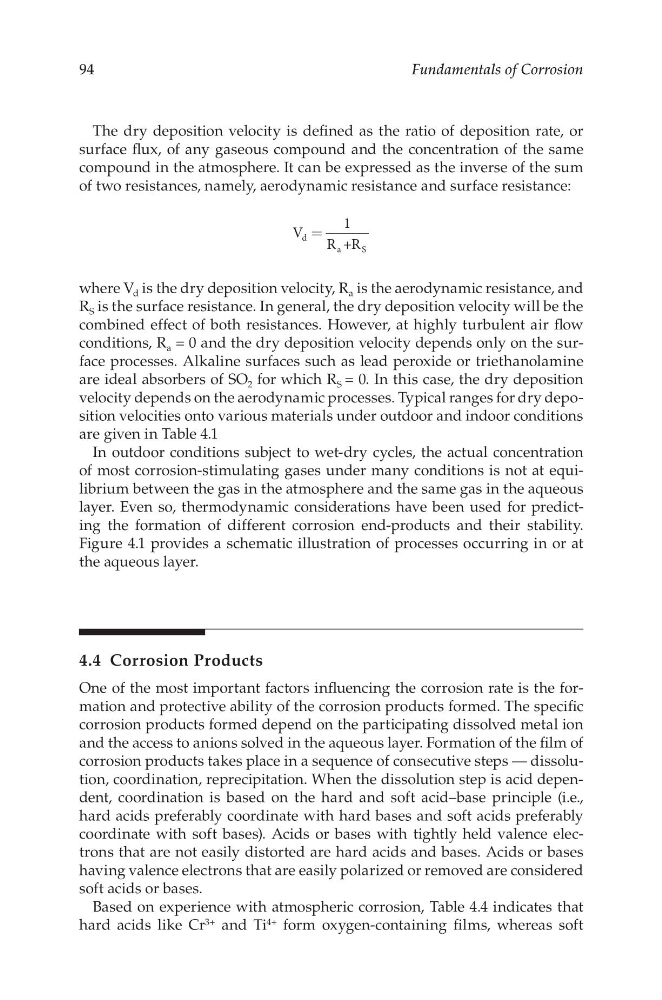
of two resistances, namely, aerodynamic resistance and surface resistance:
V
R +R
d
a
S
=
1
where V d is the dry deposition velocity, R a is the aerodynamic resistance, and
R S is the surface resistance. In general, the dry deposition velocity will be the
combined effect of both resistances. However, at highly turbulent air flow
conditions, R a = 0 and the dry deposition velocity depends only on the surface processes. Alkaline surfaces such as lead peroxide or triethanolamine
are ideal absorbers of SO 2 for which R S = 0. In this case, the dry deposition
velocity depends on the aerodynamic processes. Typical ranges for dry deposition velocities onto various materials under outdoor and indoor conditions
are given in Table 4.1
In outdoor conditions subject to wet-dry cycles, the actual concentration
of most corrosion-stimulating gases under many conditions is not at equilibrium between the gas in the atmosphere and the same gas in the aqueous
layer. Even so, thermodynamic considerations have been used for predicting the formation of different corrosion end-products and their stability.
Figure 4.1 provides a schematic illustration of processes occurring in or at
the aqueous layer.
4.4 Corrosion Products
One of the most important factors influencing the corrosion rate is the formation and protective ability of the corrosion products formed. The specific
corrosion products formed depend on the participating dissolved metal ion
and the access to anions solved in the aqueous layer. Formation of the film of
corrosion products takes place in a sequence of consecutive steps — dissolution, coordination, reprecipitation. When the dissolution step is acid dependent, coordination is based on the hard and soft acid–base principle (i.e.,
hard acids preferably coordinate with hard bases and soft acids preferably
coordinate with soft bases). Acids or bases with tightly held valence electrons that are not easily distorted are hard acids and bases. Acids or bases
having valence electrons that are easily polarized or removed are considered
soft acids or bases.
Based on experience with atmospheric corrosion, Table 4.4 indicates that
hard acids like Cr 3+ and Ti 4+ form oxygen-containing films, whereas soft
Fundamentals of Corrosion
The dry deposition velocity is defined as the ratio of deposition rate, or
surface flux, of any gaseous compound and the concentration of the same
compound in the atmosphere. It can be expressed as the inverse of the sum
of two resistances, namely, aerodynamic resistance and surface resistance:
V
R +R
d
a
S
=
1
where V d is the dry deposition velocity, R a is the aerodynamic resistance, and
R S is the surface resistance. In general, the dry deposition velocity will be the
combined effect of both resistances. However, at highly turbulent air flow
conditions, R a = 0 and the dry deposition velocity depends only on the surface processes. Alkaline surfaces such as lead peroxide or triethanolamine
are ideal absorbers of SO 2 for which R S = 0. In this case, the dry deposition
velocity depends on the aerodynamic processes. Typical ranges for dry deposition velocities onto various materials under outdoor and indoor conditions
are given in Table 4.1
In outdoor conditions subject to wet-dry cycles, the actual concentration
of most corrosion-stimulating gases under many conditions is not at equilibrium between the gas in the atmosphere and the same gas in the aqueous
layer. Even so, thermodynamic considerations have been used for predicting the formation of different corrosion end-products and their stability.
Figure 4.1 provides a schematic illustration of processes occurring in or at
the aqueous layer.
4.4 Corrosion Products
One of the most important factors influencing the corrosion rate is the formation and protective ability of the corrosion products formed. The specific
corrosion products formed depend on the participating dissolved metal ion
and the access to anions solved in the aqueous layer. Formation of the film of
corrosion products takes place in a sequence of consecutive steps — dissolution, coordination, reprecipitation. When the dissolution step is acid dependent, coordination is based on the hard and soft acid–base principle (i.e.,
hard acids preferably coordinate with hard bases and soft acids preferably
coordinate with soft bases). Acids or bases with tightly held valence electrons that are not easily distorted are hard acids and bases. Acids or bases
having valence electrons that are easily polarized or removed are considered
soft acids or bases.
Based on experience with atmospheric corrosion, Table 4.4 indicates that
hard acids like Cr 3+ and Ti 4+ form oxygen-containing films, whereas soft