

Atmospheric Corrosion
91
Atmospheric corrosion resulting from the reaction of water vapor with a
metal surface is a serious problem. Most clean metal surfaces will permit the
bonding of water in molecular form. The oxygen atom bonds to the metal
surface and acts as a Lewis base (donating an electron pair), because the
bonding is connected with a net charge transfer from the water molecule to
the surface. The water adsorbs on electron-deficient sites.
It is also possible for water to bond in dissociated form. In this case, the
driving force is the formation of metal–oxygen or metal–hydroxyl bonds.
The end-products formed as a result of the water adsorption are adsorbed
hydroxyl, atomic oxygen, and atomic hydrogen. When metal oxides are present, water may adsorb in either molecular or dissociative form. Lattice defect
sites seem to facilitate dissociation, as observed, for instance, on monocrystalline TiO 2 , NiO, and ∝-Fe 2 O 3 . The dissociation of water forms a monomolecular thick film of surface hydroxyl groups that is relatively protective and
reduces the subsequent reaction rate of water. The first monolayer of water
adsorbed to the hydroxylated oxide surface is highly immobile, whereas the
second and third layers are more randomly oriented and less immobile.
Many different metals adsorb water in similar manners, forming metal
oxyhydroxides. The exact nature of the oxyhydride formed seems to have
only a minor influence on the water adsorption phenomena. The quantity of
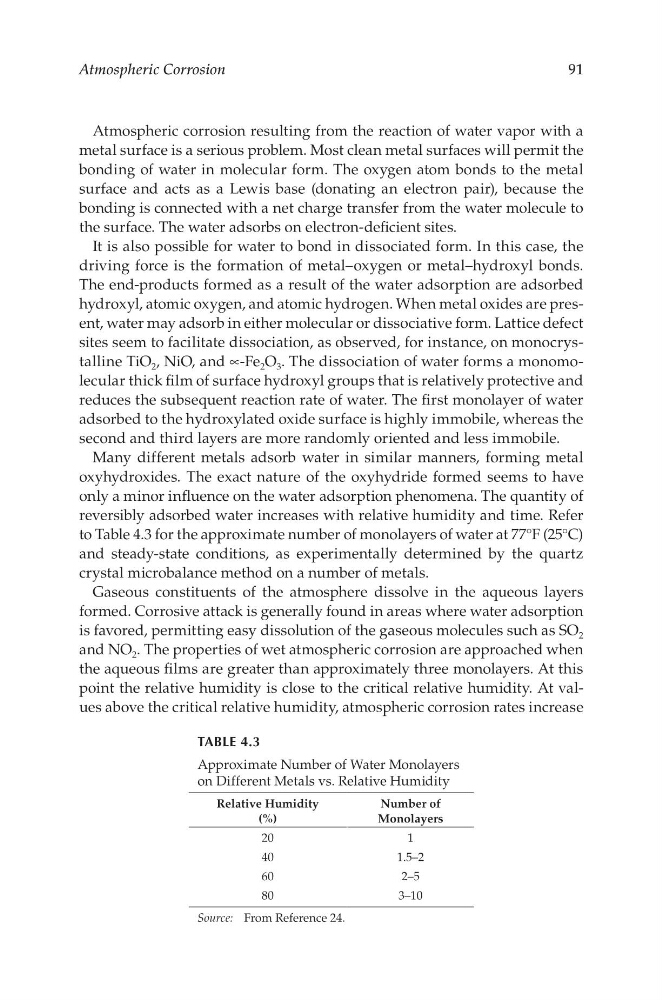
reversibly adsorbed water increases with relative humidity and time. Refer
to Table 4.3 for the approximate number of monolayers of water at 77°F (25°C)
and steady-state conditions, as experimentally determined by the quartz
crystal microbalance method on a number of metals.
Gaseous constituents of the atmosphere dissolve in the aqueous layers
formed. Corrosive attack is generally found in areas where water adsorption
is favored, permitting easy dissolution of the gaseous molecules such as SO 2
and NO 2 . The properties of wet atmospheric corrosion are approached when
the aqueous films are greater than approximately three monolayers. At this
point the relative humidity is close to the critical relative humidity. At values above the critical relative humidity, atmospheric corrosion rates increase
TabLE 4.3
Approximate Number of Water Monolayers
on Different Metals vs. Relative Humidity
Relative Humidity
(%)
Number of
Monolayers
20
1
40
1.5–2
60
2–5
80
3–10
Source: From Reference 24.
91
Atmospheric corrosion resulting from the reaction of water vapor with a
metal surface is a serious problem. Most clean metal surfaces will permit the
bonding of water in molecular form. The oxygen atom bonds to the metal
surface and acts as a Lewis base (donating an electron pair), because the
bonding is connected with a net charge transfer from the water molecule to
the surface. The water adsorbs on electron-deficient sites.
It is also possible for water to bond in dissociated form. In this case, the
driving force is the formation of metal–oxygen or metal–hydroxyl bonds.
The end-products formed as a result of the water adsorption are adsorbed
hydroxyl, atomic oxygen, and atomic hydrogen. When metal oxides are present, water may adsorb in either molecular or dissociative form. Lattice defect
sites seem to facilitate dissociation, as observed, for instance, on monocrystalline TiO 2 , NiO, and ∝-Fe 2 O 3 . The dissociation of water forms a monomolecular thick film of surface hydroxyl groups that is relatively protective and
reduces the subsequent reaction rate of water. The first monolayer of water
adsorbed to the hydroxylated oxide surface is highly immobile, whereas the
second and third layers are more randomly oriented and less immobile.
Many different metals adsorb water in similar manners, forming metal
oxyhydroxides. The exact nature of the oxyhydride formed seems to have
only a minor influence on the water adsorption phenomena. The quantity of
reversibly adsorbed water increases with relative humidity and time. Refer
to Table 4.3 for the approximate number of monolayers of water at 77°F (25°C)
and steady-state conditions, as experimentally determined by the quartz
crystal microbalance method on a number of metals.
Gaseous constituents of the atmosphere dissolve in the aqueous layers
formed. Corrosive attack is generally found in areas where water adsorption
is favored, permitting easy dissolution of the gaseous molecules such as SO 2
and NO 2 . The properties of wet atmospheric corrosion are approached when
the aqueous films are greater than approximately three monolayers. At this
point the relative humidity is close to the critical relative humidity. At values above the critical relative humidity, atmospheric corrosion rates increase
TabLE 4.3
Approximate Number of Water Monolayers
on Different Metals vs. Relative Humidity
Relative Humidity
(%)
Number of
Monolayers
20
1
40
1.5–2
60
2–5
80
3–10
Source: From Reference 24.