

80
Fundamentals of Corrosion
where Κ is the accumulated corrosion effect, t n is the time of wetness (the
period with an electrolyte layer on the surface), and V k is the average corrosion rate during the individual periods of wetness, the composition of the
electrolyte, and the temperature determine the corrosion rate. Factors affecting the time of wetness and the composition of the electrolyte film are discussed later.
In addition to the above, there are other factors that affect the corrosion
rate. Included are initial exposure conditions, sample mass, orientation,
extent of sheltering, wind velocity, nature of the corrosion products formed,
and pollutants present (both known and unknown).
4.2.1 Time of Wetness
The term “time of wetness” refers to the length of time during which the
metal surface is covered by a film of water that renders significant atmospheric corrosion possible. The actual time of wetness will vary with climatic
conditions at the location. It depends on the relative humidity of the atmosphere (being greatest when the relative humidity is greater than or equal to
80%); the temperature of the air and the metal surface above 32ºF (0ºC); the
duration and frequency of rain, fog, dew, and melting snow; as well as the
hours of sunshine and wind speed.
Moisture on the surface of the metal resulting from high humidity of the
atmosphere and the chemical and physical properties of the corrosion products produces an adsorption layer of water. Phase layers of water are the
result of rain, fog, wet or melting snow, or dew formed by condensation on
cold metallic surfaces.
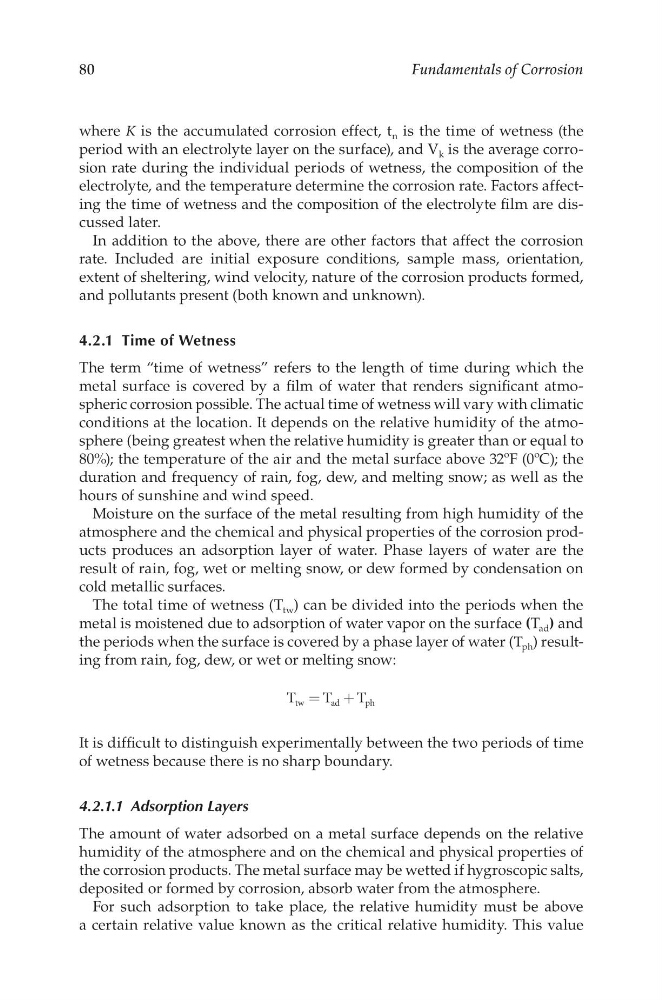
The total time of wetness (T tw ) can be divided into the periods when the
metal is moistened due to adsorption of water vapor on the surface (T ad ) and
the periods when the surface is covered by a phase layer of water (Τ ph ) resulting from rain, fog, dew, or wet or melting snow:
T
T
T
tw
ad
ph
=
+
It is difficult to distinguish experimentally between the two periods of time
of wetness because there is no sharp boundary.
4.2.1.1 Adsorption Layers
The amount of water adsorbed on a metal surface depends on the relative
humidity of the atmosphere and on the chemical and physical properties of
the corrosion products. The metal surface may be wetted if hygroscopic salts,
deposited or formed by corrosion, absorb water from the atmosphere.
For such adsorption to take place, the relative humidity must be above
a certain relative value known as the critical relative humidity. This value
Fundamentals of Corrosion
where Κ is the accumulated corrosion effect, t n is the time of wetness (the
period with an electrolyte layer on the surface), and V k is the average corrosion rate during the individual periods of wetness, the composition of the
electrolyte, and the temperature determine the corrosion rate. Factors affecting the time of wetness and the composition of the electrolyte film are discussed later.
In addition to the above, there are other factors that affect the corrosion
rate. Included are initial exposure conditions, sample mass, orientation,
extent of sheltering, wind velocity, nature of the corrosion products formed,
and pollutants present (both known and unknown).
4.2.1 Time of Wetness
The term “time of wetness” refers to the length of time during which the
metal surface is covered by a film of water that renders significant atmospheric corrosion possible. The actual time of wetness will vary with climatic
conditions at the location. It depends on the relative humidity of the atmosphere (being greatest when the relative humidity is greater than or equal to
80%); the temperature of the air and the metal surface above 32ºF (0ºC); the
duration and frequency of rain, fog, dew, and melting snow; as well as the
hours of sunshine and wind speed.
Moisture on the surface of the metal resulting from high humidity of the
atmosphere and the chemical and physical properties of the corrosion products produces an adsorption layer of water. Phase layers of water are the
result of rain, fog, wet or melting snow, or dew formed by condensation on
cold metallic surfaces.
The total time of wetness (T tw ) can be divided into the periods when the
metal is moistened due to adsorption of water vapor on the surface (T ad ) and
the periods when the surface is covered by a phase layer of water (Τ ph ) resulting from rain, fog, dew, or wet or melting snow:
T
T
T
tw
ad
ph
=
+
It is difficult to distinguish experimentally between the two periods of time
of wetness because there is no sharp boundary.
4.2.1.1 Adsorption Layers
The amount of water adsorbed on a metal surface depends on the relative
humidity of the atmosphere and on the chemical and physical properties of
the corrosion products. The metal surface may be wetted if hygroscopic salts,
deposited or formed by corrosion, absorb water from the atmosphere.
For such adsorption to take place, the relative humidity must be above
a certain relative value known as the critical relative humidity. This value