

Revision Test 4: Algebra and simple equations
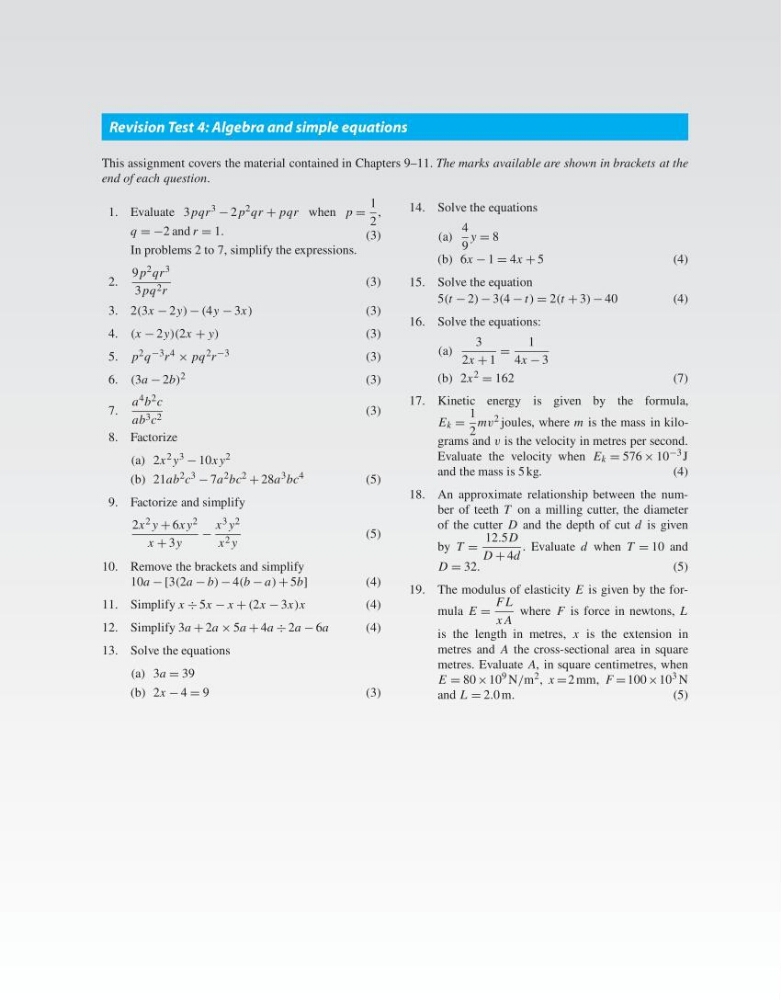
This assignment covers the material contained in Chapters 9–11. The marks available are shown in brackets at the
end of each question.
1. Evaluate 3 pqr 3 − 2 p 2 qr + pqr when p =
1
2
,
q = −2 and r = 1.
(3)
In problems 2 to 7, simplify the expressions.
2.
9 p 2 qr 3
3 pq 2 r
(3)
3. 2(3x − 2y) − (4y − 3x)
(3)
4. (x − 2y)(2x + y)
(3)
5. p 2 q −3 r 4 × pq 2 r −3
(3)
6. (3a − 2b) 2
(3)
7.
a 4 b 2 c
ab 3 c 2
(3)
8. Factorize
(a) 2x 2 y 3 − 10x y 2
(b) 21ab 2 c 3 − 7a 2 bc 2 + 28a 3 bc 4
(5)
9. Factorize and simplify
2x 2 y + 6x y 2
x + 3y
−
x 3 y 2
x 2 y
(5)
10. Remove the brackets and simplify
10a − [3(2a − b) − 4(b − a) + 5b]
( 4 )
11. Simplify x ÷ 5x − x + (2x − 3x)x
(4)
12. Simplify 3a + 2a × 5a + 4a ÷ 2a − 6a
(4)
13. Solve the equations
(a) 3a = 39
(b) 2x − 4 = 9
( 3 )
14. Solve the equations
(a)
4
9
y = 8
(b) 6x − 1 = 4x + 5
( 4 )
15. Solve the equation
5(t − 2) − 3(4 − t ) = 2(t + 3) − 40
(4)
16. Solve the equations:
(a)
3
2x + 1
=
1
4x − 3
(b) 2x 2 = 162
(7)
17. Kinetic energy is given by the formula,
E k =
1
2
mv 2 joules, where m is the mass in kilograms and v is the velocity in metres per second.
Evaluate the velocity when E k = 576 × 10 −3 J
and the mass is 5 kg.
(4)
18. An approximate relationship between the number of teeth T on a milling cutter, the diameter
of the cutter D and the depth of cut d is given
by T =
12.5D
D + 4d
. Evaluate d when T = 10 and
D = 32.
(5)
19. The modulus of elasticity E is given by the formula E =
F L
x A
where F is force in newtons, L
is the length in metres, x is the extension in
metres and A the cross-sectional area in square
metres. Evaluate A, in square centimetres, when
E = 80 × 10 9 N/m 2 , x = 2 mm, F = 100 ×10 3 N
and L = 2.0 m.
(5)
This assignment covers the material contained in Chapters 9–11. The marks available are shown in brackets at the
end of each question.
1. Evaluate 3 pqr 3 − 2 p 2 qr + pqr when p =
1
2
,
q = −2 and r = 1.
(3)
In problems 2 to 7, simplify the expressions.
2.
9 p 2 qr 3
3 pq 2 r
(3)
3. 2(3x − 2y) − (4y − 3x)
(3)
4. (x − 2y)(2x + y)
(3)
5. p 2 q −3 r 4 × pq 2 r −3
(3)
6. (3a − 2b) 2
(3)
7.
a 4 b 2 c
ab 3 c 2
(3)
8. Factorize
(a) 2x 2 y 3 − 10x y 2
(b) 21ab 2 c 3 − 7a 2 bc 2 + 28a 3 bc 4
(5)
9. Factorize and simplify
2x 2 y + 6x y 2
x + 3y
−
x 3 y 2
x 2 y
(5)
10. Remove the brackets and simplify
10a − [3(2a − b) − 4(b − a) + 5b]
( 4 )
11. Simplify x ÷ 5x − x + (2x − 3x)x
(4)
12. Simplify 3a + 2a × 5a + 4a ÷ 2a − 6a
(4)
13. Solve the equations
(a) 3a = 39
(b) 2x − 4 = 9
( 3 )
14. Solve the equations
(a)
4
9
y = 8
(b) 6x − 1 = 4x + 5
( 4 )
15. Solve the equation
5(t − 2) − 3(4 − t ) = 2(t + 3) − 40
(4)
16. Solve the equations:
(a)
3
2x + 1
=
1
4x − 3
(b) 2x 2 = 162
(7)
17. Kinetic energy is given by the formula,
E k =
1
2
mv 2 joules, where m is the mass in kilograms and v is the velocity in metres per second.
Evaluate the velocity when E k = 576 × 10 −3 J
and the mass is 5 kg.
(4)
18. An approximate relationship between the number of teeth T on a milling cutter, the diameter
of the cutter D and the depth of cut d is given
by T =
12.5D
D + 4d
. Evaluate d when T = 10 and
D = 32.
(5)
19. The modulus of elasticity E is given by the formula E =
F L
x A
where F is force in newtons, L
is the length in metres, x is the extension in
metres and A the cross-sectional area in square
metres. Evaluate A, in square centimetres, when
E = 80 × 10 9 N/m 2 , x = 2 mm, F = 100 ×10 3 N
and L = 2.0 m.
(5)