

338 Basic Engineering Mathematics
Areas of irregular figures by approximate
methods:
Trapezoidal rule
Area ≈
width of
interval
1
2
first + last
ordinate
+ sum of remaining ordinates
Mid-ordinate rule
Area ≈ (width of interval)(sum of mid-ordinates)
Simpson’s rule
Area ≈
1
3
width of
interval
first + last
ordinate
+ 4
sum of even
ordinates
+ 2
sum of remaining
odd ordinates
Mean or average value of a waveform:
mean value, y =
area under curve
length of base
=
sum of mid-ordinates
number of mid-ordinates
Triangle formulae:
Sine rule:
a
sin A
=
b
sin B
=
c
sin C
Cosine rule: a
2
= b
2
+ c
2
− 2bc cos A
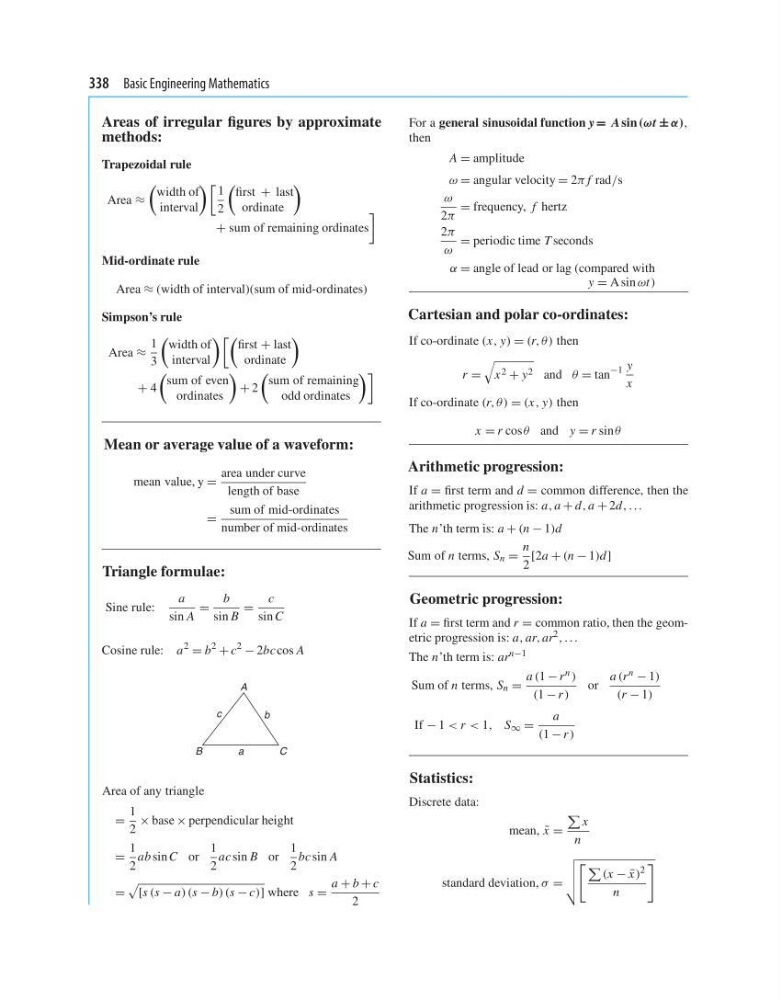
A
C
B
a
c
b
Area of any triangle
=
1
2
× base × perpendicular height
=
1
2
ab sin C or
1
2
ac sin B or
1
2
bc sin A
=
[s (s − a)(s − b)(s − c)] where s =
a + b + c
2
For a general sinusoidal function y = A sin (ωt ± α),
then
A = amplitude
ω = angular velocity = 2π f rad/s
ω
2π
= frequency, f hertz
2π
ω
= periodic time T seconds
α = angle of lead or lag (compared with
y = A sin ωt )
Cartesian and polar co-ordinates:
If co-ordinate (x, y) = (r, θ) then
r =
x 2 + y 2 and θ = tan
−1 y
x
If co-ordinate (r, θ) = (x, y) then
x = r cosθ and y = r sin θ
Arithmetic progression:
If a = first term and d = common difference, then the
arithmetic progression is: a, a + d, a + 2d, ...
The n’th term is: a + (n − 1)d
Sum of n terms, S n =
n
2
[2a + (n − 1)d]
Geometric progression:
If a = first term and r = common ratio, then the geometric progression is: a, ar, ar 2 , ...
The n’th term is: ar n−1
Sum of n terms, S n =
a (1 − r n )
(1 − r )
or
a (r n − 1)
(r − 1)
If − 1 < r < 1, S ∞ =
a
(1 − r )
Statistics:
Discrete data:
mean, ¯
x =
x
n
standard deviation, σ =
(x − ¯
x )
2
n
Areas of irregular figures by approximate
methods:
Trapezoidal rule
Area ≈
width of
interval
1
2
first + last
ordinate
+ sum of remaining ordinates
Mid-ordinate rule
Area ≈ (width of interval)(sum of mid-ordinates)
Simpson’s rule
Area ≈
1
3
width of
interval
first + last
ordinate
+ 4
sum of even
ordinates
+ 2
sum of remaining
odd ordinates
Mean or average value of a waveform:
mean value, y =
area under curve
length of base
=
sum of mid-ordinates
number of mid-ordinates
Triangle formulae:
Sine rule:
a
sin A
=
b
sin B
=
c
sin C
Cosine rule: a
2
= b
2
+ c
2
− 2bc cos A
A
C
B
a
c
b
Area of any triangle
=
1
2
× base × perpendicular height
=
1
2
ab sin C or
1
2
ac sin B or
1
2
bc sin A
=
[s (s − a)(s − b)(s − c)] where s =
a + b + c
2
For a general sinusoidal function y = A sin (ωt ± α),
then
A = amplitude
ω = angular velocity = 2π f rad/s
ω
2π
= frequency, f hertz
2π
ω
= periodic time T seconds
α = angle of lead or lag (compared with
y = A sin ωt )
Cartesian and polar co-ordinates:
If co-ordinate (x, y) = (r, θ) then
r =
x 2 + y 2 and θ = tan
−1 y
x
If co-ordinate (r, θ) = (x, y) then
x = r cosθ and y = r sin θ
Arithmetic progression:
If a = first term and d = common difference, then the
arithmetic progression is: a, a + d, a + 2d, ...
The n’th term is: a + (n − 1)d
Sum of n terms, S n =
n
2
[2a + (n − 1)d]
Geometric progression:
If a = first term and r = common ratio, then the geometric progression is: a, ar, ar 2 , ...
The n’th term is: ar n−1
Sum of n terms, S n =
a (1 − r n )
(1 − r )
or
a (r n − 1)
(r − 1)
If − 1 < r < 1, S ∞ =
a
(1 − r )
Statistics:
Discrete data:
mean, ¯
x =
x
n
standard deviation, σ =
(x − ¯
x )
2
n