

Introduction to differentiation 323
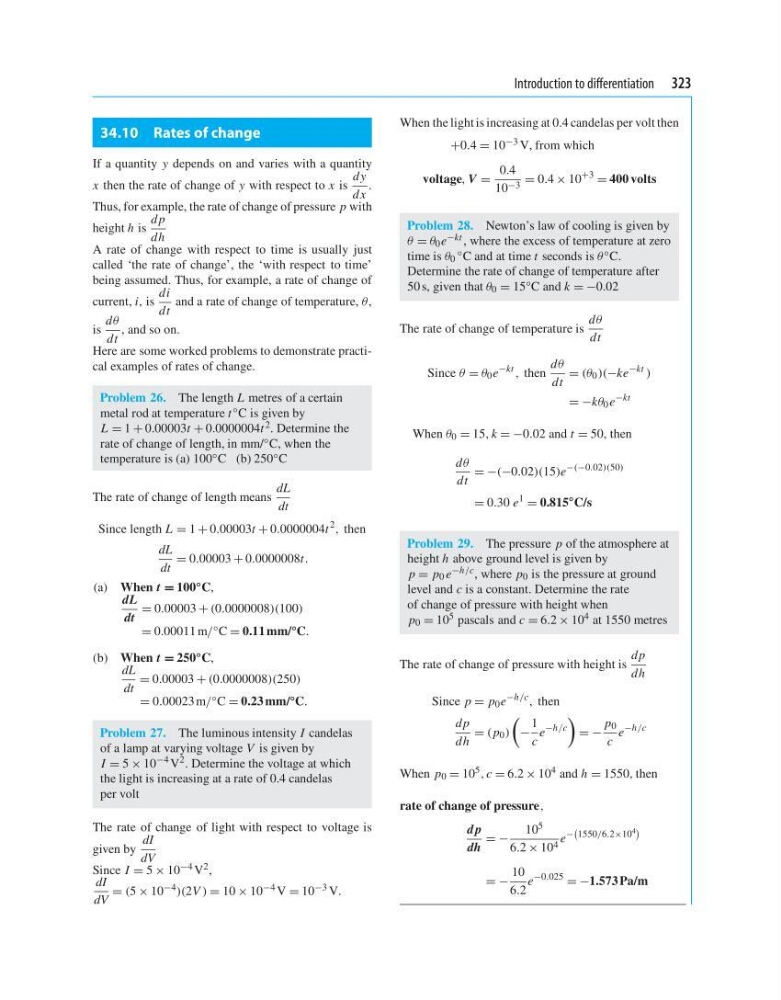
34.10 Rates of change
If a quantity y depends on and varies with a quantity
x then the rate of change of y with respect to x is
dy
dx
.
Thus, for example, the rate of change of pressure p with
height h is
dp
dh
A rate of change with respect to time is usually just
called ‘the rate of change’, the ‘with respect to time’
being assumed. Thus, for example, a rate of change of
current, i, is
di
dt
and a rate of change of temperature, θ,
is
dθ
dt
, and so on.
Here are some worked problems to demonstrate practical examples of rates of change.
Problem 26. The length L metres of a certain
metal rod at temperature t ◦ C is given by
L = 1 + 0.00003t + 0.0000004t 2 . Determine the
rate of change of length, in mm/ ◦ C, when the
temperature is (a) 100 ◦ C (b) 250 ◦ C
The rate of change of length means
dL
dt
Since length L = 1 + 0.00003t + 0.0000004t
2
, then
dL
dt
= 0.00003 + 0.0000008t.
(a) When t = 100 ◦ C,
dL
dt
= 0.00003 + (0.0000008)(100)
= 0.00011 m/ ◦ C = 0.11 mm/ ◦ C.
(b) When t = 250 ◦ C,
dL
dt
= 0.00003 + (0.0000008)(250)
= 0.00023 m/ ◦ C = 0.23 mm/ ◦ C.
Problem 27. The luminous intensity I candelas
of a lamp at varying voltage V is given by
I = 5 × 10
−4 V
2 . Determine the voltage at which
the light is increasing at a rate of 0.4 candelas
per volt
The rate of change of light with respect to voltage is
given by
dI
dV
Since I = 5 × 10 −4 V 2 ,
dI
dV
= (5 × 10 −4 )(2V ) = 10 × 10 −4 V = 10 −3 V.
When the light is increasing at 0.4 candelas per volt then
+0.4 = 10 −3 V, from which
voltage, V =
0.4
10 −3 = 0.4 × 10
+3
= 400 volts
Problem 28. Newton’s law of cooling is given by
θ = θ 0 e −kt , where the excess of temperature at zero
time is θ 0
◦ C and at time t seconds is θ ◦ C.
Determine the rate of change of temperature after
50 s, given that θ 0 = 15 ◦ C and k = −0.02
The rate of change of temperature is
dθ
dt
Since θ = θ 0 e
−kt
, then
dθ
dt
= (θ 0 )(−ke
−kt
)
= −kθ 0 e
−kt
When θ 0 = 15, k = −0.02 and t = 50, then
dθ
dt
= −(−0.02)(15)e
−(−0.02)(50)
= 0.30 e
1
= 0.815
◦ C/s
Problem 29. The pressure p of the atmosphere at
height h above ground level is given by
p = p 0 e −h/c , where p 0 is the pressure at ground
level and c is a constant. Determine the rate
of change of pressure with height when
p 0 = 10 5 pascals and c = 6.2 × 10 4 at 1550 metres
The rate of change of pressure with height is
dp
dh
Since p = p 0 e
−h/c
, then
dp
dh
= ( p 0 )
−
1
c
e
−h/c
= −
p 0
c
e
−h/c
When p 0 = 10 5 , c = 6.2 × 10 4 and h = 1550, then
rate of change of pressure,
dp
dh
= −
10 5
6.2 × 10 4 e
−
1550/6.2×10 4
= −
10
6.2
e
−0.025
= −1.573 Pa/m
34.10 Rates of change
If a quantity y depends on and varies with a quantity
x then the rate of change of y with respect to x is
dy
dx
.
Thus, for example, the rate of change of pressure p with
height h is
dp
dh
A rate of change with respect to time is usually just
called ‘the rate of change’, the ‘with respect to time’
being assumed. Thus, for example, a rate of change of
current, i, is
di
dt
and a rate of change of temperature, θ,
is
dθ
dt
, and so on.
Here are some worked problems to demonstrate practical examples of rates of change.
Problem 26. The length L metres of a certain
metal rod at temperature t ◦ C is given by
L = 1 + 0.00003t + 0.0000004t 2 . Determine the
rate of change of length, in mm/ ◦ C, when the
temperature is (a) 100 ◦ C (b) 250 ◦ C
The rate of change of length means
dL
dt
Since length L = 1 + 0.00003t + 0.0000004t
2
, then
dL
dt
= 0.00003 + 0.0000008t.
(a) When t = 100 ◦ C,
dL
dt
= 0.00003 + (0.0000008)(100)
= 0.00011 m/ ◦ C = 0.11 mm/ ◦ C.
(b) When t = 250 ◦ C,
dL
dt
= 0.00003 + (0.0000008)(250)
= 0.00023 m/ ◦ C = 0.23 mm/ ◦ C.
Problem 27. The luminous intensity I candelas
of a lamp at varying voltage V is given by
I = 5 × 10
−4 V
2 . Determine the voltage at which
the light is increasing at a rate of 0.4 candelas
per volt
The rate of change of light with respect to voltage is
given by
dI
dV
Since I = 5 × 10 −4 V 2 ,
dI
dV
= (5 × 10 −4 )(2V ) = 10 × 10 −4 V = 10 −3 V.
When the light is increasing at 0.4 candelas per volt then
+0.4 = 10 −3 V, from which
voltage, V =
0.4
10 −3 = 0.4 × 10
+3
= 400 volts
Problem 28. Newton’s law of cooling is given by
θ = θ 0 e −kt , where the excess of temperature at zero
time is θ 0
◦ C and at time t seconds is θ ◦ C.
Determine the rate of change of temperature after
50 s, given that θ 0 = 15 ◦ C and k = −0.02
The rate of change of temperature is
dθ
dt
Since θ = θ 0 e
−kt
, then
dθ
dt
= (θ 0 )(−ke
−kt
)
= −kθ 0 e
−kt
When θ 0 = 15, k = −0.02 and t = 50, then
dθ
dt
= −(−0.02)(15)e
−(−0.02)(50)
= 0.30 e
1
= 0.815
◦ C/s
Problem 29. The pressure p of the atmosphere at
height h above ground level is given by
p = p 0 e −h/c , where p 0 is the pressure at ground
level and c is a constant. Determine the rate
of change of pressure with height when
p 0 = 10 5 pascals and c = 6.2 × 10 4 at 1550 metres
The rate of change of pressure with height is
dp
dh
Since p = p 0 e
−h/c
, then
dp
dh
= ( p 0 )
−
1
c
e
−h/c
= −
p 0
c
e
−h/c
When p 0 = 10 5 , c = 6.2 × 10 4 and h = 1550, then
rate of change of pressure,
dp
dh
= −
10 5
6.2 × 10 4 e
−
1550/6.2×10 4
= −
10
6.2
e
−0.025
= −1.573 Pa/m