

320 Basic Engineering Mathematics
Now try the following Practice Exercise
Practice Exercise 134 Differentiation of
sine and cosine functions (answers on
page 354)
1. Differentiate with respect to x: (a) y = 4 sin3x
(b) y = 2 cos 6x.
2. Given f (θ) = 2 sin3θ − 5 cos 2θ, find f
(θ).
3. Find the gradient of the curve y = 2 cos
1
2
x at
x =
π
2
4. Determine the gradient of the curve
y = 3 sin2x at x =
π
3
5. An alternating current is given by
i = 5 sin 100t amperes, where t is the time
in seconds. Determine the rate of change of
current
i.e.
di
dt
when t = 0.01 seconds.
6. v = 50 sin 40t volts represents an alternating
voltage, v, where t is the time in seconds. At
a time of 20 × 10 −3 seconds, find the rate of
change of voltage
i.e.
dv
dt
.
7. If f (t ) = 3 sin(4t + 0.12) − 2 cos(3t − 0.72),
determine f (t ).
34.7 Differentiation of e ax and ln ax
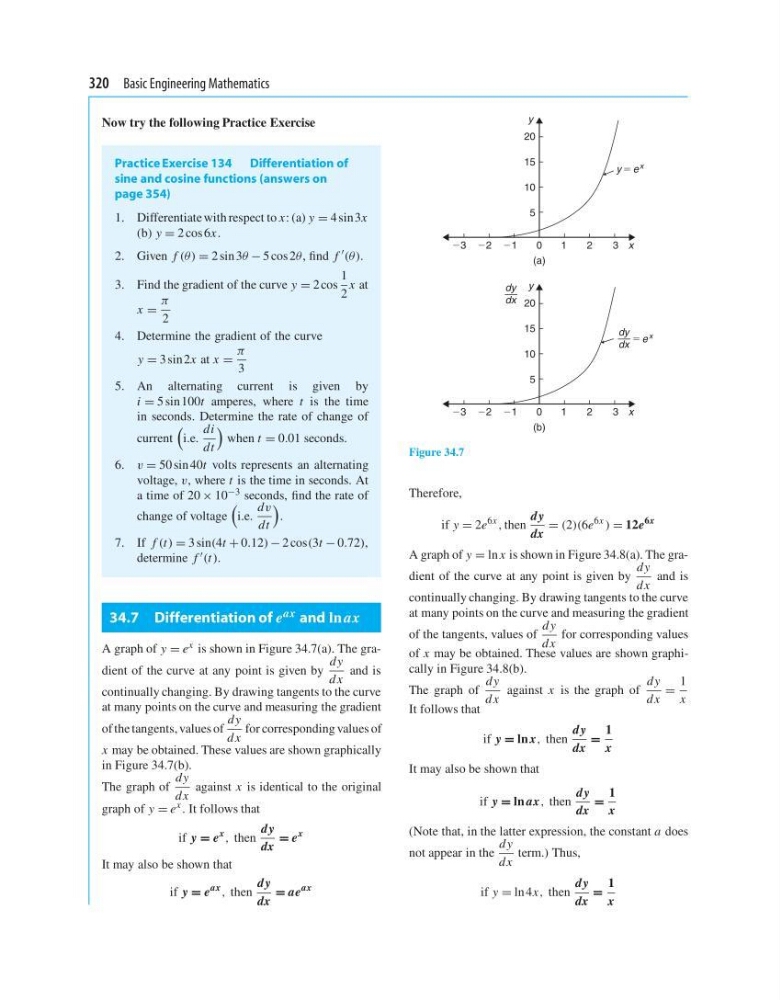
A graph of y = e x is shown in Figure 34.7(a). The gradient of the curve at any point is given by
dy
dx
and is
continually changing. By drawing tangents to the curve
at many points on the curve and measuring the gradient
of the tangents, values of
dy
dx
for corresponding values of
x may be obtained. These values are shown graphically
in Figure 34.7(b).
The graph of
dy
dx
against x is identical to the original
graph of y = e
x . It follows that
if y = e
x
, then
dy
dx
= e
x
It may also be shown that
if y = e
ax
, then
dy
dx
= ae
ax
3
y 5 e x
x
2
1
5
10
15
20
y
21
22
23
0
(a)
3
dy
dx
5 e x
dy
dx
x
2
1
5
10
15
20
y
21
22
23
0
(b)
Figure 34.7
Therefore,
if y = 2e
6x
, then
dy
dx
= (2)(6e
6x
) = 12e
6x
A graph of y = ln x is shown in Figure 34.8(a). The gradient of the curve at any point is given by
dy
dx
and is
continually changing. By drawing tangents to the curve
at many points on the curve and measuring the gradient
of the tangents, values of
dy
dx
for corresponding values
of x may be obtained. These values are shown graphically in Figure 34.8(b).
The graph of
dy
dx
against x is the graph of
dy
dx
=
1
x
It follows that
if y = lnx, then
dy
dx
=
1
x
It may also be shown that
if y = ln ax, then
dy
dx
=
1
x
(Note that, in the latter expression, the constant a does
not appear in the
dy
dx
term.) Thus,
if y = ln 4x, then
dy
dx
=
1
x
Now try the following Practice Exercise
Practice Exercise 134 Differentiation of
sine and cosine functions (answers on
page 354)
1. Differentiate with respect to x: (a) y = 4 sin3x
(b) y = 2 cos 6x.
2. Given f (θ) = 2 sin3θ − 5 cos 2θ, find f
(θ).
3. Find the gradient of the curve y = 2 cos
1
2
x at
x =
π
2
4. Determine the gradient of the curve
y = 3 sin2x at x =
π
3
5. An alternating current is given by
i = 5 sin 100t amperes, where t is the time
in seconds. Determine the rate of change of
current
i.e.
di
dt
when t = 0.01 seconds.
6. v = 50 sin 40t volts represents an alternating
voltage, v, where t is the time in seconds. At
a time of 20 × 10 −3 seconds, find the rate of
change of voltage
i.e.
dv
dt
.
7. If f (t ) = 3 sin(4t + 0.12) − 2 cos(3t − 0.72),
determine f (t ).
34.7 Differentiation of e ax and ln ax
A graph of y = e x is shown in Figure 34.7(a). The gradient of the curve at any point is given by
dy
dx
and is
continually changing. By drawing tangents to the curve
at many points on the curve and measuring the gradient
of the tangents, values of
dy
dx
for corresponding values of
x may be obtained. These values are shown graphically
in Figure 34.7(b).
The graph of
dy
dx
against x is identical to the original
graph of y = e
x . It follows that
if y = e
x
, then
dy
dx
= e
x
It may also be shown that
if y = e
ax
, then
dy
dx
= ae
ax
3
y 5 e x
x
2
1
5
10
15
20
y
21
22
23
0
(a)
3
dy
dx
5 e x
dy
dx
x
2
1
5
10
15
20
y
21
22
23
0
(b)
Figure 34.7
Therefore,
if y = 2e
6x
, then
dy
dx
= (2)(6e
6x
) = 12e
6x
A graph of y = ln x is shown in Figure 34.8(a). The gradient of the curve at any point is given by
dy
dx
and is
continually changing. By drawing tangents to the curve
at many points on the curve and measuring the gradient
of the tangents, values of
dy
dx
for corresponding values
of x may be obtained. These values are shown graphically in Figure 34.8(b).
The graph of
dy
dx
against x is the graph of
dy
dx
=
1
x
It follows that
if y = lnx, then
dy
dx
=
1
x
It may also be shown that
if y = ln ax, then
dy
dx
=
1
x
(Note that, in the latter expression, the constant a does
not appear in the
dy
dx
term.) Thus,
if y = ln 4x, then
dy
dx
=
1
x