

Introduction to differentiation 315
chord JK. By moving J nearer and nearer to
K , determine the gradient of the tangent of the
curve at K .
34.4 Differentiation from first
principles
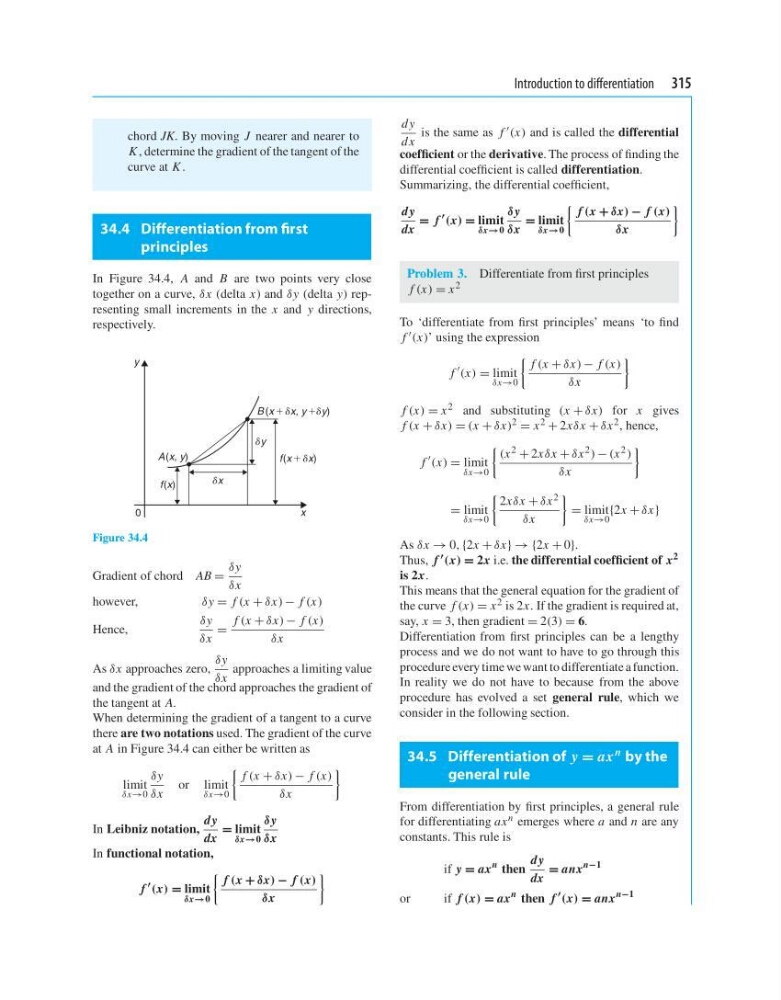
In Figure 34.4, A and B are two points very close
together on a curve, δx (delta x) and δy (delta y) representing small increments in the x and y directions,
respectively.
0
y
f(x)
f(x 1 ␦x)
␦y
␦x
x
A(x, y)
B (x 1 ␦x, y 1␦y)
Figure 34.4
Gradient of chord AB =
δy
δx
however,
δy = f (x + δx) − f (x)
Hence,
δy
δx
=
f (x + δx) − f (x)
δx
As δx approaches zero,
δy
δx
approaches a limiting value
and the gradient of the chord approaches the gradient of
the tangent at A.
When determining the gradient of a tangent to a curve
there are two notations used. The gradient of the curve
at A in Figure 34.4 can either be written as
limit
δx→0
δy
δx
or limit
δx→0
f (x + δx) − f (x)
δx
In Leibniz notation,
dy
dx
= limit
δx→0
δy
δx
In functional notation,
f
(x) = limit
δx→0
f (x + δx) − f (x)
δx
dy
dx
is the same as f (x) and is called the differential
coefficient or the derivative. The process of finding the
differential coefficient is called differentiation.
Summarizing, the differential coefficient,
dy
dx
= f
(x) = limit
δx→0
δy
δx
= limit
δx→0
f (x + δx) − f (x)
δx
Problem 3. Differentiate from first principles
f (x) = x 2
To ‘differentiate from first principles’ means ‘to find
f (x)’ using the expression
f
(x) = limit
δx→0
f (x + δx) − f (x)
δx
f (x) = x 2 and substituting (x + δx) for x gives
f (x + δx) = (x + δx) 2 = x 2 + 2xδx + δx 2 , hence,
f
(x) = limit
δx→0
(x 2 + 2xδx + δx 2 ) − (x 2 )
δx
= limit
δx→0
2xδx + δx 2
δx
= limit
δx→0
{2x + δx}
As δx → 0, {2x + δx} → {2x + 0}.
Thus, f (x) = 2x i.e. the differential coefficient of x 2
is 2x.
This means that the general equation for the gradient of
the curve f (x) = x 2 is 2x. If the gradient is required at,
say, x = 3, then gradient = 2(3) = 6.
Differentiation from first principles can be a lengthy
process and we do not want to have to go through this
procedure every time we want to differentiate a function.
In reality we do not have to because from the above
procedure has evolved a set general rule, which we
consider in the following section.
34.5 Differentiation of y = ax n by the
general rule
From differentiation by first principles, a general rule
for differentiating ax n emerges where a and n are any
constants. This rule is
if y = ax
n then
dy
dx
= anx
n−1
or
if f (x) = ax
n then f
(x) = anx
n−1
chord JK. By moving J nearer and nearer to
K , determine the gradient of the tangent of the
curve at K .
34.4 Differentiation from first
principles
In Figure 34.4, A and B are two points very close
together on a curve, δx (delta x) and δy (delta y) representing small increments in the x and y directions,
respectively.
0
y
f(x)
f(x 1 ␦x)
␦y
␦x
x
A(x, y)
B (x 1 ␦x, y 1␦y)
Figure 34.4
Gradient of chord AB =
δy
δx
however,
δy = f (x + δx) − f (x)
Hence,
δy
δx
=
f (x + δx) − f (x)
δx
As δx approaches zero,
δy
δx
approaches a limiting value
and the gradient of the chord approaches the gradient of
the tangent at A.
When determining the gradient of a tangent to a curve
there are two notations used. The gradient of the curve
at A in Figure 34.4 can either be written as
limit
δx→0
δy
δx
or limit
δx→0
f (x + δx) − f (x)
δx
In Leibniz notation,
dy
dx
= limit
δx→0
δy
δx
In functional notation,
f
(x) = limit
δx→0
f (x + δx) − f (x)
δx
dy
dx
is the same as f (x) and is called the differential
coefficient or the derivative. The process of finding the
differential coefficient is called differentiation.
Summarizing, the differential coefficient,
dy
dx
= f
(x) = limit
δx→0
δy
δx
= limit
δx→0
f (x + δx) − f (x)
δx
Problem 3. Differentiate from first principles
f (x) = x 2
To ‘differentiate from first principles’ means ‘to find
f (x)’ using the expression
f
(x) = limit
δx→0
f (x + δx) − f (x)
δx
f (x) = x 2 and substituting (x + δx) for x gives
f (x + δx) = (x + δx) 2 = x 2 + 2xδx + δx 2 , hence,
f
(x) = limit
δx→0
(x 2 + 2xδx + δx 2 ) − (x 2 )
δx
= limit
δx→0
2xδx + δx 2
δx
= limit
δx→0
{2x + δx}
As δx → 0, {2x + δx} → {2x + 0}.
Thus, f (x) = 2x i.e. the differential coefficient of x 2
is 2x.
This means that the general equation for the gradient of
the curve f (x) = x 2 is 2x. If the gradient is required at,
say, x = 3, then gradient = 2(3) = 6.
Differentiation from first principles can be a lengthy
process and we do not want to have to go through this
procedure every time we want to differentiate a function.
In reality we do not have to because from the above
procedure has evolved a set general rule, which we
consider in the following section.
34.5 Differentiation of y = ax n by the
general rule
From differentiation by first principles, a general rule
for differentiating ax n emerges where a and n are any
constants. This rule is
if y = ax
n then
dy
dx
= anx
n−1
or
if f (x) = ax
n then f
(x) = anx
n−1