

Revision Test 12 : Vectors and adding waveforms
This assignment covers the material contained in Chapters 29 and 30. The marks available are shown in brackets at
the end of each question.
1. State the difference between scalar and vector
quantities.
(2)
2. State whether the following are scalar or vector
quantities.
(a) A temperature of 50 ◦ C.
(b) 2 m 3 volume.
(c) A downward force of 10 N.
(d) 400 J of work.
(e) 20 cm 2 area.
(f) A south-easterly wind of 20 knots.
(g) 40 m distance.
(h) An acceleration of 25 m/s 2 at 30 ◦ to the
horizontal.
(8)
3. A velocity vector of 16 m/s acts at an angle of
−40 ◦ to the horizontal. Calculate its horizontal
and vertical components, correct to 3 significant
figures.
(4)
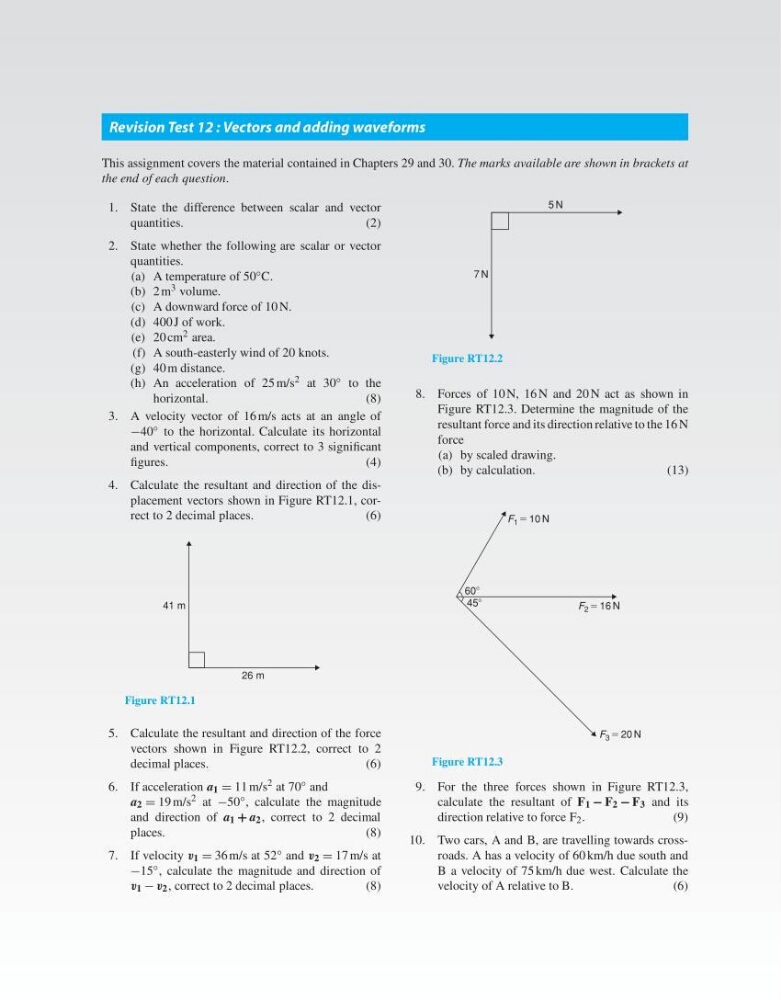
4. Calculate the resultant and direction of the displacement vectors shown in Figure RT12.1, correct to 2 decimal places.
(6)
41 m
26 m
Figure RT12.1
5. Calculate the resultant and direction of the force
vectors shown in Figure RT12.2, correct to 2
decimal places.
(6)
6. If acceleration a 1 = 11 m/s
2 at 70
◦ and
a 2 = 19 m/s 2 at −50 ◦ , calculate the magnitude
and direction of a 1 + a 2 , correct to 2 decimal
places.
(8)
7. If velocity v 1 = 36 m/s at 52 ◦ and v 2 = 17 m/s at
−15 ◦ , calculate the magnitude and direction of
v 1 − v 2 , correct to 2 decimal places.
(8)
5 N
7 N
Figure RT12.2
8. Forces of 10 N, 16 N and 20 N act as shown in
Figure RT12.3. Determine the magnitude of the
resultant force and its direction relative to the 16 N
force
(a) by scaled drawing.
(b) by calculation.
(13)
F 1 5 10 N
F 2 5 16 N
F 3 5 20 N
458
608
Figure RT12.3
9. For the three forces shown in Figure RT12.3,
calculate the resultant of F 1 − F 2 − F 3 and its
direction relative to force F 2 .
( 9 )
10. Two cars, A and B, are travelling towards crossroads. A has a velocity of 60 km/h due south and
B a velocity of 75 km/h due west. Calculate the
velocity of A relative to B.
(6)
This assignment covers the material contained in Chapters 29 and 30. The marks available are shown in brackets at
the end of each question.
1. State the difference between scalar and vector
quantities.
(2)
2. State whether the following are scalar or vector
quantities.
(a) A temperature of 50 ◦ C.
(b) 2 m 3 volume.
(c) A downward force of 10 N.
(d) 400 J of work.
(e) 20 cm 2 area.
(f) A south-easterly wind of 20 knots.
(g) 40 m distance.
(h) An acceleration of 25 m/s 2 at 30 ◦ to the
horizontal.
(8)
3. A velocity vector of 16 m/s acts at an angle of
−40 ◦ to the horizontal. Calculate its horizontal
and vertical components, correct to 3 significant
figures.
(4)
4. Calculate the resultant and direction of the displacement vectors shown in Figure RT12.1, correct to 2 decimal places.
(6)
41 m
26 m
Figure RT12.1
5. Calculate the resultant and direction of the force
vectors shown in Figure RT12.2, correct to 2
decimal places.
(6)
6. If acceleration a 1 = 11 m/s
2 at 70
◦ and
a 2 = 19 m/s 2 at −50 ◦ , calculate the magnitude
and direction of a 1 + a 2 , correct to 2 decimal
places.
(8)
7. If velocity v 1 = 36 m/s at 52 ◦ and v 2 = 17 m/s at
−15 ◦ , calculate the magnitude and direction of
v 1 − v 2 , correct to 2 decimal places.
(8)
5 N
7 N
Figure RT12.2
8. Forces of 10 N, 16 N and 20 N act as shown in
Figure RT12.3. Determine the magnitude of the
resultant force and its direction relative to the 16 N
force
(a) by scaled drawing.
(b) by calculation.
(13)
F 1 5 10 N
F 2 5 16 N
F 3 5 20 N
458
608
Figure RT12.3
9. For the three forces shown in Figure RT12.3,
calculate the resultant of F 1 − F 2 − F 3 and its
direction relative to force F 2 .
( 9 )
10. Two cars, A and B, are travelling towards crossroads. A has a velocity of 60 km/h due south and
B a velocity of 75 km/h due west. Calculate the
velocity of A relative to B.
(6)