

276 Basic Engineering Mathematics
R
0
27.67
6.99
␣
Figure 29.38
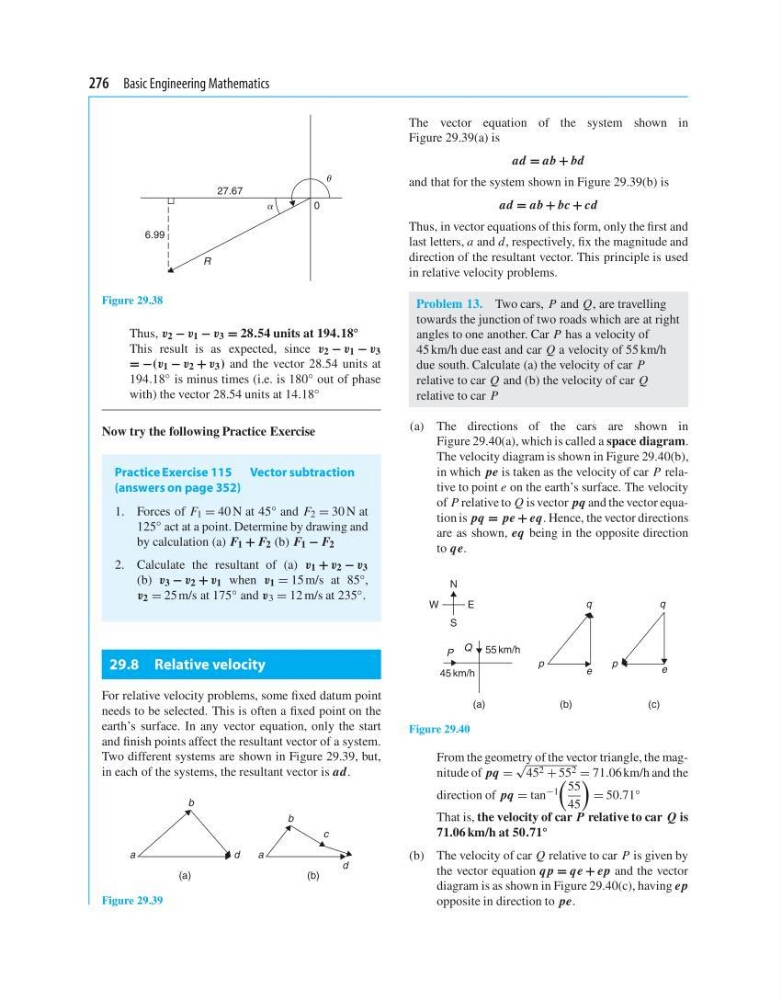
Thus, v 2 − v 1 − v 3 = 28.54 units at 194.18 ◦
This result is as expected, since v 2 − v 1 − v 3
= −(v 1 − v 2 + v 3 ) and the vector 28.54 units at
194.18 ◦ is minus times (i.e. is 180 ◦ out of phase
with) the vector 28.54 units at 14.18 ◦
Now try the following Practice Exercise
Practice Exercise 115 Vector subtraction
(answers on page 352)
1. Forces of F 1 = 40 N at 45 ◦ and F 2 = 30 N at
125
◦ act at a point. Determine by drawing and
by calculation (a) F 1 + F 2 (b) F 1 − F 2
2. Calculate the resultant of (a) v 1 + v 2 − v 3
(b) v 3 − v 2 + v 1 when v 1 = 15 m/s at 85 ◦ ,
v 2 = 25 m/s at 175 ◦ and v 3 = 12 m/s at 235 ◦ .
29.8 Relative velocity
For relative velocity problems, some fixed datum point
needs to be selected. This is often a fixed point on the
earth’s surface. In any vector equation, only the start
and finish points affect the resultant vector of a system.
Two different systems are shown in Figure 29.39, but,
in each of the systems, the resultant vector is ad.
a
d
b
(a)
a
d
b
c
(b)
Figure 29.39
The vector equation of the system shown in
Figure 29.39(a) is
ad = ab + bd
and that for the system shown in Figure 29.39(b) is
ad = ab + bc + cd
Thus, in vector equations of this form, only the first and
last letters, a and d, respectively, fix the magnitude and
direction of the resultant vector. This principle is used
in relative velocity problems.
Problem 13. Two cars, P and Q, are travelling
towards the junction of two roads which are at right
angles to one another. Car P has a velocity of
45 km/h due east and car Q a velocity of 55 km/h
due south. Calculate (a) the velocity of car P
relative to car Q and (b) the velocity of car Q
relative to car P
(a) The directions of the cars are shown in
Figure 29.40(a), which is called a space diagram.
The velocity diagram is shown in Figure 29.40(b),
in which pe is taken as the velocity of car P relative to point e on the earth’s surface. The velocity
of P relative to Q is vector pq and the vector equation is pq = pe + eq. Hence, the vector directions
are as shown, eq being in the opposite direction
to qe.
(a)
(b)
(c)
Q
P
E
N
W
S
55 km/h
45 km/h
p
e
q
p
e
q
Figure 29.40
From the geometry of the vector triangle, the magnitude of pq =
√
45 2 + 55 2 = 71.06 km/h and the
direction of pq = tan −1
55
45
= 50.71 ◦
That is, the velocity of car P relative to car Q is
71.06 km/h at 50.71 ◦
(b) The velocity of car Q relative to car P is given by
the vector equation qp = qe + ep and the vector
diagram is as shown in Figure 29.40(c), having ep
opposite in direction to pe.
R
0
27.67
6.99
␣
Figure 29.38
Thus, v 2 − v 1 − v 3 = 28.54 units at 194.18 ◦
This result is as expected, since v 2 − v 1 − v 3
= −(v 1 − v 2 + v 3 ) and the vector 28.54 units at
194.18 ◦ is minus times (i.e. is 180 ◦ out of phase
with) the vector 28.54 units at 14.18 ◦
Now try the following Practice Exercise
Practice Exercise 115 Vector subtraction
(answers on page 352)
1. Forces of F 1 = 40 N at 45 ◦ and F 2 = 30 N at
125
◦ act at a point. Determine by drawing and
by calculation (a) F 1 + F 2 (b) F 1 − F 2
2. Calculate the resultant of (a) v 1 + v 2 − v 3
(b) v 3 − v 2 + v 1 when v 1 = 15 m/s at 85 ◦ ,
v 2 = 25 m/s at 175 ◦ and v 3 = 12 m/s at 235 ◦ .
29.8 Relative velocity
For relative velocity problems, some fixed datum point
needs to be selected. This is often a fixed point on the
earth’s surface. In any vector equation, only the start
and finish points affect the resultant vector of a system.
Two different systems are shown in Figure 29.39, but,
in each of the systems, the resultant vector is ad.
a
d
b
(a)
a
d
b
c
(b)
Figure 29.39
The vector equation of the system shown in
Figure 29.39(a) is
ad = ab + bd
and that for the system shown in Figure 29.39(b) is
ad = ab + bc + cd
Thus, in vector equations of this form, only the first and
last letters, a and d, respectively, fix the magnitude and
direction of the resultant vector. This principle is used
in relative velocity problems.
Problem 13. Two cars, P and Q, are travelling
towards the junction of two roads which are at right
angles to one another. Car P has a velocity of
45 km/h due east and car Q a velocity of 55 km/h
due south. Calculate (a) the velocity of car P
relative to car Q and (b) the velocity of car Q
relative to car P
(a) The directions of the cars are shown in
Figure 29.40(a), which is called a space diagram.
The velocity diagram is shown in Figure 29.40(b),
in which pe is taken as the velocity of car P relative to point e on the earth’s surface. The velocity
of P relative to Q is vector pq and the vector equation is pq = pe + eq. Hence, the vector directions
are as shown, eq being in the opposite direction
to qe.
(a)
(b)
(c)
Q
P
E
N
W
S
55 km/h
45 km/h
p
e
q
p
e
q
Figure 29.40
From the geometry of the vector triangle, the magnitude of pq =
√
45 2 + 55 2 = 71.06 km/h and the
direction of pq = tan −1
55
45
= 50.71 ◦
That is, the velocity of car P relative to car Q is
71.06 km/h at 50.71 ◦
(b) The velocity of car Q relative to car P is given by
the vector equation qp = qe + ep and the vector
diagram is as shown in Figure 29.40(c), having ep
opposite in direction to pe.